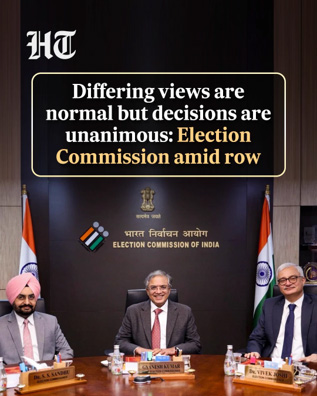
The Election Commission of India (ECI) has said that differences of opinion among its members are a normal part of internal deliberations, while maintaining that all final decisions of the Commission are taken unanimously. The issue has come up amid reports that Election Commissioners Sukhbir Singh Sandhu and Vivek Joshi had raised objections several times over decisions related to the Special Intensive Revision (SIR), voter registration and electoral-roll management.
Why in the News?
The two Election Commissioners reportedly raised objections at least 14 times over 10 months. The ECI said that Commissioners can have different views, observations and suggestions during deliberations. However, such draft-stage views should not be treated as final decisions.
Their concerns included:
Addition, deletion and restoration of voters.
Changes in the voter registration process.
Changes to Form 6 for new voters.
Management of IT systems used for electoral rolls.
Decisions allegedly taken without their knowledge.
What did the Election Commission of India say?
The Election Commission of India (ECI) stated that The Commission also said that highlighting individual internal notes does not present the complete picture of its decisions and initiatives.
Its actions are in accordance with laws and instructions of the Commission.
Different views and observations are a normal part of institutional deliberation.
Final decisions are taken unanimously.
Internal checks and balances are part of the functioning of a multi-member constitutional body.
Every officer of the Commission can give suggestions to improve the electoral system.
Form 6 controversy
Form 6 is used by new voters to register themselves on the electoral roll.
The controversial change added questions related to the Special Intensive Revision (SIR). The section was not marked mandatory, but applicants could not submit the form without answering it. Applicants were asked whether:-
Their name appeared in the electoral roll during the previous SIR.
Their parents or grandparents appeared in that role.
Neither their name nor their parents' names appeared in that roll.
Watch : Differing Views Normal but Decisions Unanimous
Objections by the Election Commissioners
On May 16, Election Commissioner Vivek Joshi recorded that Form 6 is a statutory form prescribed under the Registration of Electors Rules, 1960. On May 19, Election Commissioner Sukhbir Singh Sandhu agreed with Joshi's position. After the new declaration appeared on the ECINet portal, Sandhu again raised the issue on August 13. He referred to the earlier objections and said the changes were “unauthorised/illegal” and should be removed immediately. He also stressed that eligible young and first-time voters should be able to register without harassment. He stated that:-
Form 6 cannot be changed without amending the Rules.
An SIR order or guideline cannot itself alter a statutory form.
The proposal should be sent to the Government for the required changes.
Other reported concerns
The reported concerns were not limited to Form 6. The two Commissioners also raised questions about voter registration and the management of IT systems used for electoral rolls
Voter registration
The concerns about voter registration covered decisions related to the addition, deletion and restoration of names on electoral rolls. Questions were raised over decisions involving:
Addition of new voters.
Deletion of voters.
Restoration of voters.
Electoral-roll IT systems
The Election Commission uses IT systems for managing electoral-roll related work. The reported concerns also included questions about changes made to these systems.
The Commissioners also raised concerns about the management and control of the IT systems used for electoral rolls.
They reportedly questioned changes made without their knowledge and separately approached the Cabinet Secretary regarding the issue.
Legal framework for Form 6
Form 6 is linked to the legal framework governing electoral registration. Changes to the form have previously followed changes in the relevant law and rules. This provides the background to the disagreement over the SIR-related changes.
The process for changing Form 6 has previously involved changes to the legal framework.
In 2021, Parliament amended the Representation of the People Act, 1950 to allow the Election Commission to collect Aadhaar numbers from voters.
Following this, the Law Ministry's Legislative Department notified corresponding changes to the Registration of Electors Rules and Form 6 on June 17, 2022.
This provides the background to the disagreement over whether the SIR-related changes could be introduced without amending the Rules.
Political Reaction
The issue also led to criticism from Opposition parties. Different Opposition leaders and parties raised concerns about the functioning of the Election Commission and the reported objections by the two Commissioners.
The issue also led to criticism from Opposition parties.
The Congress called for Chief Election Commissioner Gyanesh Kumar's resignation.
Congress MP Rahul Gandhi alleged that the BJP, RSS and the Election Commission were involved in what he called “vote chori”.
CPI(M) MP John Brittas criticised the functioning of the Election Commission and referred to the reported objections concerning voter additions, deletions, restorations and Form 6.
Trinamool Congress Rajya Sabha leader Derek O'Brien referred to an earlier motion by Rajya Sabha MPs seeking the removal of CEC Gyanesh Kumar and called for it to be brought forward.
Significance
The issue is connected to important aspects of the electoral process. These include voter registration, electoral-roll management, the Special Intensive Revision, and the functioning of a multi-member constitutional body. The issue highlights questions around:-
Electoral-roll management
Voter registration
Special Intensive Revision (SIR)
Form 6
Addition and deletion of voters
Electoral IT systems
Internal checks and balances within the ECI
Decision-making in a multi-member constitutional body
The ECI maintains that differing views are part of deliberation and are normal during internal discussions, while final decisions are taken unanimously. The controversy has brought greater attention to how objections raised by individual Election Commissioners are considered and addressed before final decisions are taken. .
Conclusion
The issue has brought attention to the internal functioning of the Election Commission and the process through which decisions are taken. It also highlights the importance of voter registration, electoral-roll management and the legal process for making changes to electoral forms. The ECI maintains that different views are a normal part of deliberations and that final decisions are taken unanimously.
Test your understanding
Questions from this article
Prelims practiceQuestion: With reference to Election Commission Row: Differing Views Normal, Final Decisions Unanimous, consider the following statements:
- The Election Commission of India (ECI) has said that differences of opinion among its members are a normal part of internal deliberations, while maintaining that all final decisions of the.
- The issue has come up amid reports that Election Commissioners Sukhbir Singh Sandhu and Vivek Joshi had raised objections several times over decisions related to the Special Intensive.
Which of the statements given above is/are correct?
- 1 only
- 2 only
- Both 1 and 2
- Neither 1 nor 2
View answer and explanation
Suggested answer: (c) Both 1 and 2
Explanation: Election Commission of India says differing views and observations are a normal part of internal deliberations, while final decisions are unanimous. Know the ECI’s response amid the row over reported objections by two Election Commissioners and the Special Intensive Revision (SIR) of electoral rolls
Mains practiceQuestion: Discuss Election Commission Row: Differing Views Normal, Final Decisions Unanimous with reference to Why in the News?, What did the Election Commission of India say?, Form 6 controversy and Objections by the Election Commissioners. (150 words, 10 marks)
View answer-writing approach
Answer approach:
- Introduce the topic using its meaning and context.
- Explain Why in the News?, What did the Election Commission of India say?, Form 6 controversy and Objections by the Election Commissioners.
- Use facts and examples given in the article.
- Conclude with a balanced way forward.
Frequently asked questionsFrequently asked questions
What is Election Commission Row: Differing Views Normal, Final Decisions Unanimous?
Election Commission of India says differing views and observations are a normal part of internal deliberations, while final decisions are unanimous. Know the ECI’s response amid the row over reported objections by two Election Commissioners and the Special Intensive Revision (SIR) of electoral rolls
Why is Election Commission Row: Differing Views Normal, Final Decisions Unanimous relevant for UPSC preparation?
The issue has come up amid reports that Election Commissioners Sukhbir Singh Sandhu and Vivek Joshi had raised objections several times over decisions related to the Special Intensive Revision (SIR), voter registration and electoral-roll management
What key points should aspirants remember about Election Commission Row: Differing Views Normal, Final Decisions Unanimous?
The article covers Why in the News?, What did the Election Commission of India say?, Form 6 controversy and Objections by the Election Commissioners.