India follows a bicameral system of Parliament at the national level, while states have the option of having a second House called the Legislative Council. Members of Legislative Councils (MLCs) are elected through different categories of voters, including MLAs, local body members, graduates, and teachers. Some members are also nominated by the Governor.
Why in the News?
- The BJP-led NDA won 16 out of 28 Legislative Council seats for which elections were held in four states.
- The alliance won:
- Karnataka: All 4 seats.
- Uttar Pradesh: 6 out of 11 seats.
- Bihar: 4 out of 8 seats.
- Maharashtra: 2 out of 5 seats.
- Unlike Assembly elections, not all adult citizens are eligible to vote in MLC elections.
Legislative Council: The Second Chamber of a State
Indian legislatures are divided into two types:
- Unicameral: Legislature with only one House.
- Bicameral: Legislature with two Houses.
At the national level, India has a bicameral Parliament consisting of the Lok Sabha and Rajya Sabha. The Constitution gives states the option of having a second House called the Legislative Council.
Why was the Legislative Council introduced?
During the framing of the Constitution, there were different views on having a second chamber in states.
Arguments in favour:
- Provides representation to different sections of society.
- Acts as a revising chamber and checks hasty decisions by the Legislative Assembly.
- Brings different viewpoints into the legislative process.
Arguments against:
- Increases the financial burden on the state.
- May delay government decisions.
- Can become a means of providing political positions to leaders.
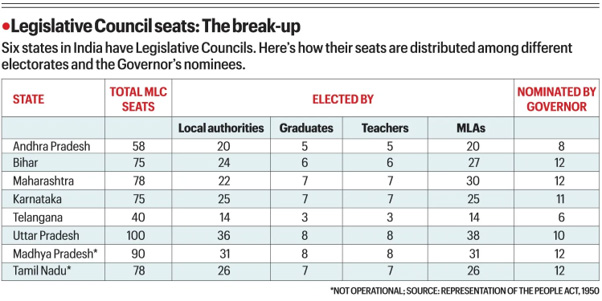
The Constitution-makers allowed states to decide whether they wanted a Legislative Council. They also limited its size and powers. States Having Legislative Councils: Currently, six states have Legislative Councils:
- Andhra Pradesh
- Bihar
- Karnataka
- Maharashtra
- Telangana
- Uttar Pradesh
Constitutional Provisions: Article 171
Article 171 of the Constitution deals with the composition of State Legislative Councils.
- A Legislative Council must have at least 40 members.
- Its maximum strength cannot exceed one-third of the total strength of the State Legislative Assembly.
Composition of the Legislative Council
| Category | Share of Members |
| Elected by MLAs | 1/3 |
| Elected by local authorities | 1/3 |
| Elected by graduates | 1/12 |
| Elected by teachers | 1/12 |
| Nominated by the Governor | Remaining 1/6 |
The Representation of the People Act, 1950 provides for the membership distribution of Legislative Councils.
Tenure and Eligibility of MLCs
- An MLC has a term of six years.
- One-third of the members retire every two years.
- The minimum age to contest an MLC election is 30 years.
- A candidate must be an elector in the state.
Governor's Nomination
The Governor nominates members having special knowledge or practical experience in:
- Literature
- Science
- Art
- Co-operative movement
- Social service
Such nominated members must be residents of the state.
How are MLCs Elected?
MLC elections are different from ordinary Assembly elections because voters are selected from specific categories.
1. Election by MLAs
- One-third of the Council members are elected by the members of the State Legislative Assembly.
- Only sitting MLAs can vote in these elections.
2. Election by Local Authorities
- One-third of the members are elected by members of local authorities.
- These include eligible local bodies such as municipalities and other specified local authorities.
- Only current members of these bodies can vote in the respective constituencies.
3. Graduate Constituencies
- One-twelfth of the Council members are elected by graduates.
- The voter must:
- Be an Indian citizen.
- Be ordinarily resident in the constituency.
- Have held a graduate degree for at least three years from a recognised university in India.
4. Teacher Constituencies
- One-twelfth of the Council members are elected by teachers.
- The voter must have worked as a teacher for at least three years during the preceding six years.
- The educational institution must be at least of secondary-school level.
Why are there Graduate and Teacher Constituencies?
The idea of giving representation to specific sections of society existed even before Independence. The objective was to bring different experiences and viewpoints into the legislative process.
- The Government of India Act, 1935 provided representation on religious, economic and social grounds.
- During the Constituent Assembly debates, member Shibban Lal Saxena suggested that Legislative Councils should represent the intelligentsia of a province.
- He proposed representation for different groups, including graduates, trade union members, local body representatives and learned professionals.
- This idea was incorporated into the Constitution.
Voting System: Single Transferable Vote (STV)
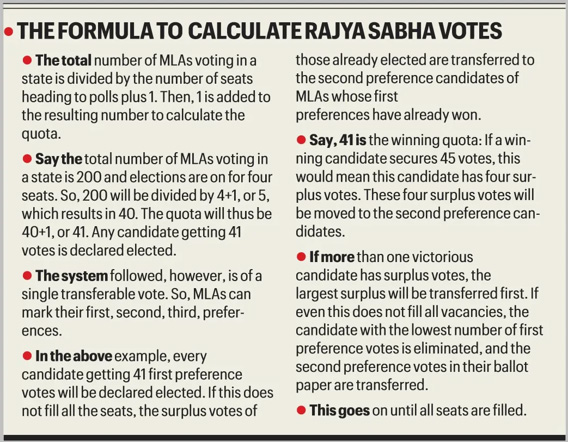
MLC elections use the Proportional Representation System by means of the Single Transferable Vote (STV).
- Unlike general elections, where voters choose only one candidate, voters in these elections rank candidates according to their preferences.
How does it work?
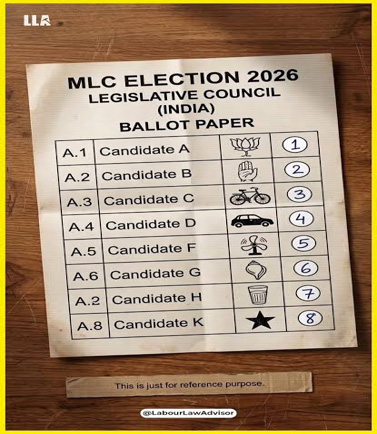
- A ballot paper contains the names of contesting candidates.
- Voters indicate their preferences by writing:
- 1 for the first preference.
- 2 for the second preference.
- 3 for the third preference, and so on.
- Candidates must secure the required number of votes, known as the quota, to get elected.
- If a candidate does not secure the required quota, votes may be transferred according to the preferences marked by voters.
Secret Ballot in MLC Elections
- In Rajya Sabha elections, MLAs must show their marked ballot paper to their party's authorised election agent.
- This open voting system was introduced in 2003.
- However, in elections to State Legislative Councils, MLAs vote through a secret ballot and are not required to show their votes to an election agent.
Legislative Council vs Rajya Sabha
Although both are Upper Houses, there are important differences between them.
| Basis | Legislative Council | Rajya Sabha |
| Level | State | Union |
| Nature | Existence depends on the state legislature's decision | Permanent House |
| Creation/Abolition | Parliament can create or abolish it by law after the State Legislative Assembly passes a special resolution | Cannot be abolished |
| Minimum Age | 30 years | 30 years |
| Tenure | 6 years; one-third retire every 2 years | 6 years; one-third retire every 2 years |
| Powers | Limited powers compared with the Legislative Assembly | Exercises important legislative powers along with the Lok Sabha, subject to constitutional provisions |
Creation and Abolition of Legislative Councils
Under Article 169, Parliament of India can create or abolish a Legislative Council.
- The process begins when the concerned State Legislative Assembly passes a resolution:
- By a majority of the total membership of the Assembly; and
- By a majority of not less than two-thirds of members present and voting.
- Parliament can then pass a law to create or abolish the Council.
Limitations of Legislative Councils
A Legislative Council does not have powers equal to the Rajya Sabha. It has limited powers over ordinary legislation and cannot permanently block a Bill passed by the Legislative Assembly.
- Its existence depends on the constitutional process for creation and abolition.
Parliamentary Committee Observation (2013). A Parliamentary Committee examining the proposal to create a Legislative Council in Rajasthan highlighted the need for a clear national policy on the creation and abolition of Legislative Councils.
- It also stressed that such institutions should not depend merely on the political preferences of the government in power.
Conclusion
Legislative Councils provide a second chamber in states and allow representation to different sections of society. Their election system is different from Assembly elections, as it involves several categories of voters and the Single Transferable Vote system. However, their limited powers and dependence on the Legislative Assembly distinguish them from the Rajya Sabha.
Test your understanding
Questions from this article
Prelims practiceQuestion: With reference to the elections to the State Legislative Council (Vidhan Parishad) in India, consider the following statements:
- One-third of the members of the State Legislative Council are elected by the members of the Legislative Assembly.
- One-twelfth of the members are elected by graduates residing in the state.
- The Governor nominates one-sixth of the members of the State Legislative Council.
- All members of the State Legislative Council are elected through direct elections.
Which of the statements given above are correct?
- 1, 2 and 3 only
- 1 and 4 only
- 2, 3 and 4 only
- 1, 2, 3 and 4
View answer and explanation
Suggested answer: (a) 1, 2 and 3 only
Explanation: As per Article 171 of the Indian Constitution, the State Legislative Council consists of members elected and nominated through different categories:
- 1/3 elected by MLAs.
- 1/3 elected by local authorities.
- 1/12 elected by graduates.
- 1/12 elected by teachers.
- 1/6 nominated by the Governor.
Hence, Statements 1, 2 and 3 are correct, while Statement 4 is incorrect because all members are not directly elected.
Mains practiceQuestion: Examine the constitutional provisions for the creation and abolition of State Legislative Councils in India. What are the major challenges associated with their functioning? (10 Marks, 150 Words)
View answer-writing approach
Answer approach:
- Introduction: Define Vidhan Parishad
- Constitutional Provisions: Explain the role of the State Legislative Assembly and Parliament in its creation or abolition.
- Challenges: Discuss political influence, limited legislative powers, additional expenditure and delays in lawmaking.
- Way Forward: Suggest transparent nominations, meaningful debates and better representation of experts.
Frequently asked questionsFrequently asked questions
What is How does the MLC Election Process Work in India??
Some states in India have a Legislative Council as their second House. MLCs are elected by MLAs, local body members, graduates, and teachers, while some are nominated by the Governor. The voting process is different from regular elections
Why is How does the MLC Election Process Work in India? relevant for UPSC preparation?
Members of Legislative Councils (MLCs) are elected through different categories of voters, including MLAs, local body members, graduates, and teachers
What key points should aspirants remember about How does the MLC Election Process Work in India??
The article covers Why in the News?, Legislative Council: The Second Chamber of a State, Why was the Legislative Council introduced? and Arguments in favour:.