The 31st Conference of the Parties (COP 31) to the United Nations Framework Convention on Climate Change (UNFCCC) concluded in Antalya, Türkiye, without adopting a final cover decision called the Antalya Pact. The conference exposed major differences among countries over fossil fuel phase-out, climate finance and climate justice. India emphasised equity, Common But Differentiated Responsibilities and Respective Capabilities (CBDR-RC), and predictable climate finance.
Why in the News?
The COP 31 concluded in Antalya, Türkiye, without adopting the proposed Antalya Pact. The proposed agreement failed due to differences over fossil fuel phase-out and adaptation finance.
- India called for climate justice, equitable burden-sharing, and stronger implementation of climate commitments.
- The unresolved issues will be carried forward to COP 32 in Addis Ababa, Ethiopia, in November 2027.
What are the Key Outcomes of UNFCCC COP 31?
1. Failure to Adopt the Antalya Pact
The proposed final cover decision, called the Antalya Pact, could not be adopted. COP 31 President Murat Kurum (Türkiye) formally declared a lack of consensus during the closing plenary.
- The European Union, UK, Norway, Vanuatu, Marshall Islands, Panama and Belize rejected the final draft.
- Under Rule 16 of the UNFCCC Rules of Procedure, unresolved issues will automatically carry over to the next conference:
- COP 32: Addis Ababa, Ethiopia.
- Year: November 2027.
2. Changes in the Draft Antalya Pact
A. Fossil Fuel Phase-Out Dropped
The draft removed references to coal, oil, and natural gas. It also removed the phrase “transitioning away from fossil fuels (TAFF)”, which was agreed upon at COP 28 in Dubai.
- It replaced these references with a broader commitment to an “irreversible global transition towards low greenhouse gas emissions and climate-resilient development”.
- The draft retained support for:
- Carbon Capture, Utilisation and Storage (CCUS).
- Carbon Dioxide Removal (CDR).
- These technologies were described as complementary measures, not substitutes for deep emission cuts.
B. 35-by-35 Electrification Target
The draft proposed raising electricity's share in global final energy consumption to 35% by 2035. This was intended to complement COP 28 goals of:
- Tripling renewable energy capacity by 2030.
- Doubling energy efficiency improvements by 2030.
Following objections from India, Russia and the Arab Group, the target was reframed as a call for global cooperation. The revised approach recognised national circumstances and energy access requirements.
C. Adaptation Finance
The draft removed the proposed target of USD 120 billion annually by 2035. It retained the ambition to triple adaptation finance but without a clear baseline or binding commitment.
- Developing countries face:
- USD 305 billion in annual adaptation needs.
- USD 5.1–6.8 trillion in NDC implementation requirements by 2030.
- The proposed Antalya-Addis Ababa Roadmap, aimed at mobilising adaptation finance, was also dropped.
3. Thematic, Ecological and Institutional Decisions
Despite the failure to adopt the Antalya Pact, some separate decisions and initiatives were announced.
- Global Goal on Adaptation (GGA): A separate decision was adopted.
- Adaptation Fund: A separate decision was adopted.
- Just Transition Work Programme: A separate decision was also adopted, although important implementation issues remained unresolved.
Wildlife for Climate Declaration
A total of 25 countries, including Brazil, Kenya, the Democratic Republic of Congo (DRC), Fiji and Zimbabwe, endorsed a non-binding political declaration.
- It was supported by the Scientific Consensus on Wildlife and Climate.
- The declaration aims to integrate wildlife conservation and population restoration into:
- Nationally Determined Contributions (NDCs).
- National Adaptation Plans (NAPs).
- It focuses on carbon storage and ecosystem resilience.
Voluntary Action Agenda and AI Pledge
Türkiye launched a voluntary AI Pledge. It addresses the rising energy consumption of AI data centres and promotes sustainable AI for climate action.
- More than USD 26 billion in green investment deals were also announced.
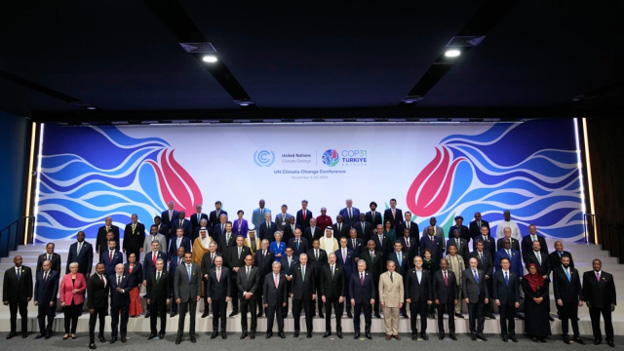
India’s Stance at UNFCCC COP 31
India positioned itself as an important voice of the Global South and coordinated with developing-country groups such as G77+China, BASIC and Like-Minded Developing Countries (LMDC). India's position was based on climate justice, equity and the principle of CBDR-RC.
Major Positions Taken by India
1. Carbon Budget Equity:
India highlighted that climate change is the result of around two centuries of largely uncontrolled industrialisation by developed economies.
- Historical cumulative emissions have already consumed more than 80% of the remaining 1.5°C carbon budget.
2. Common But Differentiated Responsibilities and Respective Capabilities (CBDR-RC):
India insisted that global climate action must follow the principles of equity and CBDR-RC. Developing countries should not be forced to compromise their poverty-eradication efforts and economic growth.
3. Country-Driven Just Transition:
India called for an inclusive and country-driven Just Transition framework.
- It should be supported by:
- Adequate concessional finance.
- Technology transfer.
- Capacity building.
4. Opposition to Top-Down Targets:
India, along with LMDC, opposed including voluntary pledges such as the 35-by-35 electrification target in formal negotiated decisions without guaranteed finance and grid-investment support.
- India also raised concerns about unilateral climate-related trade restrictions, including the European Union's Carbon Border Adjustment Mechanism (CBAM).
5. Climate Finance Accountability:
India called on developed countries to fulfil their obligations under Article 9 of the Paris Agreement.
- It emphasised timely replenishment of the Green Climate Fund (GCF).
- India also called for the Global Stocktake (GST) to remain Party-driven and non-punitive.
6. Domestic Climate Action:
India stated that the absence of a final agreement would not stop domestic climate action. It highlighted the achievement of crossing 170 GW of solar capacity.
- India reaffirmed its commitment to consensus-based multilateralism ahead of COP 32.
What is the UNFCCC Conference of the Parties (COP)?
The Conference of the Parties (COP) is the supreme decision-making body of the United Nations Framework Convention on Climate Change (UNFCCC). It brings member countries together annually to review global climate progress, negotiate agreements, and update climate commitments.
Origin and Evolution
- UNFCCC Adoption: Adopted on 9 May 1992 in New York.
- It was opened for signature at the Rio Earth Summit in June 1992 and entered into force in 1994.
- It was later complemented by:
- Kyoto Protocol (1997).
- Paris Agreement (2015).
- The Villach Conference (1985) helped establish international scientific consensus on climate risks.
- The Intergovernmental Panel on Climate Change (IPCC) was established by the World Meteorological Organization (WMO) and the United Nations Environment Programme (UNEP) in 1988.
Key Features of COP
- First COP: COP 1 was held in Berlin in 1995.
- Participation: The UNFCCC has 198 Parties.
- Main Functions:
- Review global climate progress.
- Negotiate climate agreements.
- Update commitments such as Nationally Determined Contributions (NDCs).
Institutional Structure
The COP is supported by two permanent technical bodies:
- Subsidiary Body for Implementation (SBI): Supports the implementation of the UNFCCC and related decisions.
- Subsidiary Body for Scientific and Technological Advice (SBSTA): Provides scientific and technological advice.
Other Governing Bodies:
| Governing Body | Agreement Governed |
| COP | UNFCCC |
| CMP | Kyoto Protocol |
| CMA | Paris Agreement |
These three bodies meet alongside one another during UN climate conferences.
Regional Hosting Rotation
COP summits rotate among five UN-designated geographical regions:
- Africa
- Asia-Pacific
- Eastern Europe
- Latin America and the Caribbean
- Western Europe and Others (WEOG)
Volunteer host nations are selected through regional consensus.
Recent and Upcoming COP Hosts
| Conference | Location | Year |
| COP 30 | Belém, Brazil | 2025 |
| COP 31 | Antalya, Türkiye | 2026 |
| COP 32 | Addis Ababa, Ethiopia | 2027 |
What are the Challenges in Global Climate Negotiations?
1. Dilution of Fossil Fuel Commitments:
Removing references to fossil fuel phase-out while promoting carbon capture technologies may weaken the commitments made under the COP 28 UAE Consensus.
- The EU and civil society groups, including CAN International, criticised the emphasis on CCUS and CDR without clear fossil fuel phase-out timelines.
2. Climate Finance Deficit:
Developed countries resisted committing to a clear baseline or numerical target for adaptation finance.
- This has increased the trust deficit between developed and developing countries.
- Developing countries face rising climate-related disasters and debt pressures.
3. Consensus-Based Decision-Making:
The requirement for universal consensus allows a small number of countries to block decisions.
- Climate-vulnerable countries such as Panama called for procedural reforms, including majority-based voting.
4. Geopolitical and Leadership Challenges:
The absence of the United States. Ongoing conflicts in the Middle East affecting oil and gas prices.
- Strains within the Türkiye–Australia dual-leadership model.
- These factors weakened diplomatic efforts to reach a final agreement.
What Measures Are Needed to Bridge the Climate Implementation Gap?
| Priority Area | Measures Needed |
| Adaptation Finance | Establish clear funding baselines and measurable targets. Prioritise grants and concessional finance. Revive the proposed Antalya–Addis Ababa Roadmap ahead of COP 32. |
| Fossil Fuel Transition | Restore clear commitments to transition away from fossil fuels. Link electrification targets with renewable energy expansion. |
| MDB Reforms and Debt Relief | Reform Multilateral Development Banks (MDBs), reduce the cost of green finance and expand climate-resilient debt clauses. |
| Technology Transfer | Address intellectual property barriers to improve access to grid storage, green hydrogen and clean cooling technologies. |
| Coordination Across Rio Conventions | Improve coordination among UNFCCC (Climate), CBD (Biodiversity) and UNCCD (Desertification). |
| Green Trade Framework | Replace unilateral carbon border taxes with cooperative and equity-based trade frameworks. |
Conclusion
COP 31 highlighted the gap between global climate commitments and their implementation. Although some progress was made through separate decisions, the conference failed to build consensus on fossil fuel phase-out and adaptation finance. COP 32 must focus on predictable climate finance, equitable burden-sharing and effective implementation, guided by climate justice and CBDR-RC.
Test your understanding
Questions from this article
Prelims practiceQuestion: Consider the following statements regarding the Conference of the Parties (COP) under the UNFCCC:
- COP is the supreme decision-making body of the United Nations Framework Convention on Climate Change (UNFCCC).
- COP meetings are held annually unless the Parties decide otherwise.
- COP31 is scheduled to be held in Antalya, Türkiye, in 2026.
- Decisions taken at every COP are automatically legally binding on all member countries.
Which of the statements given above are correct?
- 1 and 2 only
- 1, 2 and 3 only
- 2, 3 and 4 only
- 1, 2, 3 and 4
View answer and explanation
Suggested answer: (b) Both 1 and 2
Explanation:
- Statement 1 – Correct: COP is the supreme decision-making body of UNFCCC.
- Statement 2 – Correct: UNFCCC COPs have been held annually since 1995.
- Statement 3 – Correct: COP31 was held from 9–20 November 2026 in Antalya, Türkiye.
- Statement 4 – Incorrect: Not every COP decision is automatically legally binding. Legal obligations depend on the treaty provisions and nature of the decision.
Mains practiceQuestion: "Global climate governance is increasingly challenged by the conflict between climate ambition, developmental priorities and climate justice." Critically analyse in the context of COP31. (15 Marks | 250 Words )
View answer-writing approach
Answer approach:
- Introduction: Briefly introduce COP31
- Analyse the three-way conflict
- Climate ambition: Need for faster decarbonisation and emission reduction.
- Developmental priorities: Energy security, poverty reduction and industrial growth in developing countries.
- Climate justice: Historical responsibility and equitable access to climate finance.
- Major challenges: developed vs. developing nations, weak implementation, technology transfer, fossil fuel dependence.
- India's perspective : CBDR-RC principle, just transitions, right to development.
- Conclusion: Global climate action must balance ecological responsibility with developmental equity.