The Constituent Assembly of India was formed in 1946 under the Cabinet Mission Plan to draft the Constitution. Learn about the Constituent Assembly of India, including its formation, members, functions, key timeline, major committees and role in framing the Indian Constitution.
The Constituent Assembly of India was a special body established in November 1946 under the Cabinet Mission Plan to draft the Constitution of independent India. The Constituent Assembly of India was formed to make the Constitution of India. It discussed how the country should be governed after independence. The members discussed important issues such as citizens’ rights, the powers of the Centre and States, citizenship and the protection of minorities and weaker groups. The Assembly also helped in setting up the basic political system of independent India. After independence, it also worked as the Dominion Legislature. The Constitution was adopted on 26 November 1949 and came fully into force on 26 January 1950.
Formation of the Constituent Assembly of India
The Constituent Assembly was formed in 1946 under the Cabinet Mission Plan. Its members were not directly elected by all the people of India. Members from the provinces were elected by the provincial legislative assemblies. The rulers of the princely states chose their representatives. The Assembly originally had 389 members. This included representatives from Preamble of the ConstitutionPreamble of Indian Constitution provinces, Chief Commissioners’ Provinces and princely states. After the Partition in India, the number of members came down to 299. The first meeting of the Constituent. The Constituent assembly of India was held on 9 December 1946.
Original strength of the Constituent Assembly
The Constituent Assembly of India originally consisted of 389 members, as determined in 1946 under the Cabinet Mission PlanCabinet Mission Plan. These members were divided between British India and the Princely States. Of the total 389 seats, 296 seats were allotted to British India, while 93 seats were allocated to the Princely States. This composition represented India’s diverse regions and political units during the constitution-making process. Lets a look at original strength of the Constituent Assembly:-
- 389 Members: This was the original strength before Partition.
- 296 Members: They represented British Indian provinces and Chief Commissioners’ Provinces.
- 93 Members: They represented the princely states.
Strength after Partition
- 299 members: This was the strength after Partition.
- 229 members: They represented the provinces.
- 70 members: They represented the princely states.
After independence, the Assembly continued its work of making the Constitution. It also worked as the Dominion Legislature.
Members and Leadership of the Constituent Assembly
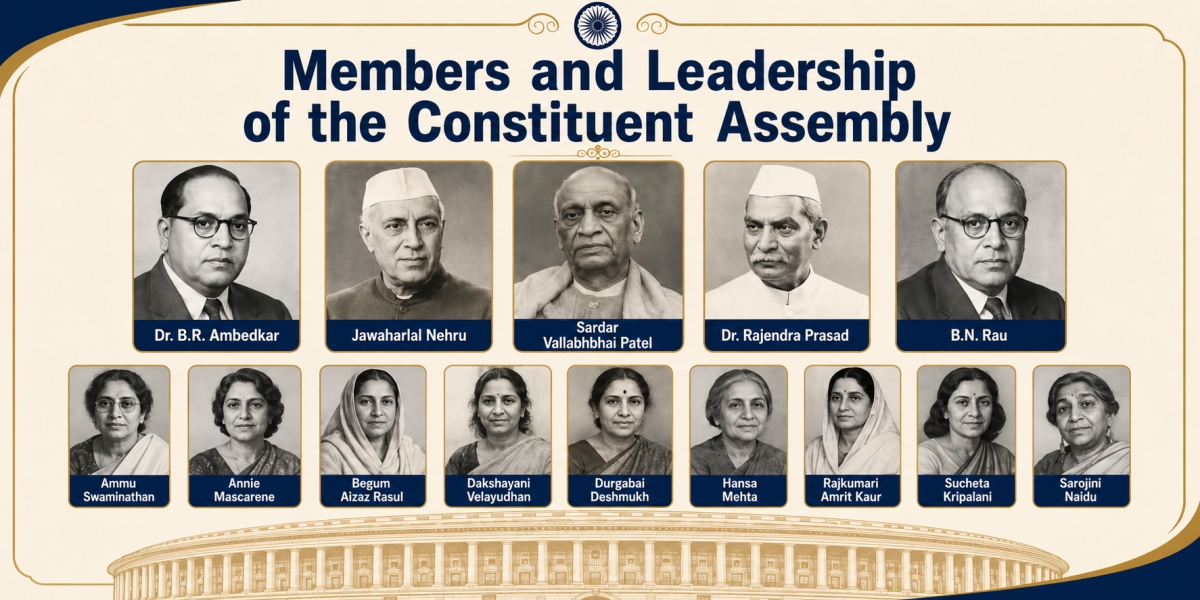
Dr. Rajendra Prasad served as the permanent President of the Constituent Assembly of India, which was formed in November 1946 under the Cabinet Mission Plan. He was elected as the President of the Assembly on 11 December 1946 and played a crucial role in guiding its proceedings. As President of IndiaPresident of India, Dr. Rajendra Prasad ensured that discussions remained orderly, democratic, and focused on constitution-making. He presided over important debates and helped the Assembly work towards building a strong constitutional framework for independent India. His leadership and impartial approach contributed significantly to the successful completion of the Constitution. After the Constitution came into effect on 26 January 1950, Dr. Rajendra Prasad became the first President of India. The members of the Constituent Assembly came from different parts of India. They included national leaders, lawyers, administrators, social reformers and women members. They took part in discussions on important issues related to the future of India.
Some important members were Dr. B.R. Ambedkar, Jawaharlal Nehru, Sardar Vallabhbhai Patel, Dr. Rajendra Prasad and B.N. Rau. Women also played an important role in the Constituent Assembly. Some women members were Ammu Swaminathan, Annie Mascarene, Begum Aizaz Rasul, Dakshayani Velayudhan, Durgabai Deshmukh, Hansa Mehta, Rajkumari Amrit Kaur, Sucheta Kripalani and Sarojini Naidu. They took part in discussions on equality, education, public health, social reform and women’s rights.
Important members
- Dr. B.R. Ambedkar: He was the Chairman of the Drafting Committee. He played an important role in matters related to equality, Fundamental Rights and social justice.
- Jawaharlal Nehru: He introduced the Objective Resolution. This later influenced the Preamble of the ConstitutionPreamble of the Constitution.
- Sardar Vallabhbhai Patel: He played an important role in bringing princely states into the Indian Union. He was also part of important committees.
- Dr. Rajendra Prasad: He was the President of the Constituent Assembly.
- B.N. Rau: He was the Constitutional Adviser and gave legal and constitutional advice.
- H.C. Mookherjee: He was the Vice-President of the Assembly and helped in its Work.
Committees of the Constituent Assembly of India
The Constituent Assembly of India formed many committees to study different parts of the Constitution. Each committee looked at a particular subject. Their reports and suggestions helped the Assembly discuss these subjects in a better way. The committees dealt with subjects such as Fundamental Rights, the powers of the Union, provincial governments, minorities and the rules of the Assembly.
Important committees of the Constituent Assembly of India
The Constituent Assembly of India established eight major committees, along with several minor committees, to undertake the detailed task of drafting the Constitution. Lets a look at the Important committees of the Constituent Assembly of India:-
- Drafting Committee- It was chaired by Dr. B.R. Ambedkar. This committee prepared and revised the draft Constitution.
- Union Powers Committee- It was chaired by Jawaharlal Nehru. This committee studied the powers of the Union and the provinces.
- Union Constitution Committee-It was chaired by Jawaharlal Nehru. This committee studied the structure of the Union government.
- Provincial Constitution Committee- It was chaired by Sardar Vallabhbhai Patel. The committee studies the structure of provincial governments.
- Advisory Committee on Fundamental Rights, Minorities and Tribal and Excluded Areas- It was chaired by Sardar Vallabhbhai Patel. It looked at Fundamental Rights and the protection of minorities and tribal areas.
- Rules of Procedure Committee- It was chaired by Dr. Rajendra Prasad. It prepared the rules for the Assembly.
- Steering Committee- It was chaired by Dr. Rajendra Prasad. It helped plan and organise the work of the Assembly. Other committees also helped the Assembly with its work. These included the States Committee, Finance and Staff Committee and Credentials Committee.
Functions of the Constituent Assembly of India
The main function of the Constituent Assembly of India was to make and adopt the Constitution. But its work covered many other important areas too. The members discussed how the government should work and what rights citizens should have. They discussed Fundamental Rights, citizenship, Centre-State relations, the judiciary, minorities and weaker groups. They also discussed emergency provisions, public services and national symbols. After independence, the Assembly also worked as the Dominion Legislature.
Major Functions of the Constituent Assembly of India
The constituent assembly had the main responsibility of preparing the constitution of India. However, its work was not limited to writing the constitution. The members discussed important issues related to the rights of citizens, the structure of the government, the relationship between the centre and the state, citizenship, minorities, and social justice. The assembly also discussed how the judiciary and other important institutions should function in Independent India. After independence, it also worked as the Dominion Legislature and passed the laws for the country. Lets a look at the major functions of the Constituent Assembly of India:-
- Making the Constitution- The Assembly discussed, prepared and adopted the Constitution.
- Discussing Fundamental Rights- It discussed the rights and freedoms of citizens.
- Deciding Centre-State relations- It decided how powers would be divided between the Centre and States.
- Deciding the government system- It helped establish the parliamentary system of government.
- Discussing citizenship- It discussed who would become a citizen of India.
- Protecting minorities and weaker groups: It discussed ways to protect their rights.
- Setting up the judiciary- It helped create the structure of an independent judiciary.
- Adopting national symbols: It adopted important national symbols, including the national flag.
- Working as the legislature- After independence, it also made laws for the country.
The Constitution was adopted on 26 November 1949. Most of its provisions came into force on 26 January 1950. On 26 January 1950, the Assembly became the provisional Parliament of IndiaParliament of India. It continued until the first general elections were held in 1951–52 and the new Parliament was formed.
Contributions of Dr. B.R. Ambedkar
Dr. B.R. Ambedkar was one of the most important members of the Constituent Assembly of India. He became the Chairman of the Drafting Committee on 29 August 1947. He led the work of preparing and changing the draft Constitution. He also explained many parts of the draft during the debates in the Assembly. Dr B.R. AmbedkarDr B.R. Ambedkar played an important role in discussions on equality, Fundamental Rights, constitutional remedies and social justice. He supported equal rights for citizens and protection against discrimination. His work in the Drafting Committee made him one of the key figures in the making of the Indian Constitution.
Contributions of Jawaharlal Nehru
Jawaharlal Nehru also played an important role in the Constituent Assembly. He introduced the Objective Resolution on 13 December 1946. The Assembly adopted the Objective Resolution on 22 January 1947. It explained the basic ideas that would guide the Constitution. These ideas later influenced the Preamble. Nehru also chaired the Union Powers Committee and the Union Constitution Committee. Through these committees, he helped in deciding the powers and structure of the Union. His ideas helped shape the basic vision of independent India.
Contributions of Sardar Vallabhbhai Patel
Sardar Vallabhbhai Patel played an important role in the Constituent Assembly. One of his The biggest contribution was bringing the princely states into the Indian Union. He also chaired the Provincial Constitution Committee. This committee studied the structure of provincial governments. Patel also chaired the Advisory Committee on Fundamental Rights, Minorities and Tribal and Excluded Areas. He took part in discussions about the rights of minorities and other important constitutional issues. His work helped strengthen national unity and the structure of the Indian Union.
Constituent Assembly of India Timeline
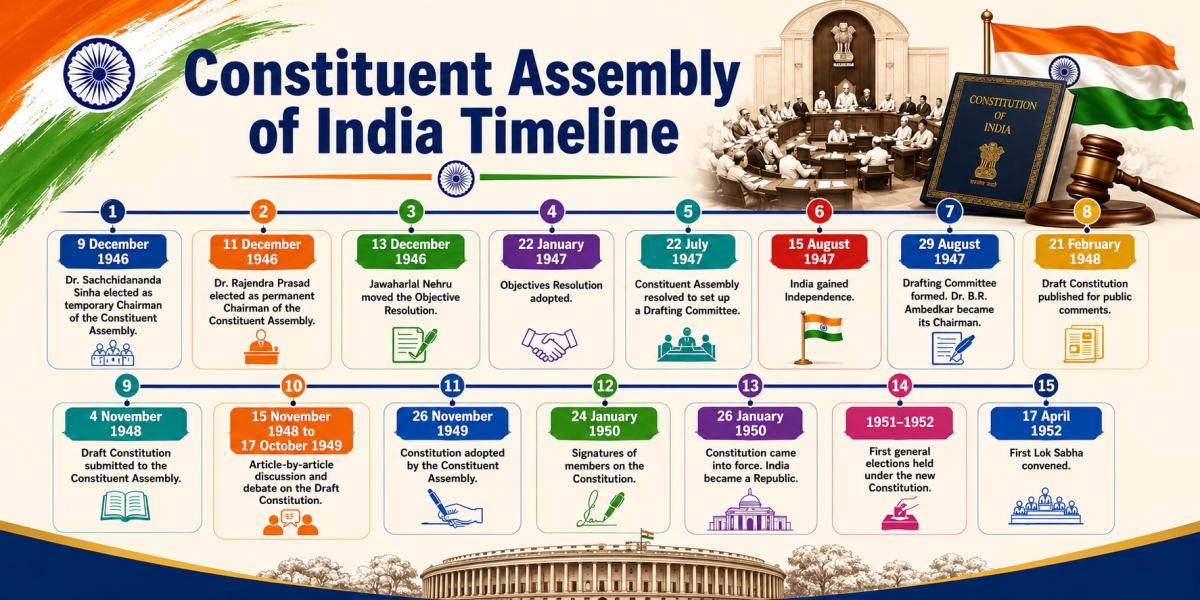
The Constituent Assembly timeline includes several important dates. These dates show how the Assembly moved from its first meeting to the adoption and implementation of the Constitution. Lets a look at the Constituent Assembly of India Timeline:-
- 9 December 1946: The first meeting of the Constituent Assembly was held. Sachchidananda Sinha was the temporary Chairman.
- 11 December 1946: Dr. Rajendra Prasad was elected President of the Assembly.
- 13 December 1946: Jawaharlal Nehru introduced the Objective Resolution.
- 22 January 1947: The Objective Resolution was adopted.
- 22 July 1947: The Assembly adopted the national flag.
- 15 August 1947: India became independent. The Assembly also started working as the Dominion Legislature.
- 29 August 1947: The Drafting Committee was formed.
- 21 February 1948: The Draft Constitution was submitted to the President of the Assembly.
- 4 November 1948: Dr. B.R. Ambedkar introduced the Draft Constitution in the Assembly.
- 15 November 1948 to 17 October 1949: The Assembly discussed the draft Constitution in detail.
- 26 November 1949: The Constitution was adopted.
- 24 January 1950: Members signed the Constitution. The Assembly also adopted “Jana Gana Mana” as the national anthem and “Vande Mataram” as the national song.
- 26 January 1950: The Constitution came fully into force. India became a Republic and the Assembly became the provisional Parliament.
- 1951–52: The first general elections under the Constitution were held.
- 17 April 1952: The first elected Lok Sabha was formed and the provisional Parliament came to an end.
Important Features and Contributions of Constituent Assembly of India
The Constituent Assembly of India was an indirectly elected body formed in December 1946 under the Cabinet Mission Plan to draft the Constitution of independent India. The Constituent Assembly gave India a Constitution based on democracy, equality and citizens’ rights. It created a system of government that continues to guide India today. The Constitution created a parliamentary system and gave citizens Fundamental Rights. It also included Directive Principles to guide the government in working for the welfare of People.
Main features of the Indian Constitution
The Constitution of India is the world’s lengthiest written constitution, blending federal and unitary features while maintaining a distinctive balance between rigidity and flexibility. Lets a look at the main features of the Indian Constitution:-
- Parliamentary democracy: India follows a parliamentary system. Where the Government of IndiaGovernment of India is responsible to the elected Lok Sabha.
- Fundamental Rights: The constitution gives citizens basic rights and freedoms and protects them from unfair treatment.
- Directive Principles of State Policy: These principles guide the government in making policies and promoting the welfare of people.
- Federal system with a strong Centre: Powers are divided between the Union and States, but the Centre has important powers.
- Independent judiciary: The judiciary works independently, Courts protect the Constitution and citizens’ rights.
- Universal adult suffrage: Adult citizens were given the right to vote. The voting age was originally 21 and was later reduced to 18.
- Secular and democratic principles: The Constitution provides equality before the law and freedom of religion. These features show the importance of the Constituent Assembly in making the Indian Constitution.
Conclusion
The Constituent Assembly of India played a major role in making the Constitution. Its members discussed important issues such as citizens rights, government structure, Centre- State relations, citizenship, social justice and national unity. The Constituent AssemblyConstituent Assembly was adopted on 26 November 1949 and came fully into force on 26 January 1950. The Assembly laid the foundation of the Indian Republic. Its work created the basic rules for how India would be governed. The Constitution made by the Assembly continues to guide India’s government, laws and democratic institutions.
Frequently asked questionsFrequently asked questions
What is Constituent Assembly of India- Formation, Members, Functions, Timeline and Role?
The Constituent Assembly of India was formed in 1946 under the Cabinet Mission Plan to draft the Constitution. Learn about the Constituent Assembly of India, including its formation, members, functions, key timeline, major committees and role in framing the Indian Constitution
Why is Constituent Assembly of India- Formation, Members, Functions, Timeline and Role relevant for UPSC preparation?
Learn about the Constituent Assembly of India, including its formation, members, functions, key timeline, major committees and role in framing the Indian Constitution
What key points should aspirants remember about Constituent Assembly of India- Formation, Members, Functions, Timeline and Role?
The article covers Formation of the Constituent Assembly of India, Original strength of the Constituent Assembly, Strength after Partition and Members and Leadership of the Constituent Assembly.