Project 18A is the Indian Navy's proposed programme to develop next-generation stealth guided-missile destroyers. These warships will be larger, more heavily armed, and technologically advanced than existing destroyers. The programme aims to strengthen India's maritime security and blue-water naval capabilities in the Indo-Pacific region.
Why in the News?
The Indian Navy is preparing to develop next-generation destroyers under Project 18A. The programme is estimated to cost around ₹80,000 crore.
- The Defence Acquisition Council (DAC), chaired by Defence Minister Rajnath Singh, has given in-principle approval to the programme.
- The proposed warships will have greater firepower, operational endurance and advanced surveillance and combat systems.
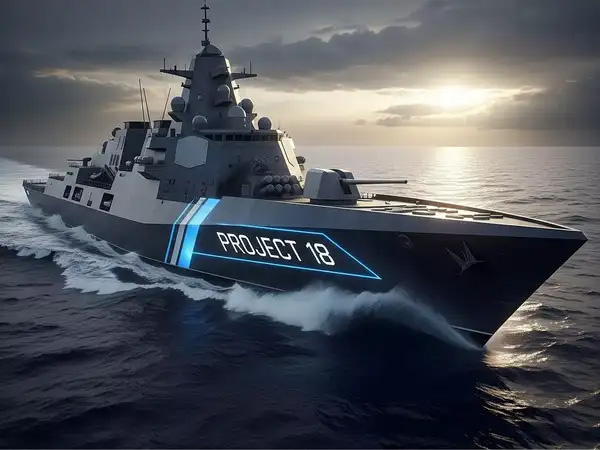
What is Project 18A?
Project 18A is a proposed next-generation destroyer programme aimed at strengthening India's indigenous guided-missile destroyer capabilities. It will continue the development of India's earlier destroyer classes. Evolution of India's Guided-Missile Destroyers
| Project | Warship Class |
| Project 15 | Delhi-class |
| Project 15A | Kolkata-class |
| Project 15B | Visakhapatnam-class |
| Project 18A | Next-generation destroyers (proposed) |
Expected Features
A larger platform will provide space for additional missiles, advanced radars, electronic warfare equipment, and power-generation systems. It will also allow the Navy to integrate new technologies during the warships' service life.
- Displacement: More than 10,000 tonnes, compared with approximately 7,400 tonnes for the Visakhapatnam-class destroyers.
- Some estimates suggest that the displacement could approach 13,000 tonnes, although final specifications have not been officially disclosed.
- Estimated Cost: Around ₹80,000 crore.
- Indigenous Content: Expected to be up to 75%.
- Design: To be developed by the Navy's in-house Warship Design Bureau (WDB).
- Construction: Domestic public and private shipyards are expected to participate.
Why Does the Indian Navy Need Bigger Destroyers?
The maritime security environment is changing rapidly. Project 18A aims to provide a larger multi-role platform capable of operating independently as well as alongside aircraft carriers and other naval task groups.
1. Growing Chinese Naval Presence
- Chinese naval vessels, submarines, and research ships have an expanding presence in the Indian Ocean Region (IOR).
- This creates new maritime security challenges for India.
2. Changing Nature of Naval Warfare
- The growing use of unmanned systems, long-range precision weapons and advanced missiles is changing naval warfare.
- Modern warships need better surveillance, detection, and defence capabilities.
3. Protection of Maritime Interests
The Indian Navy is responsible for:
- Protecting important sea lanes and maritime trade.
- Safeguarding India's maritime interests in the Indian Ocean.
- Maintaining a credible naval presence across the Indo-Pacific.
- Supporting India's wider maritime security commitments.
4. Multi-Role Combat Capabilities
During a conflict, a destroyer may have to perform several tasks simultaneously:
- Protect aircraft carriers.
- Intercept incoming missiles.
- Detect and counter hostile submarines.
- Carry out offensive strikes against enemy targets.
Expected Weapons and Technologies
Project 18A warships are expected to carry a combination of offensive and defensive weapons. The warships are also expected to have capabilities to detect and respond to emerging threats such as ballistic missiles, hypersonic weapons, and coordinated drone attacks.
| Weapon/Technology | Purpose |
| BrahMos Supersonic Cruise Missile | Anti-ship and land-attack operations |
| Indigenous long-range cruise missiles | Long-range strike capabilities |
| Advanced surface-to-air weapons | Air defence and protection against incoming threats |
| Advanced radars | Detection and tracking of threats |
| Integrated combat-management systems | Coordination of weapons and combat operations |
| Electronic warfare systems | Detection, disruption and protection against electronic threats |
Significance of Project 18A
- Strengthening Blue-Water Navy Capabilities
- Advanced surveillance and combat systems will improve the Navy's ability to protect maritime trade and critical sea lanes.
- The programme will promote indigenous warship design and manufacturing.
- It is expected to involve domestic shipyards and defence manufacturers.
- The proposed 75% indigenous content will support India's defence manufacturing ecosystem.
- The programme will encourage the development and integration of advanced radars, missiles, electronic warfare systems and combat-management technologies.
Current Status and Challenges
- The programme is still at an early stage of the defence acquisition process.
- The DAC's in-principle approval does not mean that a final construction contract has been awarded.
- Detailed design finalisation, competitive bidding, cost negotiations and further approvals are required.
- The final construction schedule and technical specifications will depend on these processes.
Conclusion
Project 18A is not merely a replacement programme for existing destroyers. It represents India's effort to develop larger, more capable and technologically advanced surface combatants. If successfully implemented, it will strengthen India's blue-water naval capabilities, maritime security and defence self-reliance, particularly in the strategically important Indo-Pacific region.
Test your understanding
Questions from this article
Prelims practiceQuestion: Consider the following pairs of Indian defence projects and their associated platforms:
| Project | Associated with |
| 1. Project 15B | Visakhapatnam-class Destroyers |
| 2. Project 17A | Nilgiri-class Stealth Frigates |
| 3. Project 75 | Scorpene-class Submarines |
| 4. Project 28 | Anti-Submarine Warfare Corvettes |
How many of the pairs given above are correctly matched?
- Only one
- Only two
- Only three
- All four
View answer and explanation
Suggested answer: (d) All four
Explanation: All four pairs are correctly matched.
- Project 15B: Visakhapatnam-class guided-missile destroyers.
- Project 17A: Nilgiri-class stealth frigates.
- Project 75: Scorpene-class diesel-electric submarines.
- Project 28: Kamorta-class anti-submarine warfare corvettes.
Mains practiceQuestion: Discuss the role of emerging defence technologies in strengthening India's national security. Highlight the major challenges. (10 Marks, 150 Words)
View answer-writing approach
Answer approach:
- Introduction: Briefly explain the importance of modern defence technologies.
- Significance: AI, drones, cyber warfare, robotics and hypersonic weapons.
- Challenges: High costs, technological dependence, cyber threats and limited research and development.
- Way Forward: Promote indigenous innovation, defence startups and public-private partnerships.
Frequently asked questionsFrequently asked questions
What is What is Project 18A? Understanding India's Next-Generation Warships?
Project 18A aims to build India's next-generation stealth destroyers. These warships will have better weapons, advanced technology, and improved surveillance systems. The project will help the Indian Navy protect its maritime interests and strengthen India's defence capabilities
Why is What is Project 18A? Understanding India's Next-Generation Warships relevant for UPSC preparation?
These warships will be larger, more heavily armed, and technologically advanced than existing destroyers
What key points should aspirants remember about What is Project 18A? Understanding India's Next-Generation Warships?
The article covers Why in the News?, What is Project 18A?, Expected Features and Why Does the Indian Navy Need Bigger Destroyers?.