The Colombo Security Conclave (CSC) is a regional security grouping that promotes cooperation among Indian Ocean countries. It focuses on maritime security, counter-terrorism, cyber security, and other common security challenges.
Why in the News?
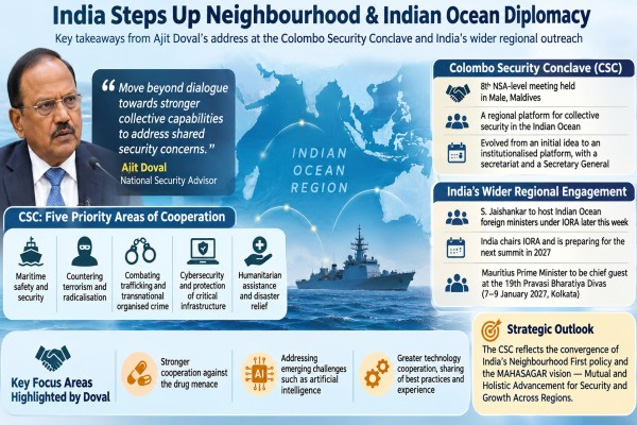
On November 26, 2026, the Colombo Security Conclave adopted a Roadmap of Cooperation for 2026-2027. The roadmap was adopted after the 8th National Security Advisor (NSA)-Level Meeting, hosted by the Maldives in Malé.
- Member countries agreed to strengthen cooperation in maritime safety, counter-terrorism, and other regional security areas.
- The meeting took place amid growing security challenges in the Indian Ocean region.
1. About the Colombo Security Conclave (CSC)
The Colombo Security Conclave is a regional grouping that promotes cooperation on common security concerns in the Indian Ocean region.
- It brings together countries that share maritime interests and face similar security challenges.
- It aims to strengthen regional peace and security through cooperation, training and capacity-building.
Member Countries:
- India
- Maldives
- Mauritius
- Sri Lanka
- Bangladesh
- Seychelles
Other Participants:
- Australia and Malaysia participated as guest nations.
- Mauritius joined the meeting virtually.
2. 2026-2027 Roadmap of Cooperation
The member countries adopted a roadmap covering planned activities and key outcomes under five major pillars.
Five Core Pillars of Cooperation
| Pillar | Main Focus |
| 1. Maritime Safety and Security | Addressing maritime security challenges and improving safety in the Indian Ocean. |
| 2. Countering Terrorism and Radicalisation | Joint efforts to prevent terrorism and radicalisation. |
| 3. Combating Trafficking and Transnational Organised Crime | Cooperation against trafficking and organised criminal networks operating across borders. |
| 4. Cyber Security and Protection of Critical Infrastructure and Technology | Strengthening cyber security and protecting critical infrastructure and technology. |
| 5. Humanitarian Assistance and Disaster Relief (HADR) | Cooperation during humanitarian emergencies and natural disasters. |
Key Areas of Cooperation:
- Training programmes.
- Sharing of best practices.
- Capacity-building initiatives.
- Implementation of decisions taken during earlier meetings.
- Strengthening collective responses to regional security challenges.
3. 8th NSA-Level Meeting
The meeting was hosted by the Maldives at Villa Nautica Paradise Island in Malé. It was held on Wednesday, November 25, 2026.
- The joint statement was released on November 26, 2026.
Important Participants:
| Country | Representative |
| India | National Security Advisor Ajit Doval |
| Maldives | Lt. Col. (Retd.) Ibrahim Latheef, National Security Advisor |
| Sri Lanka | Air Vice Marshal (Retd.) Sampath Thuyacontha, Defence Secretary |
| Bangladesh | Lieutenant General Md Faizur Rahman, Commandant, National Defence College |
| Mauritius | Participated virtually |
| Australia and Malaysia | Guest nations |
Other Important Developments:
- The Conclave's first Secretary-General, Vice Admiral (Retd.) S. N. Ghormade, presented a review of progress made in implementing decisions taken at the previous NSA-level meeting.
- The 7th NSA-Level Meeting was held in New Delhi on November 20, 2025.
4. India's Role and Strategic Vision
National Security Advisor Ajit Doval highlighted the importance of cooperation among Indian Ocean countries.
He emphasised that:
- Countries in the Indian Ocean region share a common maritime domain.
- These countries are connected through civilisational ties developed over centuries.
- They face evolving and serious security challenges.
- Collective efforts are necessary to address these challenges.
Connection with India's Foreign Policy
Doval described the CSC as a convergence of two important Indian policy approaches:
A. Neighbourhood First Policy
- Focuses on strengthening relations with India's neighbouring countries.
- Promotes regional cooperation, stability and development.
B. MAHASAGAR Vision
- MAHASAGAR stands for Mutual and Holistic Advancement for Security and Growth Across Regions.
- It reflects India's approach towards cooperation, security and growth across the wider maritime region.
India has also assured member countries of its continued support and assistance in achieving the Conclave's common objectives.
5. Strategic Importance of the Indian Ocean Region
The Indian Ocean is important for regional security, international trade, and maritime connectivity.
- Trade and Connectivity: It connects major economies of Asia, Africa, and Europe.
- Energy Transportation: It is an important route for international shipping and the transportation of energy resources.
- Maritime Security: Security in the region is essential for the smooth movement of goods and resources.
- Transnational Threats: Terrorism, trafficking and organised crime can affect regional stability.
- Regional Cooperation: Cooperation among coastal and island countries helps improve maritime security and regional stability.
China's Role
China's assertive behaviour in the Indo-Pacific and Indian Ocean region has emerged as a concern for several regional countries, including India.
- This makes cooperation among Indian Ocean countries important for addressing shared security concerns.
6. Significance of the Colombo Security Conclave
- Regional Security: Promotes collective efforts to address common security threats.
- Maritime Cooperation: Strengthens coordination among countries sharing the Indian Ocean.
- Counter-Terrorism: Encourages cooperation against terrorism and radicalisation.
- Cyber Security: Supports the protection of critical infrastructure and technology.
- Capacity Building: Promotes training and sharing of best practices.
- Disaster Management: Improves cooperation in humanitarian assistance and disaster relief.
- Strategic Cooperation: Strengthens India's engagement with neighbouring countries and the wider Indian Ocean region.
Conclusion
The Colombo Security Conclave provides a platform for Indian Ocean countries to address common security challenges through collective action. The 2026-2027 Roadmap aims to strengthen cooperation across five key pillars. For India, the grouping supports its Neighbourhood First Policy and MAHASAGAR vision, while promoting peace, stability and security in the Indian Ocean region.
Test your understanding
Questions from this article
Prelims practiceQuestion: Regarding colombo security conclave, how many of the below countries are members of it:
- India
- Maldives
- Mauritius
- Sri Lanka
- Bangladesh
- Seychelles
- Australia
Choose the correct option:
- 1, 2, 3 and 4
- 1, 2, 3 and 5
- 1, 2, 3, 4, 5 and 6
- All of the above
View answer and explanation
Suggested answer: (c) 1, 2, 3, 4, 5 and 6
Explanation:
Member Countries:
- India
- Maldives
- Mauritius
- Sri Lanka
- Bangladesh
- Seychelles
Other Participants:
- Australia and Malaysia participated as guest nations.
Mains practiceQuestion: "Critically examine the role of the Colombo Security Conclave (CSC) in shaping India's maritime security architecture in the Indian Ocean. What challenges must be addressed to enhance its institutional resilience?" (15 Marks)
View answer-writing approach
Answer approach:
- Introduction : introduce Colombo security conclave briefly with its objectives.
- Body:
- Describe the role of the Colombo Security Conclave (CSC) in shaping India's maritime security architecture in the Indian Ocean include neighbourhood first policy, mahasagar vision, trade promotion, connectivity and counter terrorism measures.
- challenges must be addressed to enhance its institutional resilience like China's interference, swinging political allegiance in the nations etc
- Way forward: building trust, mutual respect, peace & stability and India should act as net security provider in the region.