Cyclone Murasu is a severe cyclonic storm that developed over the Bay of Bengal and affected the coastal districts of Andhra Pradesh with strong winds and heavy rainfall. It triggered flash flood warnings in several districts. The cyclone also drew attention because of its Tamil name, which reflects India's cultural and linguistic diversity.
Why in the News?
On November 3, 2026, the India Meteorological Department (IMD) issued flash flood warnings for six districts of Andhra Pradesh due to Cyclone Murasu.
- Coastal areas experienced strong winds and very heavy rainfall, particularly in Bapatla district.
- The cyclone continued to affect the region despite expectations of weakening into a cyclonic storm.
- Its name also attracted attention as Murasu was identified as the first Tamil name assigned to a tropical cyclone since the regional naming system began in 2004.
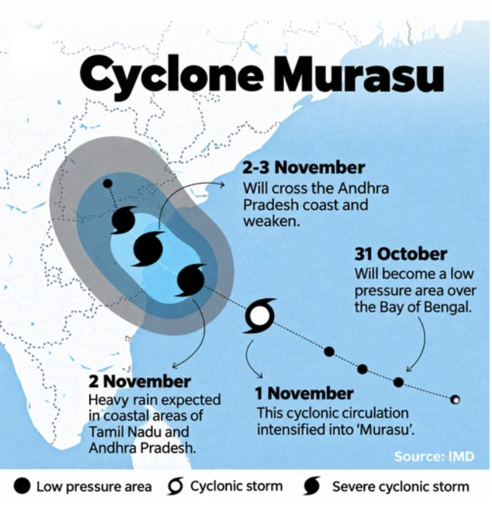
Cyclone Murasu: Movement and Impact
This explains how Cyclone Murasu moved towards Andhra Pradesh and affected the coastal areas. It covers where the cyclone made landfall, which districts received heavy rainfall, where flash flood warnings were issued and how the storm moved after reaching the coast.
1. Landfall and Movement
The cyclone crossed the Andhra Pradesh coast near Ongole, close to Kothapatnam in Prakasam district and Chinnaganjam in Bapatla district. Landfall occurred between 3:30 a.m. and 8:30 a.m. on November 3, 2026.
- After landfall, the storm moved in a north-northwestward direction at around 8 kmph until 1 p.m.
- Wind speeds of 95–105 kmph continued along the Andhra Pradesh coast.
- Wind speeds were expected to decrease to 85–95 kmph as the system weakened into a cyclonic storm.
2. Flash Flood Warnings
The IMD issued flash flood warnings for six districts facing a moderate risk of flash floods:
- Bapatla
- Guntur
- Krishna
- Eluru
- Palnadu
- Prakasam
The Andhra Pradesh State Disaster Management Authority (APSDMA) also warned of very heavy rainfall in the following districts:
- Polavaram
- Kakinada
- NTR
- Krishna
- Bapatla
- Palnadu
3. Heavy Rainfall
- Bapatla district continued to receive very heavy rainfall.
- Some locations recorded more than 150 mm of rainfall.
4. Location of the Storm
According to observations at 1 p.m. on November 3, 2026, the storm was located:
- 30 km north-northeast of Ongole.
- 40 km southwest of Bapatla.
- 90 km north-northeast of Kavali.
- 100 km south-southwest of Vijayawada.
- 120 km west-southwest of Machilipatnam.
How Are Tropical Cyclones Named?
Tropical cyclones over the North Indian Ocean, including the Bay of Bengal and the Arabian Sea, are named under a regional system coordinated by the World Meteorological Organization (WMO).
- The regional cyclone-naming system became operational in September 2004.
- Participating countries contribute names to a common list.
- The Regional Specialised Meteorological Centre (RSMC), New Delhi, under the IMD, is responsible for assigning names to cyclones in the region.
- Naming helps authorities, the media and the public identify cyclones and communicate warnings more effectively.
Criteria for Selecting Cyclone Names
Cyclone names must follow certain guidelines:
- They should be easy to pronounce and clearly understood.
- They should not exceed eight letters.
- They should be neutral and should not hurt the sentiments of any community.
- Their pronunciation should be clear.
Why Was the Name 'Murasu' Suggested?
Murasu is a traditional Tamil percussion instrument, similar to a drum. The name was suggested by the Regional Meteorological Centre (RMC), Chennai.
- Historically, the instrument was used to communicate important information and alert people.
- Its loud and powerful sound is also associated with thunder, making it suitable for a cyclone's name.
- According to S. Balachandran, former Additional Director General of Meteorology, Murasu was the first Tamil name assigned to a tropical cyclone since the naming system began in 2004.
India's Contribution to Cyclone Naming
After the names in the first list were exhausted, RSMC New Delhi sought fresh names from coastal states, including Odisha and Andhra Pradesh, in 2020.
- India contributed 13 names to the regional naming list, along with contributions from 12 other countries.
- The second list also included names contributed by additional participating countries, such as the United Arab Emirates and Yemen.
- Murasu was the third Indian name to feature in the list, after Gati and Tej.
Other Tamil Names Suggested
RMC Chennai also suggested names linked to the ocean, fishing, and agriculture. However, these names were not included in the final list. Neer, another Tamil word, was included in the cyclone-naming list. These included:-
- Thirukai
- Kalappai
- Yer
- Naavai
Significance of Cyclone Naming
- Disaster Communication: Names make it easier for authorities, the media, and the public to identify cyclones and communicate warnings.
- Regional Cooperation: The naming system reflects cooperation among countries around the North Indian Ocean.
- Cultural Representation: Names such as Murasu represent the cultural and linguistic diversity of participating countries.
- Public Awareness: Familiar and meaningful names can help people understand and respond to cyclone warnings.
Conclusion
Cyclone Murasu highlights the vulnerability of India's eastern coast to cyclones, heavy rainfall, and flash floods. It also underlines the need for effective early warnings and disaster preparedness. Its Tamil name reflects India's cultural contribution to the regional cyclone-naming system.
Test your understanding
Questions from this article
Prelims practiceQuestion: Consider the following statements: (UPSC Prelims 2020)
- Jet streams occur in the Northern Hemisphere only.
- Only some cyclones develop an eye.
- The temperature inside the eye of a cyclone is nearly 10°C lesser than that of the surroundings.
Which of the statements given above is/are correct?
- 1 only
- 2 and 3 only
- 2 only
- 1 and 3 only
View answer and explanation
Suggested answer: (c) 2 only
Explanation:
- Statement 1 is incorrect: Jet streams occur in both Northern and Southern Hemispheres.
- Statement 2 is correct: Only some cyclones, particularly mature tropical cyclones, develop a distinct eye.
- Statement 3 is incorrect: The eye of a tropical cyclone is generally warmer than its surroundings due to descending air.
Mains practiceQuestion: What is the Fujiwhara effect? Explain its impact on the movement and intensity of tropical cyclones. (10 Marks, 150 Words)
View answer-writing approach
Answer approach:
The Fujiwhara Effect occurs when two nearby tropical cyclones interact and rotate around a common centre.
- Movement: It can change their direction, speed and path.
- Intensity: Cyclones may weaken, merge into a larger system or one may absorb the other.
Significance: It makes cyclone forecasting difficult and highlights the need for better weather monitoring and early warning systems.
Frequently asked questionsFrequently asked questions
What is Cyclone Murasu- Impact on Andhra Pradesh and Meaning of Its Tamil Name?
Cyclone Murasu hit the Andhra Pradesh coast, bringing strong winds and heavy rainfall. It also led to flash flood warnings in several districts. The article explains the cyclone's impact, how cyclones are named, and the meaning of Murasu
Why is Cyclone Murasu- Impact on Andhra Pradesh and Meaning of Its Tamil Name relevant for UPSC preparation?
It triggered flash flood warnings in several districts
What key points should aspirants remember about Cyclone Murasu- Impact on Andhra Pradesh and Meaning of Its Tamil Name?
The article covers Why in the News?, Cyclone Murasu: Movement and Impact, 1. Landfall and Movement and 2. Flash Flood Warnings.