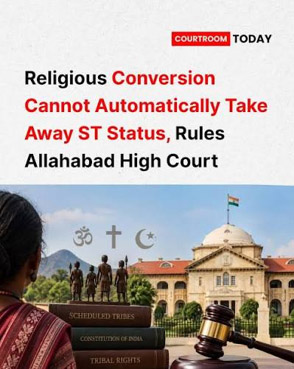
The Allahabad High Court has held that changing one’s religion does not automatically end Scheduled Tribe (ST) status. The case involved a woman who claimed to belong to the Bhuiyan Scheduled Tribe and had purchased tribal land in Sonbhadra, Uttar Pradesh. The Allahabad High Court recently held that religious conversion or an inter-religious marriage does not, by itself, automatically terminate a person's Scheduled Tribe (ST) status acquired by birth. In its September 14, 2026 decision in Nanhki Naimunnisha v. State of U.P. and Others, the court observed that a change of religion does not ipso facto extinguish ST status. However, where the status is challenged, the individual may be required to establish a continuing and genuine connection with their tribal community, including relevant social, cultural and community ties.
Context
- The Allahabad High Court has held that conversion to another religion does not automatically terminate Scheduled Tribe (ST) status.
- However, when a person’s continuing tribal identity is disputed, the court can examine whether the person continues to have a connection with the concerned tribal community.
- The ruling came in a dispute over the purchase of tribal land in Sonbhadra, Uttar Pradesh.
What Was the Case About?
At the heart of the dispute was whether the petitioner, despite being an ST by birth, continued to be legally recognised as a member of the Scheduled Tribe after her religious conversion and inter-religious marriage.
- The case involved three agricultural land transactions in Sonbhadra district.
- The transactions took place in:
- The petitioner claimed to belong to the Bhuiyan Scheduled Tribe by birth.
- She relied on an ST certificate issued by the revenue authorities.
- The sellers of the land were also claimed to be members of Scheduled Tribes.
Why Were the Transactions Challenged?
The transactions were challenged because the law places restrictions on the transfer of land belonging to Scheduled Tribes in order to prevent tribal land alienation. Therefore, the validity of the transactions depended upon whether the petitioner was legally recognised as a Scheduled Tribe member at the time of purchase.
The revenue authorities questioned whether the petitioner continued to possess ST status when she purchased the land.
- Material before the authorities showed that:
- She had married a Muslim man according to Islamic rites.
- She had lived with him for several decades.
- She was known by a different name.
- Some official records described her as Muslim.
- In January 2026, the Deputy Collector of Sonbhadra:
- Declared the three transactions void.
- Directed that the land vest in the State government.
Legal Provision Involved
The dispute involved restrictions on the transfer of land belonging to Scheduled Tribes.
Section 157-B of the U.P. Zamindari Abolition and Land Reforms Act, 1950
- It restricts the transfer of land belonging to members of Scheduled Tribes to persons who are not members of a Scheduled Tribe.
- Therefore, the key question was whether the purchaser herself continued to have ST status on the dates of the three transactions.
Watch : Religious Conversion and ST Status
What Did the Allahabad High Court Hold?
The Allahabad High Court addressed whether religious conversion by itself could terminate ST status.
- A Bench of Justice Arun Kumar dismissed the three writ petitions.
- It upheld the orders declaring the land transactions void. In this particular case, the petitioner failed to establish that she continued to possess the Bhuiyan tribal identity at the time of the disputed land purchases.
- Religious conversion does not automatically terminate ST status. Whether a person continues to belong to an ST is a question of fact, requiring examination of tribal customs, traditions, social organisation, community participation and acceptance.
Basis of the Court's Reasoning
- The court relied on Supreme Court decisions including:
- State of Kerala v. Chandramohanan (2004)
- Chinthada Anand v. State of Andhra Pradesh (2026)
- The court held that whether a person continues to belong to a Scheduled Tribe after conversion is primarily a question of fact.
- Conversion ≠ Automatic loss of ST status.
- However, continuing tribal identity must be examined on the facts and evidence of the case.
Role of the Constitution (Scheduled Tribes) Order, 1950
- The Constitution (Scheduled Tribes) Order, 1950 does not prescribe a religion-based exclusion from ST status.
- Therefore, a person cannot be considered to have lost ST status merely because they converted to another religion.
What Factors Can Be Examined?
Where continuing ST status is disputed, courts can examine factors such as:
- Tribal traits
- Customs
- Traditions
- Connection with the tribal community
- Participation in the community's social and cultural life
- Recognition and acceptance by the tribal community
Application to the Present Case
- The court did not treat the petitioner's conversion, marriage or Muslim identity in official records as individually conclusive.
- Instead, it considered the overall circumstances and available evidence.
- The petitioner was unable to establish sufficient evidence that she continued to:
- Follow the customs and traditions of the Bhuiyan tribe.
- Participate in its social and community life.
- Remain recognised and accepted by the community.
- Therefore, the court concluded that she had not established the required continuing tribal connection when she purchased the land.
Important Distinction
The court's reasoning can be understood through the distinction between:
- Religion: Conversion to another religion does not automatically remove ST status.
- Tribal Identity: Continuing ST status may depend on whether the person continues to have the required connection with the tribal community, when that status is disputed.
Court's Caution
- The court cautioned against applying an overly rigid test.
- A person cannot be expected to prove that they followed every tribal custom throughout their entire life.
- Similarly, a single document describing a person as belonging to another religion cannot by itself determine their ST status.
Why Is the Ruling Significant?
- Religion and ST status: It distinguishes religious identity from tribal identity.
- Case-by-case determination: Continuing ST status after conversion must be examined on the basis of facts and evidence.
- Protection of tribal land: ST status becomes important where laws restrict the transfer of tribal land.
- Community connection: The judgment highlights the importance of continuing social and cultural connection with the tribal community.
- No automatic exclusion: Conversion itself cannot be treated as an automatic rule for extinguishing ST status.
Conclusion
The Allahabad High Court has held that changing one’s religion does not automatically end Scheduled Tribe (ST) status. The case involved a woman who claimed to belong to the Bhuiyan Scheduled Tribe and had purchased tribal land in Sonbhadra, Uttar Pradesh. The authorities questioned her ST status because she had married a Muslim man and some official records identified her as Muslim. The court said that conversion alone cannot decide whether a person continues to have ST status. The court can look at the facts of each case. It may consider the person’s connection with the tribal community, customs, traditions, social life and acceptance by the community. In this case, the woman could not provide enough evidence to show that she continued to have a strong connection with the Bhuiyan community. The court therefore upheld the decision that the land transactions were invalid. The ruling makes an important distinction between religious identity and tribal identity.
Test your understanding
Questions from this article
Prelims practiceQuestion: With reference to Religious Conversion and Scheduled Tribe Status- Allahabad High Court Ruling, consider the following statements:
- The Allahabad High Court has held that changing one’s religion does not automatically end Scheduled Tribe (ST) status
- The case involved a woman who claimed to belong to the Bhuiyan Scheduled Tribe and had purchased tribal land in Sonbhadra, Uttar Pradesh
Which of the statements given above is/are correct?
- 1 only
- 2 only
- Both 1 and 2
- Neither 1 nor 2
View answer and explanation
Suggested answer: (c) Both 1 and 2
Explanation: The Allahabad High Court examined whether religious conversion affects Scheduled Tribe status, holding that conversion alone does not automatically end ST status. The ruling focuses on continued tribal identity, customs, community ties and acceptance
Mains practiceQuestion: Discuss Religious Conversion and Scheduled Tribe Status- Allahabad High Court Ruling with reference to What Was the Case About?, Why Were the Transactions Challenged?, Legal Provision Involved and What Did the Allahabad High Court Hold?. (150 words, 10 marks)
View answer-writing approach
Answer approach:
- Introduce the topic using its meaning and context.
- Explain What Was the Case About?, Why Were the Transactions Challenged?, Legal Provision Involved and What Did the Allahabad High Court Hold?.
- Use facts and examples given in the article.
- Conclude with a balanced way forward.
Frequently asked questionsFrequently asked questions
What is Religious Conversion and Scheduled Tribe Status- Allahabad High Court Ruling?
The Allahabad High Court examined whether religious conversion affects Scheduled Tribe status, holding that conversion alone does not automatically end ST status. The ruling focuses on continued tribal identity, customs, community ties and acceptance
Why is Religious Conversion and Scheduled Tribe Status- Allahabad High Court Ruling relevant for UPSC preparation?
The case involved a woman who claimed to belong to the Bhuiyan Scheduled Tribe and had purchased tribal land in Sonbhadra, Uttar Pradesh
What key points should aspirants remember about Religious Conversion and Scheduled Tribe Status- Allahabad High Court Ruling?
The article covers What Was the Case About?, Why Were the Transactions Challenged?, Legal Provision Involved and What Did the Allahabad High Court Hold?.