The 2026 WHO-UNICEF report highlights ongoing gaps in school Water, Sanitation and Hygiene (WASH) services, emphasizing that access to safe water, adequate sanitation, and proper hygiene is essential for creating healthy, inclusive, and equitable learning environments. India has made major progress in providing drinking water and sanitation facilities in schools since the launch of the Swachh Bharat Mission in 2014. However, ensuring that these facilities remain clean, functional, and accessible is the next major challenge.
Why in the News?
The latest data from the WHO/UNICEF Joint Monitoring Programme (JMP) and UDISE+ 2025-26 show significant improvement in school sanitation. However, thousands of schools still have non-functional or missing girls' toilets, highlighting the gap between construction and regular maintenance.
Progress in School Sanitation
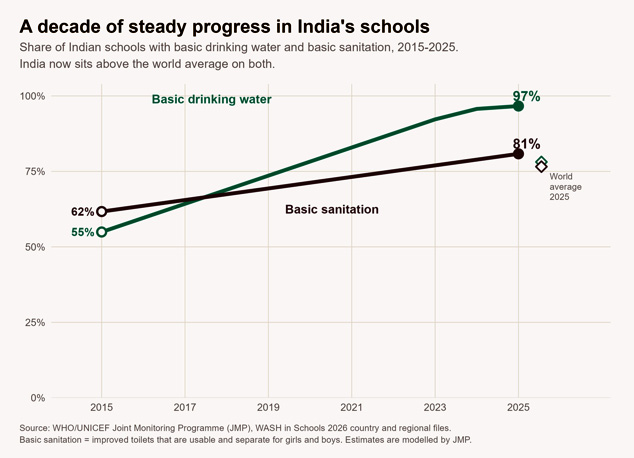
The Swachh Vidyalaya initiative under the Swachh Bharat Mission aimed to provide separate toilets for boys and girls in government schools. Between 2015 and 2025, India recorded substantial improvement:
| Indicator | 2015 | 2025 |
|---|
| Schools with basic drinking water | 55% | 97% |
| Schools with basic sanitation | 62% | 81% |
| Schools with no sanitation | 27% | 14% |
India's improvement in access to basic drinking water was among the fastest recorded across the countries covered by the JMP. According to UDISE+ 2025-26, 98.5% of girls' and co-educational schools have a girls' toilet.
Toilets and Girls' Education
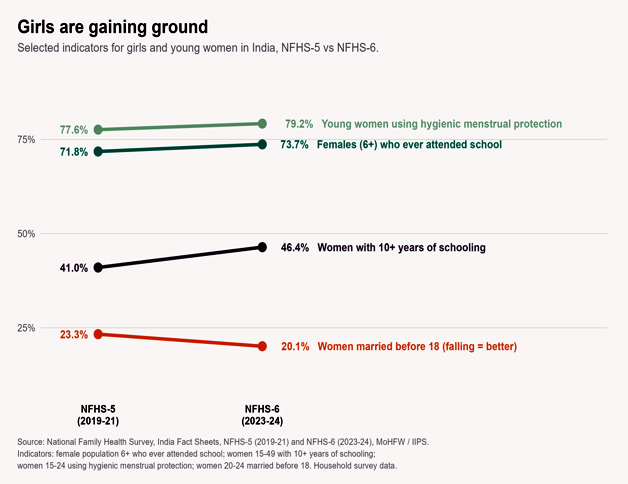
School sanitation is not only a public-health issue. It also affects education and school attendance, particularly for adolescent girls. Separate and usable toilets provide privacy, safety and dignity, especially after puberty. Better sanitation can therefore support girls in continuing their education. UDISE+ 2025-26 shows that the annual dropout rate in Classes 9–12 was:
The NFHS-6 (2023–24) also shows improvement in women's educational attainment. The share of women with 10 or more years of education increased from 41% in NFHS-5 to 46.4% in NFHS-6.
Regional and Gender Gaps
Progress is not uniform across India. The proportion of women with 10 or more years of education is:
- Rural women: 39.7%
- Urban women: 61.5%
Menstrual hygiene also shows a rural-urban gap. Among women aged 15–24, about three-fourths of rural women use hygienic menstrual protection, compared with around nine-tenths in urban areas. Promoting menstrual equity is essential to ensure that girls and women have equal access to safe menstrual products, clean facilities, water, and accurate hygiene information. Therefore, a clean toilet with running water and proper menstrual-hygiene facilities can play an important role in ensuring regular attendance of adolescent girls.
The Maintenance Gap
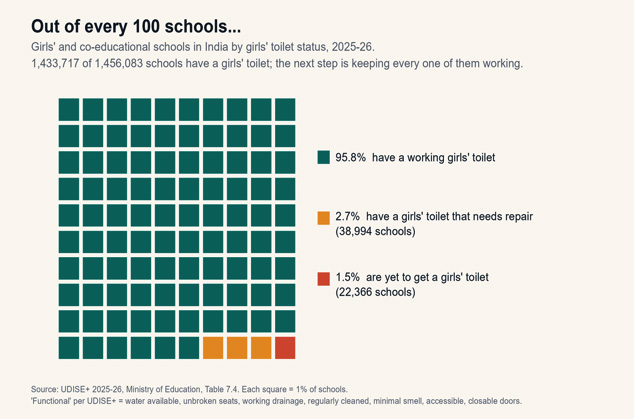
The major challenge is now shifting from toilet construction to toilet maintenance.
UDISE+ reports:
- 38,994 schools have a girls' toilet that exists but is not functional.
- 22,366 schools have no girls' toilets.
- Together, this affects more than 61,000 schools, or about 4% of the total.
Although the percentage is relatively small, the absolute number is significant because of India's large school system.
Regional Differences in Functionality
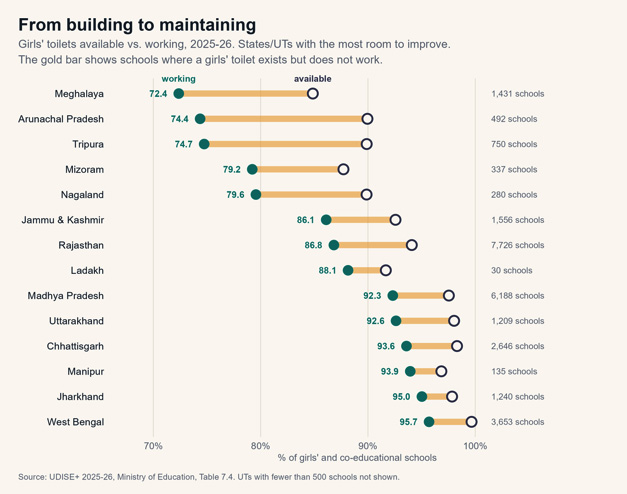
In 24 of 36 States and Union Territories, at least 95% of schools have a functioning girls' toilet. The North-Eastern region faces greater challenges:
- Meghalaya: 72.4%
- Arunachal Pradesh: 74.4%
- Tripura: 74.7%
- Mizoram and Nagaland: Below 80%
Factors include hilly terrain, scattered schools, and seasonal water shortages. In larger States, the challenge is mainly the scale of the maintenance backlog. For example:
- Rajasthan: 7,726 schools have girls' toilets requiring repair.
- Madhya Pradesh: 6,188 schools have girls' toilets requiring repair.
Difference Between UDISE+ and JMP Data
There is a significant difference between the two major data systems. UDISE+ reports that about 97% of schools have at least one functional toilet, while the JMP estimates basic sanitation coverage at 81%. The difference is partly linked to data-collection methods and definitions. UDISE+ considers a toilet functional when it meets several conditions, including:
- Availability of a toilet seat and water.
- Proper drainage.
- Regular cleaning.
- Minimal odour.
- Accessibility.
- Closable doors.
However, UDISE+ data are based on responses from school heads, which are subsequently certified, rather than an independent nationwide physical survey.
Hygiene Data Gap
A similar difference exists in school handwashing facilities. UDISE+ reports that 96.9% of schools have a handwashing facility. The JMP, however, estimates basic hygiene coverage at around 53%, because it requires the availability of both soap and water. This highlights the need for stronger and more consistent monitoring and verification systems.
Way Forward
The next phase of school sanitation should focus on maintenance, quality and accountability, rather than only constructing more toilets.
1. Dedicated Maintenance Funding
A portion of school grants could be earmarked for:
- Repairs
- Cleaning
- Water supply
- Soap and hygiene materials
States with larger maintenance backlogs, such as Rajasthan and Madhya Pradesh, could receive priority.
2. Community Monitoring
School Management Committees (SMCs) and parents can participate in regular inspections. The existing UDISE+ criteria can be used for monthly checks, with results included in the school's annual reporting.
3. Region-Specific Solutions
Hilly and water-stressed regions need infrastructure suited to local conditions.
Possible solutions include:
- Rainwater harvesting
- Low-water toilets
- Durable construction materials
- Designs suited to difficult terrain
4. Menstrual Hygiene Management
School sanitation programmes should integrate menstrual hygiene management. Information already collected on facilities such as incinerators and sanitary-pad vending machines can help identify schools requiring additional support.
Conclusion
India has made substantial progress in expanding school sanitation and drinking-water facilities. The focus must now shift from construction to sustained maintenance, reliable data, menstrual hygiene, and community monitoring. A functional and safe school toilet is not merely a sanitation facility; it is an important part of an inclusive education system.
Source: The Hindu
Frequently asked questionsFrequently asked questions
What is School Sanitation in India Improves, but Maintenance Gaps Persist?
School sanitation in India has improved with better access to toilets and hygiene facilities, but maintenance, cleanliness, water availability and regular upkeep remain key challenges
Why is School Sanitation in India Improves, but Maintenance Gaps Persist relevant for UPSC preparation?
India has made major progress in providing drinking water and sanitation facilities in schools since the launch of the Swachh Bharat Mission in 2014
What key points should aspirants remember about School Sanitation in India Improves, but Maintenance Gaps Persist?
The article covers Why in the News?, Progress in School Sanitation, Toilets and Girls' Education and Regional and Gender Gaps.