The Punjab and Haryana High Court recently heard a case involving a 26-year-old Muslim man and a 17-year-and-eight-month-old Muslim woman. The couple asked the court to protect them from the woman’s family. Under traditional interpretations of Muslim personal law, puberty, often presumed to be attained at 15 years of age, has historically been treated as a basis for marriage capacity. However, this position may come into tension with India’s secular statutory framework on child protection and the minimum legal age of marriage.
Context
The recent case involved a Muslim couple who approached the Punjab and Haryana High Court for protection of their life and liberty. The court referred to the position under Muslim personal law regarding puberty and marriage, but it did not finally decide the validity of the marriage
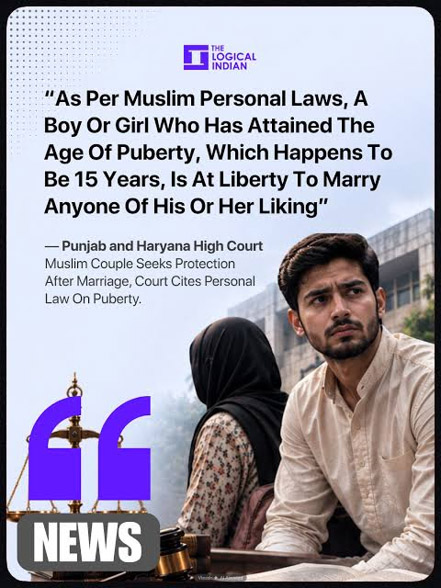
The Punjab and Haryana High Court recently observed that under Muslim personal law, a person who has attained puberty is presumed competent to marry a person of their choice.
The observation has again brought attention to the legal relationship between Muslim personal law and statutory laws such as the Prohibition of Child Marriage Act, 2006 (PCMA) and the Protection of Children from Sexual Offences Act, 2012 (POCSO).
Personal Law vs. Statutory Law Conflict
Muslim Personal Law: Under traditional principles of Mohammedan law, including those discussed in Mulla’s Principles of Mahomedan Law, a Muslim who has attained puberty has traditionally been regarded as capable of contracting marriage. Puberty has often been presumed at 15 years of age in the absence of evidence to the contrary, although the application of these principles is subject to prevailing statutory law and judicial interpretation.
Statutory Laws: The Prohibition of Child Marriage Act (PCMA), 2006 defines a child in relation to age and establishes legal restrictions on child marriage. The Protection of Children from Sexual Offences (POCSO) Act, 2012 protects persons below 18 years of age and criminalises sexual acts involving children, irrespective of personal-law considerations.
What Was the Current Case?
The current case concerned a Muslim couple who sought protection from the woman’s family. The High Court dealt with their request for protection of life and liberty and did not give a final ruling on whether their marriage was legally valid
The case involved a 26-year-old Muslim man and a 17-year-and-eight-month-old Muslim woman.
The couple approached the Punjab and Haryana High Court seeking protection of their life and liberty from the woman's family.
They stated that they had performed nikah after the woman's father opposed their relationship.
Justice Vikram Aggarwal referred to the position under Muslim personal law that a Muslim boy or girl who has attained puberty, presumed at 15 years in the absence of evidence to the contrary, may marry a person of their choice.
However, the court did not finally decide whether the marriage was legally valid.
The court directed the Senior Superintendent of Police (Rural), Ludhiana, to consider the couple's representation and take appropriate action according to law.
What Does Muslim Personal Law Say?
Muslim personal law treats puberty as an important factor in determining the capacity to marry. The High Court referred to the rule that a Muslim person of sound mind who has attained puberty can enter into a marriage contract.
The High Court referred to Article 195 of Sir Dinshah Fardunji Mulla's Principles of Mohammedan Law.
It recognises a Muslim person of sound mind who has attained puberty as competent to enter into a marriage contract.
In the absence of evidence showing an earlier or later attainment of puberty, 15 years is presumed to be the age of puberty.
The Punjab and Haryana High Court had earlier relied on this position in Kammu v. State of Haryana (2010).
In that case, the court held that a Muslim boy or girl who had attained puberty could marry a person of their choice, subject to the applicable legal requirements.
What Does the Prohibition of Child Marriage Act Say?
The Prohibition of Child Marriage Act, 2006 sets specific age limits for identifying a child for the purpose of child marriage. This creates an important legal question when the age recognised under personal law is lower than the statutory age prescribed by Parliament.
Under the Prohibition of Child Marriage Act, 2006 (PCMA):
Male child: A person who has not completed 21 years.
Female child: A person who has not completed 18 years.
Child marriage: A marriage where either of the contracting parties is a child.
This creates a legal question when personal law recognises puberty as relevant to marriage while the PCMA prescribes statutory age limits.
What Does the POCSO Act Say?
The POCSO Act provides special legal protection to children from sexual offences. Under the Act, a child means a person below 18 years, which creates another point of conflict when a minor’s marriage is recognised under personal law. Different courts have considered this issue differently.
The Protection of Children from Sexual Offences Act, 2012 (POCSO) protects persons below 18 years from sexual offences.
The question of whether personal law can affect the application of POCSO has been considered by different courts.
Judicial Position Over the Years
Different High Courts have taken different approaches to the relationship between Muslim personal law, the PCMA and POCSO. Some judgments have given importance to Muslim personal law, while others have held that child protection statutes apply despite personal law.
Watch : Muslim Minor Marriage vs POCSO Act
1. Mohd. Samim v. State of Haryana (2018)
The Punjab and Haryana High Court considered the marriage of a 16-year-old Muslim girl.
The petitioner argued that the marriage was valid under Muslim Personal Law and that the PCMA did not apply.
The court concluded that the marriage was valid under Muslim law because the girl had attained puberty.
It consequently directed her release from a Safe House to reside with her husband.
2. Rahul v. State of Karnataka (2021)
3. Aleem Pasha v. State of Karnataka (2022)
The Karnataka High Court again held that POCSO is a special legislation for protecting children from sexual offences.
It therefore held that POCSO would override Muslim personal law in this context.
The court observed that sexual intercourse with a wife below 18 years could attract the provisions of POCSO, even if the relationship was within marriage.
The argument that puberty at around 15 years permitted marriage under Mohammedan law was rejected in relation to the application of POCSO.
Supreme Court Proceedings
The issue has also reached the Supreme Court through proceedings involving challenges to earlier High Court decisions. The Supreme Court’s proceedings have added another layer to the legal debate, particularly regarding the use of the Punjab and Haryana High Court’s earlier judgment as a precedent.
In October 2022, the Supreme Court issued notice on a plea by the National Commission for Protection of Child Rights (NCPCR) concerning a Punjab and Haryana High Court ruling involving a Muslim couple who had married under Muslim rites and sought protection.
The Supreme Court did not interfere with the relief granted to the couple at that stage.
In January 2023, the Supreme Court stated that the Punjab and Haryana High Court's judgment in Javed v. State of Haryana and Others (2022), which had held that a Muslim girl aged 15 could enter into a valid marriage under personal law, should not be relied upon as a precedent in other cases.
However, in August 2025, the Supreme Court dismissed an NCPCR petition challenging the 2022 Punjab and Haryana High Court judgment.
A Bench comprising Justices B.V. Nagarathna and R. Mahadevan held that the NCPCR lacked a locus standi to challenge the High Court's order.
4. Moidutty Musliyar v. State of Kerala (2024)
The Kerala High Court refused to quash proceedings against persons accused of conducting a child marriage.
The accused argued that Muslim personal law should apply instead of the PCMA.
The court rejected this argument and allowed the proceedings under Sections 10 and 11 of the PCMA to continue.
5. Rubi v. State of U.P. (2026)
The Allahabad High Court held that Muslim personal law recognising puberty as the age of marriage cannot override statutory provisions such as:
The court emphasised the statutory protections available to children.
Legal Issue
The main legal issue is how Muslim personal law should operate when its rules relating to the age of marriage come into conflict with statutory child protection laws. Courts have taken different approaches to this question.
Muslim Personal Law
→ Puberty is recognised as relevant to marriage; 15 years is presumed in the absence of evidence to the contrary | Statutory Child Protection Laws
→ PCMA prescribes 18 years for females and 21 years for males for the definition of a child
→ POCSO protects persons below 18 years
This has resulted in different judicial approaches across different High Courts. |
Why Is the Issue Significant?
The issue is important because it involves the relationship between personal laws and laws enacted by Parliament for child protection. It also raises questions about how courts should interpret these laws when their provisions appear to come into conflict. The Allahabad High Court’s 2026 judgment has added another judicial view to this continuing debate.
Personal law vs statutory law: It raises questions about the extent to which personal laws can operate when Parliament has enacted child-protection legislation.
Child protection: The issue directly concerns the protection of persons below the statutory age of adulthood under relevant laws.
Uniformity in law: Different High Court decisions have taken different approaches.
Judicial interpretation: Courts continue to examine how personal laws should interact with laws such as the PCMA and POCSO.
Constitutional questions: The issue involves the broader relationship between personal laws, statutory legislation and fundamental legal protections.
Current Legal Position
The latest Punjab and Haryana High Court order was concerned with the couple’s request for protection of life and liberty. The court did not finally decide whether the marriage itself was legally valid.
The latest Punjab and Haryana High Court order did not finally determine the validity of the 17-year-old's marriage. It dealt with the couple's request for protection of life and liberty.
The broader question of how Muslim personal law interacts with the PCMA and POCSO remains contested, with different courts having taken different positions.
Conclusion
The Punjab and Haryana High Court recently heard a case involving a 26-year-old Muslim man and a 17-year-and-eight-month-old Muslim woman. The couple asked the court for protection from the woman’s family. The court referred to Muslim personal law, under which a Muslim person who has reached puberty may be considered capable of marriage. In the absence of other evidence, 15 years is generally presumed as the age of puberty. However, the court did not finally decide whether the marriage was legally valid. The issue is important because Indian laws have different age rules. Under the Prohibition of Child Marriage Act, 2006, a girl below 18 and a boy below 21 are considered children for marriage purposes. The POCSO Act, 2012 protects people below 18 from sexual offences. Different High Courts have taken different views on how personal law relates to these child-protection laws. The issue therefore remains legally contested.
Test your understanding
Questions from this article
Prelims practiceQuestion: With reference to Muslim Minor Marriage- Conflict Between Personal Law and Child Protection Laws, consider the following statements:
- The Punjab and Haryana High Court recently heard a case involving a 26-year-old Muslim man and a 17-year-and-eight-month-old Muslim woman
- The couple asked the court to protect them from the woman’s family
Which of the statements given above is/are correct?
- 1 only
- 2 only
- Both 1 and 2
- Neither 1 nor 2
View answer and explanation
Suggested answer: (c) Both 1 and 2
Explanation: Explore the legal conflict surrounding Muslim minor marriage, including the relationship between personal law and child protection laws, the legal age of marriage, judicial interpretations, and child rights in India
Mains practiceQuestion: Discuss Muslim Minor Marriage- Conflict Between Personal Law and Child Protection Laws with reference to Personal Law vs. Statutory Law Conflict, What Was the Current Case?, What Does Muslim Personal Law Say? and What Does the Prohibition of Child Marriage Act Say?. (150 words, 10 marks)
View answer-writing approach
Answer approach:
- Introduce the topic using its meaning and context.
- Explain Personal Law vs. Statutory Law Conflict, What Was the Current Case?, What Does Muslim Personal Law Say? and What Does the Prohibition of Child Marriage Act Say?.
- Use facts and examples given in the article.
- Conclude with a balanced way forward.