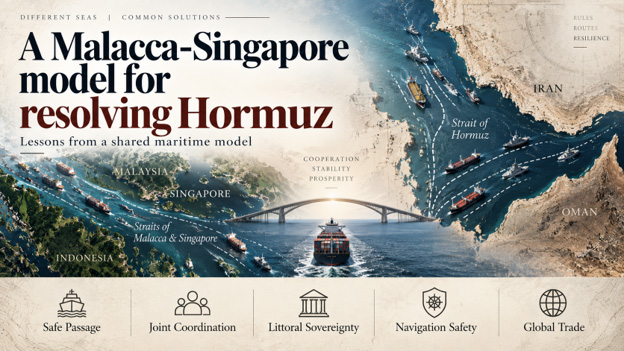
The Straits of Malacca and Singapore offer an important example of how littoral states, user countries and major powers can develop arrangements for the safe passage of ships through strategically important waterways. The experience may provide useful lessons for the Strait of Hormuz, although the security concerns in the two regions are different.
Why in the News?
- The continuing crisis in the Strait of Hormuz has raised questions about how the waterway could be reopened and how safe navigation could be maintained.
- The Malacca-Singapore Straits provide a possible reference point because their governance evolved through negotiations among Indonesia, Malaysia and Singapore, alongside the interests of major maritime powers and international shipping.
- However, the two situations are not identical. While the Malacca-Singapore arrangement focused heavily on navigation safety and environmental concerns, the central concern in Hormuz is Iran's security.
Malacca-Singapore Straits: Geographic Importance
- The Strait of Malacca extends for around 800 km between the Malay Peninsula and Indonesia's Sumatra island.
- It connects the Andaman Sea with the Strait of Singapore.
- The Strait of Singapore, around 105 km long, forms the eastern continuation of the Malacca Strait and connects it to the South China Sea.
- Together, the two waterways form an important maritime route connecting major parts of the Indian and Pacific Ocean regions.
A Territorial Turning Point
- The status of the Straits underwent a major change during the 20th century.
- They were once considered “international” in the sense that they were treated similarly to the high seas, over which no country exercised territorial claims.
Indonesia's Position
Malaysia's Position
- Malaysia also moved towards a 12-nautical-mile territorial sea.
- Despite its earlier armed conflict with Indonesia over Borneo in 1963, Malaysia chose to work with Jakarta on the Straits through:
- Bilateral treaties
- Joint naval patrols
- Cooperation on the management and security of the Straits
This cooperation continues to the present.
Territorial Waters and Passage Rights
- At their narrowest points, the Straits are considerably less than 24 nautical miles wide.
- Once Indonesia and Malaysia claimed 12-nautical-mile territorial seas, their territorial waters met in the middle.
- As a result, there was no remaining strip of high seas or exclusive economic zone (EEZ) between them.
- Under the customary law of the period, the Straits therefore became territorial seas.
- Foreign vessels had the right of “innocent passage”, although Indonesia or Malaysia could suspend this right for security reasons. The arrangement also excluded submerged submarines.
The 1971 Joint Statement
In 1971, Indonesia, Malaysia and Singapore issued a joint statement proposing a coordinating body involving representatives of the three countries to administer the Straits. Singapore, being highly dependent on trade and shipping, did not fully agree with declaring the Straits “not international”.
- However, it joined Malaysia in supporting cooperation on the safety of navigation.
This marked an important attempt to balance:
- Territorial sovereignty
- Freedom of navigation
- Maritime security
- Commercial shipping interests
Role of the Great Powers
The Malacca-Singapore issue also involved major powers.
Japan
- Japan was an important participant through the Japan-funded Malacca Strait Council.
- Instead of seeking an internationalised regime, Japan supported cooperation with the three littoral states.
United States and Soviet Union
- Interestingly, the United States and Soviet Union, despite being rivals in other areas, shared an interest in maintaining the Straits as an international maritime route.
- Their objective was to preserve the right of “continued, politically uncluttered transit” for ships.
- This demonstrated that major powers could have a common interest in maintaining safe maritime transit even when their broader strategic interests differed.
UNCLOS and the Concept of Transit Passage
During the final stages of UNCLOS negotiations in the 1970s, the United Kingdom introduced the concept of “transit passage”. This applied to straits connecting the high seas or EEZs.
- Transit passage provided a right of transit in a “continuous and expeditious” manner.
- It went beyond the earlier concept of innocent passage because it also applied to warships.
- Indonesia accepted this formulation with reservations and linked its acceptance to greater security for its archipelago, which UNCLOS addressed separately.
Malaysia's concerns focused on:
- Environmental safety
- Insurance requirements
- Permissible vessel draught
The 2007 Cooperative Mechanism
In 2007, Indonesia, Malaysia and Singapore, working with the international community, established a Cooperative Mechanism. It built on a traffic separation scheme similar to one that Iran and Oman had agreed upon for the Strait of Hormuz in the 1960s. A key element was financial cooperation between:
- Littoral states
- User states
- Shipping industry
- Other interested stakeholders
The funds supported:
- Aids to navigation
- Hydrographic surveys
- Safety projects
Aids to Navigation Fund
The Aids to Navigation Fund receives voluntary contributions from non-profit organisations, industry stakeholders and states interested in the safe and efficient use of the Straits. The contributions are not treated as tolls. The fund is administered on a rotational basis by a committee consisting of representatives of:-
- Indonesia
- Malaysia
- Singapore
- Contributing stakeholders
The three littoral states do not impose fees or tolls on ships exercising their right of transit passage.
The Geographic Parallel with Strait of Hormuz
- The Strait of Hormuz has a geographic similarity with the Malacca-Singapore Straits.
- The territorial waters of Iran and Oman intersect, meaning that sections of Hormuz fall within their territorial waters.
- This creates a situation where questions of territorial sovereignty and international navigation rights intersect.
Iran's Position
- In 1993, Iran, which has not ratified UNCLOS, passed a law requiring foreign warships to obtain its authorisation to pass through the Strait.
- This remains a major point of disagreement.
Gulf Cooperation and Regional Interests
The Persian Gulf has experienced both conflict and cooperation among regional countries.
For example:
- The United Arab Emirates has been among Iran's leading trading partners.
- Qatar has supported Iran-Oman talks.
- Qatar has also proposed the Malacca-Singapore Straits as a possible model for Hormuz.
These examples indicate that regional states have economic and strategic interests in maintaining stable maritime connectivity.
Why the Malacca Model Cannot Be Directly Replicated
Although there are clear technical similarities, the geopolitical circumstances are different. The Malacca-Singapore arrangement developed while UNCLOS itself was being negotiated and implemented. This allowed different countries to negotiate trade-offs within a broader international framework governing the world's oceans.
- In contrast, the central concern in the Strait of Hormuz is Iran's security.
- There is also an additional complication: even if Gulf countries agree on a common framework, the United States may not necessarily accept it.
- According to the source, Iran and Oman have apparently agreed on a framework for reopening the Strait, but the Strait has not yet been reopened, and the United States has not accepted the arrangement.
Malacca-Singapore vs Strait of Hormuz
| Aspect | Malacca-Singapore Straits | Strait of Hormuz |
|---|
| Key littoral states | Indonesia, Malaysia, Singapore | Iran, Oman |
| Territorial waters | Territorial waters of littoral states intersect | Iranian and Omani territorial waters intersect |
| Major concern | Navigation safety and environment | Iran's security |
| International framework | Developed alongside UNCLOS | Iran has not ratified UNCLOS |
| Passage framework | Transit passage under UNCLOS | Passage remains contested |
| Cooperation | Littoral states + user states + industry | Iran-Oman discussions |
| Financial mechanism | Aids to Navigation Fund | No comparable mechanism mentioned |
| Major-power role | Japan, U.S. and Soviet Union participated in different ways | U.S. has not accepted the reported arrangement |
Lessons from the Malacca-Singapore Model
The experience of the Malacca-Singapore Straits highlights several elements that could be relevant to Hormuz:-
- Cooperation among littoral states can help manage strategically important waterways.
- User states and shipping industries can contribute to navigation and safety infrastructure.
- Traffic separation schemes can reduce risks to shipping.
- Joint mechanisms can balance territorial interests with commercial navigation.
- International cooperation can support hydrographic surveys and navigation infrastructure.
- Agreements require consideration of both regional security concerns and international shipping interests.
However, the political and security context of Hormuz is different, particularly because Iran's security concerns are central to the dispute.
Conclusion
The Malacca-Singapore Straits demonstrate how a strategically important waterway can move from territorial disagreement towards a system based on cooperation, navigation rights and shared responsibility for maritime safety. The experience provides a possible reference for the Strait of Hormuz, particularly in areas such as traffic management, navigation safety and cooperation among littoral and user states.
Test your understanding
Questions from this article
Prelims practiceQuestion: With reference to Malacca-Singapore Model for Resolving the Strait of Hormuz crisis, consider the following statements:
- The Straits of Malacca and Singapore offer an important example of how littoral states, user countries and major powers can develop arrangements for the safe passage of ships through.
- The experience may provide useful lessons for the Strait of Hormuz, although the security concerns in the two regions are different
Which of the statements given above is/are correct?
- 1 only
- 2 only
- Both 1 and 2
- Neither 1 nor 2
View answer and explanation
Suggested answer: (c) Both 1 and 2
Explanation: Explore the Malacca-Singapore Model as a possible framework for addressing the Strait of Hormuz crisis, focusing on maritime security, regional cooperation, freedom of navigation, energy security and coordinated crisis management
Mains practiceQuestion: Discuss Malacca-Singapore Model for Resolving the Strait of Hormuz crisis with reference to Why in the News?, Malacca-Singapore Straits: Geographic Importance, A Territorial Turning Point and Indonesia's Position. (150 words, 10 marks)
View answer-writing approach
Answer approach:
- Introduce the topic using its meaning and context.
- Explain Why in the News?, Malacca-Singapore Straits: Geographic Importance, A Territorial Turning Point and Indonesia's Position.
- Use facts and examples given in the article.
- Conclude with a balanced way forward.
Frequently asked questionsFrequently asked questions
What is Malacca-Singapore Model for Resolving the Strait of Hormuz crisis?
Explore the Malacca-Singapore Model as a possible framework for addressing the Strait of Hormuz crisis, focusing on maritime security, regional cooperation, freedom of navigation, energy security and coordinated crisis management
Why is Malacca-Singapore Model for Resolving the Strait of Hormuz crisis relevant for UPSC preparation?
The experience may provide useful lessons for the Strait of Hormuz, although the security concerns in the two regions are different
What key points should aspirants remember about Malacca-Singapore Model for Resolving the Strait of Hormuz crisis?
The article covers Why in the News?, Malacca-Singapore Straits: Geographic Importance, A Territorial Turning Point and Indonesia's Position.