The United States has announced a deal allowing Russia to supply diesel to the U.S. and the global market, despite Washington’s efforts to restrict Russia’s energy revenues. The move has raised questions about the consistency of U.S. sanctions policy and could complicate India’s trade negotiations with the U.S. It may also affect India’s fuel exports to Russia and its energy security.
Why in the News?
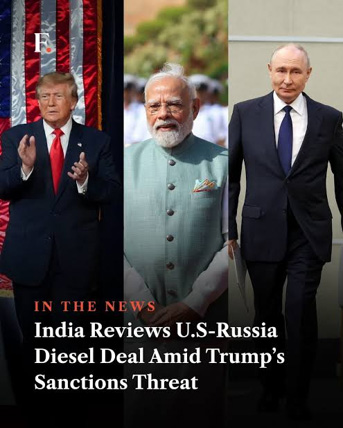
On October 10, 2026, U.S. President Donald Trump announced an agreement with Russian President Vladimir Putin for Russia to supply diesel to the U.S. and the global market. On October 11, Trump also announced an ‘energy ceasefire’ between Russia and Ukraine. These developments could have implications for India’s energy trade, energy security, and relations with the U.S. The Ministry of External Affairs (MEA) will be central to assessing the diplomatic implications of these developments and safeguarding India’s energy interests while maintaining balanced relations with both the United States and Russia..
1. What Is the U.S.- Russia Diesel Deal?
The agreement allows Russia to supply large quantities of diesel to the U.S. and the global market. Trump said the arrangement would help reduce fuel prices in the U.S. and other countries. The announced supply schedule includes:
- Over 300,000 tonnes of diesel immediately.
- 500,000 tonnes in November.
- 1 million tonnes immediately thereafter.
- An additional 3 million tonnes within a short period, depending on the condition of Russian diesel refineries.
Trump defended the agreement on the grounds that it would serve American economic interests by lowering fuel prices.
2. Conflict with the U.S. Russia Sanctions Policy
On September 18, 2026, U.S. President Donald Trump signed the Lindsey O. Graham Sanctioning Russia and Iran Act of 2026 into law. The legislation aims to restrict Russia’s ability to finance its war in Ukraine through sanctions on Russian leaders and companies and tariffs on major trading partners importing Russian energy. The Ministry of External Affairs (MEA) is monitoring the U.S.-Russia sanctions bill and its potential implications for India’s energy trade and diplomatic relations. However, the new diesel agreement has raised concerns among U.S. lawmakers about the consistency of Washington’s policy toward Russia..
- The Act provides for tariffs of up to 100% on countries importing large quantities of Russian oil and gas.
- Republican lawmakers have argued that allowing Russian diesel sales could generate revenue for the Russian government and weaken pressure on Moscow.
- The agreement has raised questions about whether the U.S. can justify penalising other countries for importing Russian energy while permitting Russian fuel supplies to its own market.
3. Implications for India-U.S. Trade Relations
India’s trade negotiations with the U.S. have repeatedly faced difficulties over tariffs and India’s imports of Russian oil. The latest agreement could add another complication to these talks.
Watch : US-Russia Diesel Deal
Background of Trade Negotiations
- February 2025: India and the U.S. began efforts to negotiate a trade agreement.
- August 2025: The U.S. raised tariffs on India to 50%, citing India’s imports of Russian oil as a reason.
- October 2025: Trade negotiations resumed.
- February 2026: The two countries announced a framework for an interim trade agreement.
- March 2026: The U.S. launched investigations into India and other countries concerning forced labour and structural excess capacity.
- July 2026: The forced-labour investigation resulted in 10% tariffs on India, while the excess-capacity investigation remained incomplete.
- September 2026: The Russia sanctions legislation added another potential obstacle to the negotiations.
Why Does the Diesel Deal Matter?
India is one of the largest importers of Russian energy. The U.S. legislation could expose India to additional tariffs, while China has secured an arrangement preventing additional tariffs until early 2027, as described in the current developments. The diesel agreement may therefore strengthen India’s concerns about the consistency of U.S. trade policy. It could complicate negotiations over tariffs, market access and energy imports.
4. Implications for India’s Energy Sector
The agreement comes at a time when fuel supplies are under pressure due to the conflict in West Asia. Changes in Russian fuel exports could affect international fuel availability and India’s energy trade.
- Global fuel prices: Increased Russian diesel supplies could put downward pressure on prices if the announced volumes reach the market.
- Trade uncertainty: The possibility of additional U.S. tariffs could increase uncertainty for India’s energy imports and wider trade relations.
- Diplomatic concerns: Differences in the treatment of India and Russia could create further friction in India-U.S. relations.
The actual impact will depend on the implementation of the diesel agreement, the volume of supplies reaching the market, and the U.S. approach to tariffs.
5. What Is the ‘Energy Ceasefire’ Between Russia and Ukraine?
On October 11, 2026, Trump announced an energy ceasefire between Russia and Ukraine. It requires both Russia & Ukraine to halt military attacks on each other’s energy infrastructure, such as oil refineries. However, the announcement did not provide clear details about its duration, scope, or implementation. Ukrainian President Volodymyr Zelenskyy initially indicated that he was unaware of the discussions but later expressed willingness to cooperate.
Possible Impact on India
Ukraine has attacked Russian oil refineries, disrupting Russia’s domestic fuel production. As a result, Russia has imported refined petroleum products despite being a major crude oil producer.
- Russia imported a record 172,000 tonnes of oil products in August 2026, according to the Centre for Research on Energy and Clean Air (CREA).
- India accounted for 70% of these imports by Russia.
- If the ceasefire takes effect and Russian refineries are repaired, Russia may restore its domestic fuel production.
- This could reduce Russia’s need to import refined fuel from India and affect Indian fuel exporters.
However, the ceasefire’s impact remains uncertain because its implementation and duration have not been clearly established.
6. Challenges to the Energy Ceasefire
The announcement has been followed by conflicting accounts of military activity. Zelenskyy stated that Ukraine had not attacked Russian energy facilities during a particular night, while Russia continued to attack Ukrainian energy infrastructure and other facilities.
These developments raise doubts about whether the ceasefire will be implemented effectively. If attacks continue, damage to Russian refineries could persist, keeping Russia dependent on imported refined fuels, including supplies from India.
Conclusion
The U.S.–Russia diesel agreement highlights the tension between energy affordability and sanctions aimed at limiting Russia’s war financing. For India, the main concerns are the possibility of additional U.S. tariffs, delays in trade negotiations, and a potential decline in fuel exports to Russia if the energy ceasefire succeeds. India’s energy trade and diplomatic interests will depend on how the U.S. sanctions policy and the Russia–Ukraine ceasefire develop.
Article Resource- The Hindu
Test your understanding
Questions from this article
Prelims practiceQuestion: With reference to US-Russia Diesel Deal: Implications for India’s Energy Security, consider the following statements:
- The United States has announced a deal allowing Russia to supply diesel to the U.S
- and the global market, despite Washington’s efforts to restrict Russia’s energy revenues
Which of the statements given above is/are correct?
- 1 only
- 2 only
- Both 1 and 2
- Neither 1 nor 2
View answer and explanation
Suggested answer: (c) Both 1 and 2
Explanation: The US-Russia diesel deal and its potential impact on India’s energy security, crude oil imports, fuel prices, and geopolitical relations
Mains practiceQuestion: Discuss US-Russia Diesel Deal: Implications for India’s Energy Security with reference to Why in the News?, 1. What Is the U.S.- Russia Diesel Deal?, 2. Conflict with the U.S. Russia Sanctions Policy and 3. Implications for India-U.S. Trade Relations. (150 words, 10 marks)
View answer-writing approach
Answer approach:
- Introduce the topic using its meaning and context.
- Explain Why in the News?, 1. What Is the U.S.- Russia Diesel Deal?, 2. Conflict with the U.S. Russia Sanctions Policy and 3. Implications for India-U.S. Trade Relations.
- Use facts and examples given in the article.
- Conclude with a balanced way forward.
Frequently asked questionsFrequently asked questions
What is US-Russia Diesel Deal: Implications for India’s Energy Security?
The US-Russia diesel deal and its potential impact on India’s energy security, crude oil imports, fuel prices, and geopolitical relations
Why is US-Russia Diesel Deal: Implications for India’s Energy Security relevant for UPSC preparation?
and the global market, despite Washington’s efforts to restrict Russia’s energy revenues
What key points should aspirants remember about US-Russia Diesel Deal: Implications for India’s Energy Security?
The article covers Why in the News?, 1. What Is the U.S.- Russia Diesel Deal?, 2. Conflict with the U.S. Russia Sanctions Policy and 3. Implications for India-U.S. Trade Relations.