India is facing pressure on its coal stocks as electricity demand rises and hydroelectric power generation declines. Although the Union Coal Minister has denied a coal shortage, data from the Central Electricity Authority (CEA) show critically low coal stocks at several thermal power plants. Rising temperatures, weaker monsoon conditions and greater dependence on coal-based power have added to the pressure.
Why in the News?
As of September 30, 2026, 84 out of 191 thermal power plants in India had critically low coal stocks, according to the CEA. This represents more than 44% of the monitored plants.
- Union Coal and Mines Minister G. Kishan Reddy attributed the situation to rising electricity demand rather than a shortage of coal.
- India's power demand increased by 10% in 2026, the highest year-on-year rise in the past decade.
- Power shortages increased in September 2026 to their highest level since August 2023.
1. Coal Stock Position in Thermal Power Plants
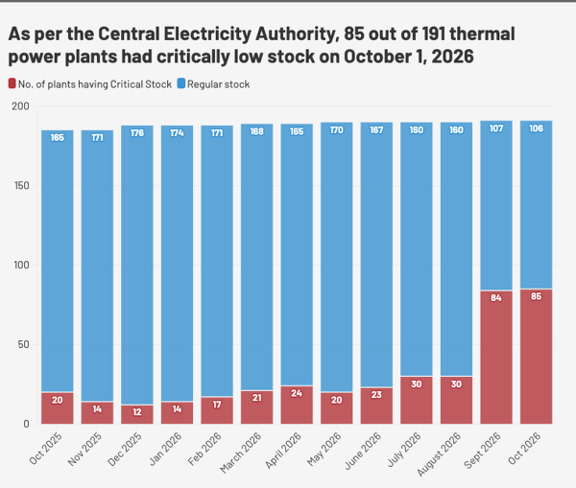
The CEA classifies a thermal power plant as having critically low coal stocks when its inventory falls below 25% of the required normative stock or is sufficient for less than three days of power generation. The latest figures indicate pressure on coal availability at power plants, even as the government attributes the situation partly to higher electricity demand.
- Total thermal power plants monitored: 191
- Plants with critically low stocks: 84
- Share of affected plants: More than 44%
2. Rising Electricity Demand
India's electricity demand has increased because of economic activity and higher cooling requirements during periods of elevated temperatures. The International Energy Agency (IEA) has identified rising temperatures and greater ownership of cooling appliances as important factors driving electricity demand.
- Average maximum temperatures increased from 25.53°C in January 2025 to 35.97°C in April 2025.
- Greater use of fans and air conditioners increases electricity consumption.
- India recorded an all-time peak power demand of 270.8 GW on May 21, 2026.
Higher demand places additional pressure on coal-fired power plants when other sources of electricity generation are unable to meet the requirement.
3. Declining Hydroelectric Power and El Niño
India's dependence on coal-based thermal power has increased amid lower hydroelectric power generation. El Niño is the warming of the central and eastern equatorial Pacific Ocean. It can alter atmospheric circulation and weaken monsoon conditions in India, although its effects vary between years.
- Weaker rainfall can reduce water availability for hydroelectric power generation.
- Lower hydroelectric output can increase dependence on coal-fired power plants.
- India experienced its highest rainfall deficit for June since 2014, according to the rainfall data discussed in the report.
- The report also notes a pattern of weaker monsoons during years with strong El Niño events.
The combination of weaker hydroelectric generation and rising electricity demand can intensify pressure on coal stocks.
4. Importance of Coal in India's Energy Mix
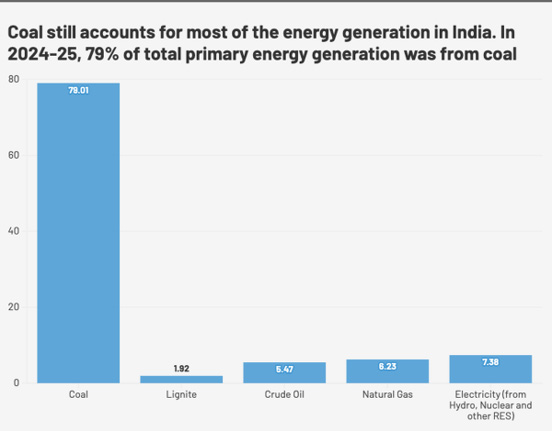
Coal remains a major source of electricity in India. According to the Energy Statistics India 2026 report of the Ministry of Statistics and Programme Implementation, coal accounted for 79% of total energy generated in 2024–25. Its importance makes coal availability crucial for maintaining reliable electricity supply.
- Energy security: Coal helps meet India's large electricity requirements.
- Industrial activity: Reliable electricity is essential for manufacturing and other economic activities.
- Grid reliability: Thermal power helps meet demand when renewable and hydroelectric generation are insufficient.
- Supply vulnerability: Heavy dependence on coal increases the impact of stock shortages and disruptions in fuel supply.
5. Rising Temperatures and Electricity Demand
India recorded its hottest August since nationwide record-keeping began in 1901, according to the India Meteorological Department (IMD).
- Average mean temperature in August 2026: 28.01°C.
- Normal average mean temperature: 27.34°C.
- Temperature above normal: 0.67°C.
Higher temperatures increase the need for cooling, particularly in homes, offices, and commercial establishments. This can raise electricity consumption and increase the operational pressure on thermal power plants.
6. Key Challenges
India's coal-stock situation reflects several interconnected challenges.
- Demand growth: Electricity demand is rising rapidly.
- Weather-related pressure: High temperatures increase cooling requirements, while weaker rainfall can affect hydroelectric generation.
- Dependence on coal: Coal's large contribution to electricity generation makes the power sector vulnerable to disruptions in coal availability.
- Supply security: Lower demand during cooler months may ease pressure on stocks, but it does not necessarily resolve underlying supply problems.
Way Forward
India needs to strengthen electricity planning to manage demand fluctuations and reduce pressure on coal stocks.
- Improve coal-stock monitoring and fuel-supply planning at thermal power plants.
- Strengthen coordination between coal production, transportation, and electricity generation.
- Expand renewable energy and improve energy storage.
- Improve the reliability of hydroelectric generation through better water-resource management.
- Promote energy efficiency and energy-efficient cooling appliances.
- Improve demand forecasting to prepare for heatwaves and seasonal changes in electricity consumption.
Conclusion
Critically low coal stocks at several thermal power plants highlight the challenge of meeting India's growing electricity demand. Rising temperatures and lower hydroelectric generation can increase dependence on coal-based power. While cooler weather may temporarily ease demand, long-term energy security requires reliable fuel supplies, better planning, energy efficiency, and diversification of electricity sources.
Test your understanding
Questions from this article
Prelims practiceQuestion: With reference to India’s Coal Reserves Under Pressure as Electricity Demand Increases, consider the following statements:
- India is facing pressure on its coal stocks as electricity demand rises and hydroelectric power generation declines
- Although the Union Coal Minister has denied a coal shortage, data from the Central Electricity Authority ( CEA ) show critically low coal stocks at several thermal power plants
Which of the statements given above is/are correct?
- 1 only
- 2 only
- Both 1 and 2
- Neither 1 nor 2
View answer and explanation
Suggested answer: (c) Both 1 and 2
Explanation: How rising electricity demand is putting pressure on India’s coal reserves, affecting power supply, energy security, and the country’s transition towards renewable energy
Mains practiceQuestion: Discuss India’s Coal Reserves Under Pressure as Electricity Demand Increases with reference to Why in the News?, 1. Coal Stock Position in Thermal Power Plants, 2. Rising Electricity Demand and 3. Declining Hydroelectric Power and El Niño. (150 words, 10 marks)
View answer-writing approach
Answer approach:
- Introduce the topic using its meaning and context.
- Explain Why in the News?, 1. Coal Stock Position in Thermal Power Plants, 2. Rising Electricity Demand and 3. Declining Hydroelectric Power and El Niño.
- Use facts and examples given in the article.
- Conclude with a balanced way forward.
Frequently asked questionsFrequently asked questions
What is India’s Coal Reserves Under Pressure as Electricity Demand Increases?
How rising electricity demand is putting pressure on India’s coal reserves, affecting power supply, energy security, and the country’s transition towards renewable energy
Why is India’s Coal Reserves Under Pressure as Electricity Demand Increases relevant for UPSC preparation?
Although the Union Coal Minister has denied a coal shortage, data from the Central Electricity Authority ( CEA ) show critically low coal stocks at several thermal power plants
What key points should aspirants remember about India’s Coal Reserves Under Pressure as Electricity Demand Increases?
The article covers Why in the News?, 1. Coal Stock Position in Thermal Power Plants, 2. Rising Electricity Demand and 3. Declining Hydroelectric Power and El Niño.