The Supreme Court has permitted the traditional Karthigai Deepam lamp to be lit at the Deepathoon, an ancient stone pillar on Thiruparankundram Hill in Madurai, Tamil Nadu, on November 24, 2026. The permission has been granted as an interim arrangement amid a dispute between Hindu worshippers and the Hazrat Sultan Sikandar Badusha Auliya Dargah over the ownership of the hilltop and the location of the religious ritual.
Why in the News?
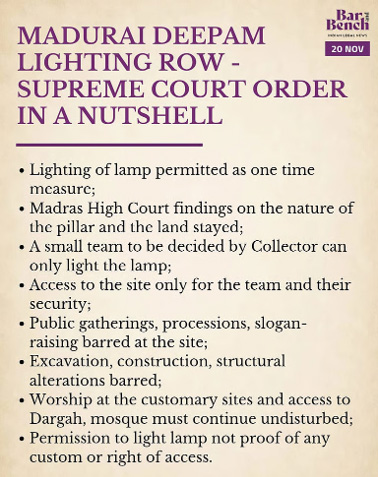
On November 20, 2026, the Supreme Court of India allowed a one-time lighting of the Karthigai Deepam lamp at the Deepathoon on November 24. A bench comprising Justices Aravind Kumar and Vipul M. Pancholi granted the interim permission.
- However, the court stayed portions of the Madras High Court judgment that had upheld the direction to restore the practice of lighting the lamp at the Deepathoon.
- The dispute concerns the location of the traditional lamp-lighting ceremony and ownership of the hilltop.
What is the Karthigai Deepam Dispute?
The controversy concerns where the traditional Karthigai Deepam lighting ceremony is held at the Arulmigu Subramaniaswamy Temple, Thiruparankundram. For decades, devotees have lit the festival lamp at the Deepa Mandapam, near the Uchipillaiyar temple on the hill's lower slopes.
- Hindu groups have demanded permission to light the lamp at the Deepathoon, an ancient stone pillar located higher up the hill.
- The stone pillar is approximately 50 metres from the dargah.
- The dispute has resulted in legal proceedings over:
- The location of the religious ritual.
- Ownership of the hilltop.
- The rights of the temple and the dargah.
Supreme Court Proceedings
The dargah opposed the demand to light the lamp at the Deepathoon, claiming ownership of the entire hilltop. Senior advocate Amit Anand Tiwari, representing the dargah, referred to a 1920 judicial order passed in a civil suit.
- He argued that the findings established that the flight of stairs from Nellithope to the hill belonged to the shrine.
- The dargah claimed that the entire hilltop, including the area containing the mosque, flagstaff and stone pillar, belonged to it.
- It opposed lighting the lamp at the stone pillar, irrespective of the distance between the pillar and the dargah.
Objections Raised by the Dargah Committee
Senior advocate Huzefa Ahmadi, appearing for the dargah committee, challenged the procedure followed by the Madras High Court. He raised two major objections:
- Inadequate opportunity to respond: The single-judge bench allegedly passed its order without giving the dargah sufficient time to file a reply under the High Court rules.
- Unnotified site visit: The judge conducted a site visit without informing the dargah before passing the order.
Position of the Tamil Nadu Government
The Tamil Nadu government opposed the demand to light the lamp near the dargah. It argued that permitting the ritual could create wider legal and administrative complications.
- The government also warned that allowing the practice could lead to thousands of survey pillars across the country acquiring a religious character.
- It expressed concerns over possible law-and-order challenges at a site with a history of communal tension.
Tamil Nadu Government Opposes ASI Takeover
The Tamil Nadu Hindu Religious and Charitable Endowments (HR&CE) Department opposed a petition seeking to bring the temple and the entire Thiruparankundram Hill under the control of the Archaeological Survey of India (ASI).
Arguments of the HR&CE Department
According to an affidavit filed before the Supreme Court by HR&CE Commissioner T. G. Vinay:
- The temple's ownership and existing religious practices had already been settled through decades of judicial proceedings.
- The hill was owned by the Arulmigu Subramaniaswamy Temple to the extent recognised by a civil court decree of 1923.
- This decree was subsequently restored by the Privy Council in 1931.
- The department argued that the settled ownership rights could not be disturbed through a petition without legal grounds.
Reliefs Opposed by the HR&CE Department
The department opposed three demands made by the petitioner, Hindu Dharma Parishad:
- Transfer of the entire temple and hill to the ASI.
- Keeping a lamp burning round the clock at the stone pillar known as the Deepathoon.
- Lighting the entire hill with lamps during the Karthigai Deepam festival.
Traditional Practice of Lamp Lighting
The HR&CE Department maintained that the festival lamp had traditionally been lit at the Deepa Mandapam, near the Uchipillaiyar temple.
- It stated that the traditional practice did not involve lighting the lamp at the hilltop or the stone pillar.
- The department also referred to historical records of attempts made in 1862 and 1912 to light lamps near the hill's summit, where the dargah is situated.
ASI's Role and Archaeological Protection
- The HR&CE Department argued that archaeological protection at Thiruparankundram covered only specified features, including:
- The rock-cut cave.
- Inscriptions.
- It maintained that this protection did not extend to the entire hill or the functioning temple.
Law-and-Order Concerns
The department warned that allowing lamps to be lit at multiple locations, particularly near the dargah, could disturb existing arrangements.
- It also cautioned that such permission could create law-and-order challenges due to the site's history of communal tension.
Important Institutions and Legal Provisions Involved
| Institution / Authority | Role in the Dispute |
| Supreme Court | Granted one-time interim permission for lamp lighting at the Deepathoon on November 24, 2026. |
| Madras High Court | Earlier upheld the direction to restore the practice of lighting the lamp at the Deepathoon. |
| HR&CE Department, Tamil Nadu | Manages the religious endowment and opposed the proposed ASI takeover. |
| Archaeological Survey of India (ASI) | Its proposed control over the temple and entire hill was opposed by the HR&CE Department. |
| Arulmigu Subramaniaswamy Temple | Hindu temple associated with the traditional Karthigai Deepam ceremony. |
| Hazrat Sultan Sikandar Badusha Auliya Dargah | Opposes lighting the lamp at the Deepathoon and claims ownership of the hilltop. |
Conclusion
The Thiruparankundram Karthigai Deepam dispute involves questions of religious practice, property ownership, judicial decisions, and administration of religious endowments. The Supreme Court's one-time permission provides an interim arrangement for November 24, 2026, while the wider dispute over the hilltop and the location of the ritual remains unresolved.
Test your understanding
Questions from this article
Prelims practiceQuestion: With reference to Indian secularism, consider the following statements:
- The Indian Constitution adopts the principle of strict separation of religion and State, prohibiting all State support to religious institutions.
- Articles 25–28 guarantee freedom of religion, but the State may impose reasonable restrictions on religious practices in the interests of public order, morality, and health.
- Under Indian secularism, the State is expected to treat all religions equally and may engage in religious reform or regulation without establishing any religion as the State religion.
- A religious practice is automatically protected under Article 25 if it is claimed to be essential to a religion.
Which of the statements given above are correct?
- 1 and 2 only
- 2 and 3 only
- 2, 3 and 4 only
- 1, 2, 3 and 4
View answer and explanation
Suggested answer: (b) 2 and 3 only
Explanation:
Statement 1 is incorrect: India follows positive secularism or “principled distance,” not absolute separation. The State can regulate secular aspects of religion, support religious institutions non-discriminatorily, and undertake social reform.
Statement 4 is incorrect: Not every claimed religious practice receives Article 25 protection. The Supreme Court has held that only practices integral or essential to the religion may qualify; the State can regulate practices linked to public order, health, morality, and other legitimate objectives.
Mains practiceQuestion: “The Deepathoon controversy illustrates that Indian secularism is not the absence of religion from public life, but the State’s principled distance from all religions.” In light of the Thiruparankundram Karthigai Deepam dispute, critically examine this statement. (250 words)
View answer-writing approach
Answer approach:
Intro: Indian secularism = equal respect +
State neutrality, not religion’s exclusion from public life.
Body:
●
Articles 25–26 protect religious
freedom.
●
The State can impose reasonable
restrictions for public order.
Deepathoon link: One-time SC permission
balances faith, public peace, and judicial caution.
Conclusion: Secularism means regulated coexistence, not
majoritarianism or blanket prohibition.
Frequently asked questionsFrequently asked questions
What is Karthigai Deepam Dispute- Supreme Court Verdict on Thiruparankundram Hill Lamp?
The Karthigai Deepam dispute as the Supreme Court permits one-time lamp lighting at Thiruparankundram Hill, examining the religious, legal, and constitutional issues
Why is Karthigai Deepam Dispute- Supreme Court Verdict on Thiruparankundram Hill Lamp relevant for UPSC preparation?
The permission has been granted as an interim arrangement amid a dispute between Hindu worshippers and the Hazrat Sultan Sikandar Badusha Auliya Dargah over the ownership of the hilltop and the location of the religious ritual
What key points should aspirants remember about Karthigai Deepam Dispute- Supreme Court Verdict on Thiruparankundram Hill Lamp?
The article covers Why in the News?, What is the Karthigai Deepam Dispute?, Supreme Court Proceedings and Objections Raised by the Dargah Committee.