The government is expected to introduce fresh Bills on delimitation and the implementation of women's reservation during the special session of Parliament beginning November 30, 2026. A major issue is the government's proposed use of the 2011 Census, even though the latest Census exercise is expected to be completed soon in most parts of the country.
Why in the News?
The Centre is expected to introduce fresh legislation on delimitation and women's reservation in the special sitting of Parliament beginning November 30, 2026. The government is considering using the 2011 Census as the basis for delimitation instead of waiting for the latest Census data.
- The proposed legislation may provide for a uniform 50% increase in Lok Sabha seats across States.
- This could address concerns raised by Opposition parties, particularly those from southern States, about changes in their relative political representation.
- However, questions remain about why the government wants to use older population data when a new Census is due.
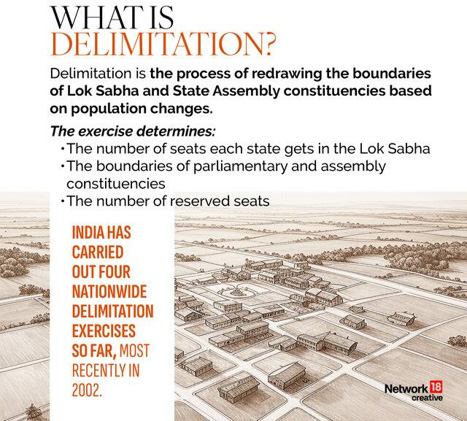
1. What is Delimitation?
Delimitation refers to the process of fixing or redrawing the boundaries of electoral constituencies. It may also involve changing the number of seats allocated to different States.
- Its main objective is to ensure fair representation by maintaining a reasonable balance between population and elected representatives.
Two Types of Readjustment Under the Constitution
The Constitution provides for two kinds of readjustment:
| Constitutional Provision | Purpose |
| Article 81(2)(a) | Provides for the allocation of Lok Sabha seats among States to ensure, as far as practicable, a uniform population-to-seat ratio across the country, subject to exceptions for certain smaller States. |
| Article 81(2)(b) | Seeks to maintain a similar level of population-based representation among constituencies within individual States. |
Why Has the Allocation of Seats Among States Been Frozen?
The allocation of Lok Sabha seats among States has effectively remained frozen since 1976. The objective was to ensure that States which successfully controlled population growth did not lose their political representation.
- The allocation of seats among States continues to be broadly based on the 1971 Census.
- However, constituency boundaries in most parts of the country were last redrawn using the 2001 Census.
Proposed 50% Increase in Lok Sabha Seats
The government is expected to address concerns about unequal representation by proposing a uniform 50% increase in Lok Sabha seats across States.
Examples:
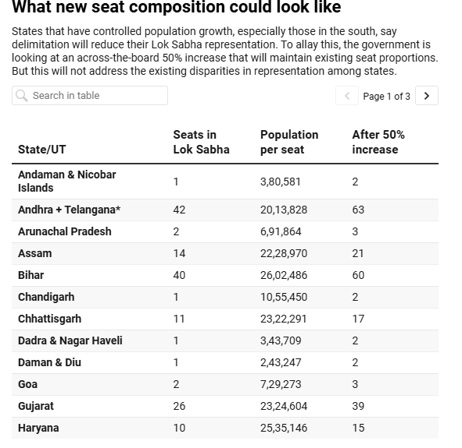
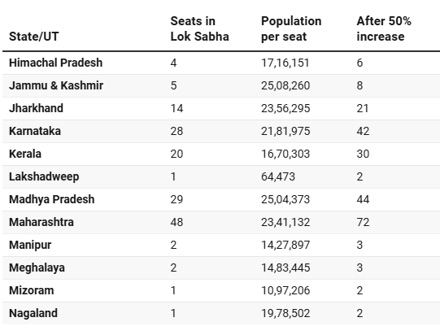
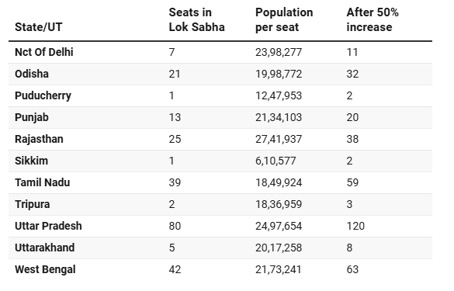
Impact of the Proposed Increase:
It would reduce the number of people represented by an individual Member of Parliament (MP). However, it would not remove the existing differences in population-to-seat ratios among States.
- Even using the 2011 Census, after the proposed increase, the population represented by an average MP in Bihar would be around 17.35 lakh, compared to 11.14 lakh in Kerala.
Why Is the Latest Census Still Important?
If the allocation of seats among States is decided independently of their current population, the main purpose of using a fresh Census would be to:
- Determine where additional constituencies should be created within each State.
- Decide how many constituencies should be reserved for Scheduled Castes (SCs) and Scheduled Tribes (STs).
- Ensure that constituency boundaries reflect the population distribution within States.
For these purposes, the latest available population data would normally be more suitable.
2. Why Does the Government Want to Use the 2011 Census?
The government's main objective is to implement the 33% reservation for women in the Lok Sabha and State Legislative Assemblies before the 2029 general election.
A. Link Between Women's Reservation and Delimitation
The Constitution (106th Amendment) Act, 2023 was passed by Parliament in September 2023. It provides for 33% reservation for women in the Lok Sabha and State Legislative Assemblies.
- However, its implementation is linked to a delimitation exercise following the first Census conducted after the enactment of the legislation.
B. Government's Argument: Time Constraints
On April 17, Union Home Minister Amit Shah argued in the Lok Sabha that delimitation after the fresh Census could not be completed before the 2029 general election.
- The process involves extensive public consultations and other administrative steps.
- Therefore, waiting for the latest Census data could delay the implementation of women's reservation.
C. Census Completion and Availability of Data Are Different
There is an important difference between completing Census enumeration and making detailed population data available for delimitation.
- India's first digital Census is expected to reduce the time required to process population data.
- Provisional population figures were expected to become available within 10 days of completing enumeration.
- Verification was expected to take another six months.
- However, delimitation requires detailed population data at the level of:
- Villages.
- Towns.
- Wards.
- Scheduled Caste and Scheduled Tribe populations.
D. Manipur-Related Delay
- Census operations in Manipur have been put on hold until April 30, 2027, following a High Court order.
- This creates an additional challenge in completing the Census process across the country.
E. Time Available for Delimitation
If a Delimitation Commission is constituted immediately after the passage of the Bills, it could get more than two years to complete the exercise using the 2011 Census.
- Waiting for detailed population figures from the 2027 Census could significantly reduce the time available before the 2029 general election.
Previous Experience:
The last nationwide delimitation exercise was initiated in 2002.
- It was completed in 2008.
- The process was interrupted by a change in the applicable Census and the 2004 general election.
3. What are the Problems With Using the 2011 Census?
Using older population data may create a mismatch between actual population distribution and political representation.
A. Changes in Population Distribution
The government itself highlighted uneven population growth and migration as important reasons for delimitation in the Statement of Objects and Reasons of the Delimitation Bill introduced in April.
- Migration, particularly from rural to urban areas, has changed population distribution across constituencies.
- Rapidly expanding metropolitan regions, satellite townships and industrial centres have attracted large populations since the 2011 Census.
Therefore, using the 2011 Census may not reflect the present population distribution accurately.
B. Example: Unequal Voter Distribution in Telangana
Election Commission data from the 2024 Lok Sabha elections indicates significant differences in the number of registered voters across constituencies.
| Constituency | Registered Voters |
| Malkajgiri, Telangana | 37.80 lakh |
| Hyderabad, Telangana | 22.17 lakh |
- Malkajgiri includes large parts of the Hyderabad metropolitan region.
- Between 2019 and 2024, Malkajgiri added more than 6.3 lakh electors.
- This indicates the rapid growth of population in certain urban constituencies.
Important: Electoral rolls cannot replace Census data. However, they can indicate demographic changes across constituencies.
C. Impact on the Distribution of Seats Within States
Consider a hypothetical State that receives 150 Assembly or parliamentary constituencies after delimitation.
- A region that accounted for 10% of the State's population in 2011 would be entitled to roughly 15 seats.
- If its share of the State's population increases to 15% by 2027, it could be entitled to around 22–23 seats based on the fresh Census.
Impact of Using the 2011 Census:
Fast-growing urban regions may receive fewer constituencies than their current population would justify. Areas with slower population growth may retain a relatively higher share of representation.
- The geographical distribution of political representation within States could be affected.
- The number and location of constituencies reserved for SCs and STs could also be influenced by outdated population proportions.
4. Will Another Delimitation Take Place After the 2027 Census?
This question is important because of the constitutional changes proposed in the Bills introduced in April 2026.
A. Constitution (131st Amendment) Bill, 2026
The Bill failed to secure the required majority in the Lok Sabha. It proposed removing the constitutional requirement of undertaking delimitation after every Census.
- It sought to amend Articles 81 and 82.
- The proposed changes would allow Parliament to decide through legislation:
- Which Census would form the basis of delimitation.
- When the delimitation exercise would be undertaken.
- Similar changes were proposed for State Legislative Assemblies.
B. Role of the Delimitation Bill
The accompanying Delimitation Bill defined the applicable Census by referring to the population figures published on the date of constitution of the Delimitation Commission.
- This meant that even if fresh Census figures became available while the Commission was working, there would be no automatic requirement to use them.
C. Implications of the Proposed Changes
If similar provisions are retained in the new Bills:
- There would be no constitutional requirement to undertake another delimitation immediately after the publication of the 2027 Census.
- Constituencies drawn using the 2011 Census could continue for several elections.
- Another delimitation exercise would depend on Parliament legislating for it.
Thus, the choice of Census could have long-term implications for political representation.
5. What Are the Political Calculations Behind Linking Women's Reservation and Delimitation?
The linking of women's reservation with delimitation has important political implications for different parties.
A. Electoral Advantage for the BJP
Implementing women's reservation before the 2029 general election would allow the BJP to present it as the fulfilment of a major promise of women's political empowerment.
- The party has consistently sought to build women as a distinct electoral constituency through welfare schemes and political messaging.
B. Political Positioning Against the Opposition
In April, Prime Minister Narendra Modi and Home Minister Amit Shah framed Opposition resistance to the delimitation package as opposition to women's reservation.
- Shah argued that Opposition parties could face the anger of women voters in subsequent elections.
C. Expansion of Lok Sabha Seats and Political Parties
Expanding the strength of the Lok Sabha before implementing women's reservation could reduce the pressure on political parties to deny tickets to existing legislators and aspirants.
Comparison of Existing and Proposed Lok Sabha Strength:
| Particulars | Existing Lok Sabha | Expanded Lok Sabha |
| Total Seats | 543 | 816 |
| Seats Reserved for Women (33%) | 181 | 272 |
| Seats Open to Candidates of Either Gender | 362 | 544 |
Why Is This Important?
- In the existing 543-member Lok Sabha, implementing 33% reservation would leave only 362 seats open to candidates of either gender.
- In an expanded Lok Sabha of 816 members, around 544 seats would remain open after reserving one-third of the seats for women.
- This would reduce competition for existing seats and lower the pressure on political parties to deny tickets to a large number of sitting MPs and aspirants.
Conclusion
Delimitation is essential for ensuring fair political representation. However, using the 2011 Census when newer population data is expected raises concerns about outdated constituency boundaries and unequal representation within States. At the same time, the government wants to implement 33% women's reservation before the 2029 general election. The challenge is to balance the timely implementation of women's reservation with accurate population-based representation, fair delimitation and public trust in the electoral process.