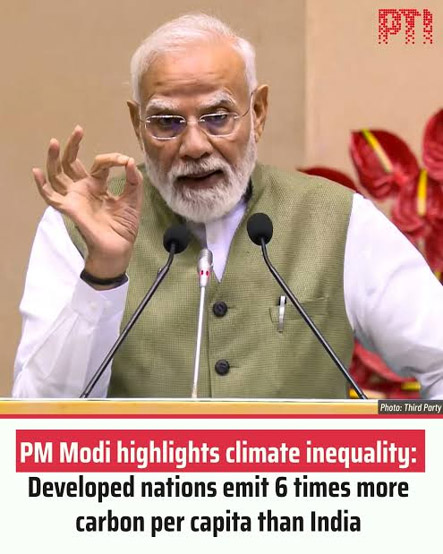
Climate change is a global concern, but all countries do not have the same level of carbon emissions or development needs. India has highlighted the importance of looking at per-capita emissions while discussing climate responsibility. The Prime Minister of India Narendra Modi addressed the National Green Tribunal (NGT) International Conference on “The Future of Environment and Climate Dynamics”. He highlighted the gap in per-capita carbon emissions between India and developed countries and outlined India’s progress in renewable energy and clean mobility.
India and Global Carbon Emissions
India has highlighted the difference in per-capita emissions between developing and developed countries. At the same time, the country is expanding non-fossil fuel energy capacity while continuing its development process.
Per-capita emissions
Per-capita emissions show how much carbon dioxide is emitted on average by each person. India has highlighted this difference while discussing the responsibility of different countries in tackling climate change.
India’s per-capita carbon emissions are less than half the global average.
Per-capita carbon emissions in developed countries are six times higher than India’s.
PM Modi highlighted that the responsibility for carbon emissions is often placed on developing countries, despite differences in per-capita emissions.
India’s climate approach
India is increasing its non-fossil fuel energy capacity while continuing its development process. The country has also highlighted its progress towards its international climate commitments.
PM Modi stated that India was the only G20 country to have fulfilled its COP21 Paris climate commitments ahead of schedule.
India’s Progress in Renewable Energy
Renewable energy is an important part of India’s climate approach. Solar energy has seen major growth, while India is also expanding wind and hydropower capacity.
Solar energy
Solar power has become one of the key areas of India’s renewable energy expansion. The increase in installed capacity reflects the growing role of solar energy in the country’s energy system.
KUSUM Yojana
The KUSUM Yojana connects renewable energy with agriculture by supporting the use of solar pumps. It can help farmers use solar energy for irrigation and reduce dependence on conventional power sources.
One Nation One Grid
A connected national power grid allows electricity to move between different parts of the country. It also supports better integration and use of renewable energy.
Solar-powered homes
India has also started a mission to make homes centres of solar power generation. The focus is on increasing the use of solar energy at the household level.
Clean Mobility and Transport
The transport sector is another important part of India’s climate efforts. India is expanding electric vehicles, metro rail, railway electrification and dedicated freight infrastructure to support cleaner and more efficient transport.
Electric Vehicles
Electric mobility has expanded significantly in India over the past decade. The rise in EV sales is part of the country’s efforts to promote cleaner mobility.
Metro Rail
Metro rail has expanded across Indian cities, providing an alternative to private vehicles for urban travel. The growth of metro networks has also increased the reach of public transport.
Before 2014:
Currently:
Railways and freight transport
Railway electrification and dedicated freight corridors are important parts of India’s transport infrastructure. These measures can help reduce dependence on conventional fuels and improve the movement of goods.
100% railway electrification has been achieved.
Inland waterways have expanded.
Around 3,000 km of Dedicated Freight Corridor has been completed.
These measures are aimed at reducing fuel consumption.
Nuclear Energy
Nuclear energy is also being expanded as India looks to increase its electricity generation capacity. Nuclear power is being discussed alongside other low-carbon energy sources. PM Modi highlighted the opposition faced by some government nuclear initiatives through court cases. This reflects the wider challenge of balancing clean-energy expansion with environmental concerns.
India’s Global Environmental Initiatives
India has also promoted international cooperation on renewable energy, biofuels and biodiversity. These initiatives provide platforms for countries to work together on common environmental challenges.
Watch : Carbon Emission Responsibility
International Solar Alliance (ISA)
The International Solar Alliance focuses on the promotion of solar energy. It aims to strengthen international cooperation in the solar energy sector.
Global Biofuel Alliance (GBA)
The Global Biofuel Alliance focuses on cooperation in biofuels. It brings countries together to promote cooperation in this area.
International Big Cat Alliance (IBCA)
The International Big Cat Alliance focuses on big-cat conservation and biodiversity protection. It supports international cooperation for the conservation of big-cat species.
Climate Justice and Developing Countries
Climate change is also linked with questions of Equity and Efficiency. Developing countries have to address climate impacts while continuing to meet their development needs.
Key issues include:
Differences in per-capita emissions.
Development needs of developing countries.
Climate impacts faced by vulnerable countries.
Support through the loss and damage fund under the UN climate framework.
Role of Judiciary in Environmental Governance
The judiciary has an important role in dealing with environmental issues. Courts are increasingly looking at the relationship between environmental protection, development and climate-related rights.
CJI Surya Kant highlighted the changing approach of courts towards environmental issues.
From Conservation vs Development to Sustainable Development
The traditional debate often looked at conservation and development as competing goals. The focus is now increasingly on finding ways to balance development with environmental protection.
The debate is no longer simply:
Instead, the focus should be on:
Environmental Rights and Climate-related Rights
Climate change is also bringing new questions about rights and human well-being. Environmental protection is closely connected with people’s health, livelihoods and quality of life.
CJI Surya Kant highlighted the shift from:
He also emphasised that the environment is closely connected with human well-being.
NGT and Sustainable Development
The National Green Tribunal plays an important role in India’s environmental governance. The conference brought together major constitutional and environmental institutions to discuss climate change and sustainable development.
The conference included:
Chief Justice of India Surya Kant
Environment Minister Bhupender Yadav
Attorney General R. Venkataramani
NGT Chairperson Justice Prakash Shrivastava
Sustainable Development vs Unsustainable Development
The discussion focused on the need to combine development with environmental protection. Environment Minister Bhupender Yadav stated that the real choice is not between development and the environment.
He stated that the real choice is:
Biodiversity Conservation
Climate action also includes protecting biodiversity and wildlife. India has several important species that require conservation and protection of their habitats.
India’s environmental efforts also include protection of:
Tigers
Elephants
Lions
Great Indian Bustard
Vultures
Conclusion
India’s climate approach includes renewable energy expansion, clean mobility, biodiversity conservation and sustainable development. The NGT conference also highlighted the importance of climate justice, differences in per-capita emissions and the growing role of the judiciary in environmental governance.
Frequently asked questionsFrequently asked questions
What is Carbon Emission Responsibility- India Highlights Low Per-Capita Emissions?
Prime Minister Modi addressed the National Green Tribunal. At the NGT International Conference on The Future of Environment and Climate Dynamics, Prime Minister Narendra Modi highlighted the difference in per-capita carbon emissions between India and developed countries
Why is Carbon Emission Responsibility- India Highlights Low Per-Capita Emissions relevant for UPSC preparation?
At the NGT International Conference on The Future of Environment and Climate Dynamics, Prime Minister Narendra Modi highlighted the difference in per-capita carbon emissions between India and developed countries
What key points should aspirants remember about Carbon Emission Responsibility- India Highlights Low Per-Capita Emissions?
The article covers India and Global Carbon Emissions, India's Progress in Renewable Energy, Clean Mobility and Transport and Nuclear Energy.