The Cabinet Committee on Economic Affairs (CCEA) has approved higher Minimum Support Prices (MSP) for all mandated Rabi crops for the 2027-28 Marketing Season. The increase aims to provide remunerative prices to farmers and encourage cultivation of crops such as pulses and oilseeds. The highest increase is for safflower, followed by rapeseed & mustard and lentil (masur).

Why in the News?
The government approved the revised MSP for six Rabi crops for the 2027-28 Marketing Season.
- Safflower: MSP increased by ₹675/quintal.
- Rapeseed & Mustard: Increased by ₹413/quintal.
- Lentil (Masur): Increased by ₹390/quintal.
- Barley: Increased by ₹136/quintal.
- Gram: Increased by ₹83/quintal.
- Wheat: Increased by ₹25/quintal.
MSP for Rabi Crops 2027-28
The revised MSPs provide different margins over the estimated cost of production.
| Crop | MSP 2027-28 (₹/quintal) | Increase (₹/quintal) | Margin over Cost |
|---|
| Wheat | 2,610 | 25 | 106% |
| Barley | 2,286 | 136 | 58% |
| Gram | 5,958 | 83 | 59% |
| Lentil (Masur) | 7,390 | 390 | 92% |
| Rapeseed & Mustard | 6,613 | 413 | 96% |
| Safflower | 7,215 | 675 | 50% |
MSP and the 1.5 Times Cost Principle
The revised MSPs are in line with the Union Budget 2018-19 announcement that Minimum Support Prices (MSP) should be fixed at least 1.5 times the All-India weighted average Cost of Production. The expected margins over cost for the 2027-28 Rabi crops are:
- Wheat: 106%
- Rapeseed & Mustard: 96%
- Lentil: 92%
- Gram: 59%
- Barley: 58%
- Safflower: 50%
The higher MSPs for pulses and oilseeds are also intended to encourage crop diversification beyond cereals.
MSP and Crop Diversification
The Government of India has been using MSP to encourage farmers to cultivate crops other than cereals, particularly pulses and oilseeds. This is important because diversification can help reduce excessive dependence on a limited number of crops and support the availability of important food commodities.
Procurement and MSP Payments
Government procurement of Rabi crops has increased significantly over the years.
- Wheat procurement during 2014-15 to 2025-26 reached 3,715 LMT, compared with 2,254 LMT during 2004-05 to 2013-14.
- Procurement of the six Rabi crops increased to 3,921 LMT, compared with 2,302 LMT during the earlier period.
- MSP payments to wheat farmers during 2014-15 to 2025-26 reached ₹7.31 lakh crore.
- MSP payments for the six Rabi crops reached ₹8.36 lakh crore during the same period.
What is Minimum Support Price (MSP)?
MSP is a government-announced price intended to provide farmers protection when market prices fall. It provides price support and encourages production of key agricultural commodities.
- The government announces MSPs before the Kharif and Rabi seasons.
- The Commission for Agricultural Costs and Prices (CACP) recommends MSPs, which the CCEA then approves.
Crops Covered Under MSP
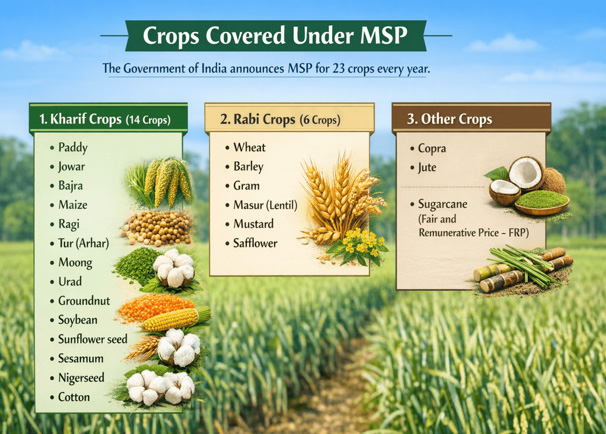
The government fixes MSP for 22 mandated crops + 1 Sugarcane (Fair & Remunerative Price - FRP). These include:
- 14 Kharif crops
- 6 Rabi crops
- 2 commercial crops
MSP is also determined for Toria and de-husked coconut based on the MSPs of rapeseed & mustard and copra, respectively.
Kharif Crops
The major Kharif crops covered under MSP include:
- Paddy
- Jowar
- Bajra
- Ragi
- Maize
- Tur
- Moong
- Urad
- Groundnut
- Sunflower seed
- Soyabean
- Sesamum
- Nigerseed
- Cotton
Rabi Crops
The six Rabi crops are:
- Wheat
- Barley
- Gram
- Masur (Lentil)
- Rapeseed & Mustard
- Safflower
Commercial Crops
How is MSP Determined?
The CACP considers several economic and agricultural factors while recommending MSP. The objective is to balance farmers’ interests with market and economic conditions. Major considerations include:
- Cost of production
- Demand and supply
- Domestic and international market price trends
- Inter-crop price parity
- Terms of trade between agriculture and non-agricultural sectors
- Changes in input prices
- Input-output price relationships
- Industrial cost structure
- Cost of living
- Impact on subsidies
- Farmer income parity
A2+FL Formula
The source notes that MSP is calculated using the A2+FL cost concept.
- A2: Actual paid-out costs incurred by farmers.
- FL: Imputed value of family labour.
The 1.5-times principle is applied with reference to the All-India weighted average Cost of Production.
Importance of MSP
MSP provides farmers with a degree of price security and can reduce the risk of distress sales when market prices fall. It can also:
- Support farm incomes.
- Encourage production of essential crops.
- Contribute to food security.
- Protect against price fluctuations.
- Support rural livelihoods.
- Encourage cultivation of selected crops through differentiated price support.
Conclusion
The increase in MSP for Rabi crops for 2027-28 aims to provide farmers with remunerative prices while supporting crop diversification and food security. The relatively higher increases for safflower, rapeseed & mustard and lentil are particularly relevant for encouraging pulses and oilseeds. However, the effectiveness of MSP ultimately depends not only on announced prices but also on procurement, market access and farmers’ ability to realise these prices.
Test your understanding
Questions from this article
Prelims practiceQuestion: With reference to Cabinet Approves MSP for Rabi Crops for Marketing season 2027-28, consider the following statements:
- The Cabinet Committee on Economic Affairs (CCEA) has approved higher Minimum Support Prices (MSP) for all mandated Rabi crops for the 2027-28 Marketing Season
- The increase aims to provide remunerative prices to farmers and encourage cultivation of crops such as pulses and oilseeds
Which of the statements given above is/are correct?
- 1 only
- 2 only
- Both 1 and 2
- Neither 1 nor 2
View answer and explanation
Suggested answer: (c) Both 1 and 2
Explanation: Rabi MSP 2027-28. Here know the new Minimum Support Prices approved by the Cabinet, crop-wise MSP rates, key highlights, and significance for indian farmers
Mains practiceQuestion: Discuss Cabinet Approves MSP for Rabi Crops for Marketing season 2027-28 with reference to Why in the News?, MSP and the 1.5 Times Cost Principle, MSP and Crop Diversification and Procurement and MSP Payments. (150 words, 10 marks)
View answer-writing approach
Answer approach:
- Introduce the topic using its meaning and context.
- Explain Why in the News?, MSP and the 1.5 Times Cost Principle, MSP and Crop Diversification and Procurement and MSP Payments.
- Use facts and examples given in the article.
- Conclude with a balanced way forward.
Frequently asked questionsFrequently asked questions
What is Cabinet Approves MSP for Rabi Crops for Marketing season 2027-28?
Rabi MSP 2027-28. Here know the new Minimum Support Prices approved by the Cabinet, crop-wise MSP rates, key highlights, and significance for indian farmers
Why is Cabinet Approves MSP for Rabi Crops for Marketing season 2027-28 relevant for UPSC preparation?
The increase aims to provide remunerative prices to farmers and encourage cultivation of crops such as pulses and oilseeds
What key points should aspirants remember about Cabinet Approves MSP for Rabi Crops for Marketing season 2027-28?
The article covers Why in the News?, MSP and the 1.5 Times Cost Principle, MSP and Crop Diversification and Procurement and MSP Payments.