UPSC Current Affairs
Minimum Support Price: Calculation, Crops and Issues
Minimum Support Price is an announced floor price intended to protect farmers against a sharp fall in market prices for selected crops. Its calculation, procurement coverage, relation to sugarcane pricing and impact on cropping patterns remain central agricultural-policy questions.
VRAuthor Desk
6 min read
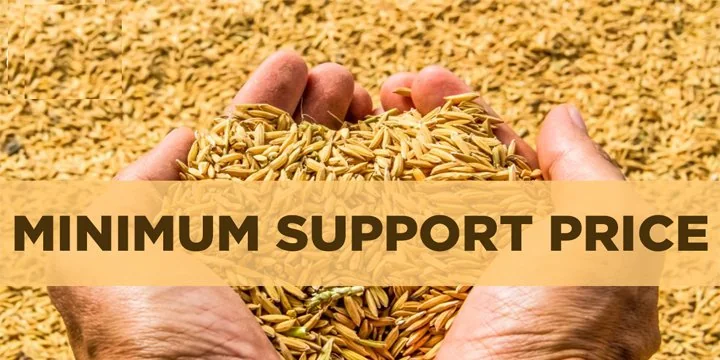
In brief: Minimum Support Price is an announced floor price intended to protect farmers against a sharp fall in market prices for selected crops. Its calculation, procurement coverage, relation to sugarcane pricing and impact on cropping patterns remain central agricultural-policy questions.
Minimum Support Price is an announced floor price intended to protect farmers against a sharp fall in market prices for selected crops. Its calculation, procurement coverage, relation to sugarcane pricing and impact on cropping patterns remain central agricultural-policy questions.
About:
- Minimum Support Price (MSP) is a form of market intervention by the Government of India to insure agricultural producers against any sharp fall in farm prices.
- The minimum support prices are announced by the Government of India at the beginning of the sowing season for certain crops on the basis of the recommendations of the Commission for Agricultural Costs and Prices (CACP).
- MSP is price fixed by Government of India to protect the producer - farmers - against excessive fall in price during bumper production years.
- The minimum support prices are a guarantee price for their produce from the Government.
- The major objectives are to support the farmers from distress sales and to procure food grains for public distribution.
- In case the market price for the commodity falls below the announced minimum price due to bumper production and glut in the market, government agencies purchase the entire quantity offered by the farmers at the announced minimum price.
Determination of MSP: In formulating the recommendations in respect of the level of minimum support prices and other non-price measures, the Commission takes into account, apart from a comprehensive view of the entire structure of the economy of a particular commodity or group of commodities, the following factors:-
- Cost of production
- Changes in input prices
- Input-output price parity
- Trends in market prices
- Demand and supply
- Inter-crop price parity
- Effect on industrial cost structure
- Effect on cost of living
- Effect on general price level
- International price situation
- Parity between prices paid and prices received by the farmers.
- Effect on issue prices and implications for subsidy
Pricing policy for sugarcane:
- The pricing of sugarcane is governed by the statutory provisions of the Sugarcane (Control) Order, 1966 issued under the Essential Commodities Act (ECA), 1955.
The CACP is required to pay due regard to the statutory factors listed in the Control Order, which are
- the cost of production of sugarcane;
- the return to the grower from alternative crops and the general trend of prices of agricultural commodities;
- the availability of sugar to the consumers at a fair price;
- the price of sugar;
- the recovery rate of sugar from sugarcane;
- the realization made from sale of by-products viz. molasses, bagasse and press mud or their imputed value (inserted in December, 2008) and;
- reasonable margins for growers of sugarcane on account of risk and profits (inserted in October, 2009).
- States also announce a price called the State Advisory Price (SAP), which is usually higher than the SMP.
Crops covered:
- Government announces minimum support prices (MSPs) for 22 mandated crops and fair and remunerative price (FRP) for sugarcane.
- The mandated crops are 14 crops of the kharif season, 6 rabi crops and two other commercial crops.
- In addition, the MSPs of toria and de-husked coconut are fixed on the basis of the MSPs of rapeseed/mustard and copra, respectively.
The list of crops are as follows:
- Cereals (7) - paddy, wheat, barley, jowar, bajra, maize and ragi
- Pulses (5) - gram, arhar/tur, moong, urad and lentil
- Oilseeds (8) - groundnut, rapeseed/mustard, toria, soyabean, sunflower seed, sesamum, safflower seed and nigerseed
- Raw cotton
- Raw jute
- Copra
- De-husked coconut
- Sugarcane (Fair and remunerative price)
- Virginia flu cured (VFC) tobacco
Syllabus: Prelims
Context:
- The Cabinet Committee on Economic Affairs (CCEA), chaired by Prime Minister approved raising minimum support prices (MSP) of kharif crops for the 2023-24 marketing season.
- The hike in MSP will “ensure remunerative prices to the growers for their produce and encourage crop diversification.”
About MSP:
- Minimum Support Price (MSP) is a form of market intervention by the Government of India to insure agricultural producers against any sharp fall in farm prices.
- The minimum support prices are announced by the Government of India at the beginning of the sowing season for certain crops on the basis of the recommendations of the Commission for Agricultural Costs and Prices (CACP).
- MSP is price fixed by Government of India to protect the producer - farmers - against excessive fall in price during bumper production years.
- The minimum support prices are a guarantee price for their produce from the Government.
- The major objectives are to support the farmers from distress sales and to procure food grains for public distribution.
- In case the market price for the commodity falls below the announced minimum price due to bumper production and glut in the market, government agencies purchase the entire quantity offered by the farmers at the announced minimum price.
Determination of MSP:
- In formulating the recommendations in respect of the level of minimum support prices and other non-price measures, the Commission takes into account, apart from a comprehensive view of the entire structure of the economy of a particular commodity or group of commodities, the following factors:-
- Cost of production
- Changes in input prices
- Input-output price parity
- Trends in market prices
- Demand and supply
- Inter-crop price parity
- Effect on industrial cost structure
- Effect on cost of living
- Effect on general price level
- International price situation
- Parity between prices paid and prices received by the farmers.
- Effect on issue prices and implications for subsidy
Pricing policy for sugarcane:
- The pricing of sugarcane is governed by the statutory provisions of the Sugarcane (Control) Order, 1966 issued under the Essential Commodities Act (ECA), 1955.
- The Sugarcane (Control) Order, 1966 was amended in October, 2009 and the concept of SMP was replaced by the Fair and Remunerative Price (FRP) of sugarcane.
- States also announce a price called the State Advisory Price (SAP), which is usually higher than the SMP.
Crops covered under MSP:
- Government announces minimum support prices (MSPs) for 22 mandated crops and fair and remunerative price (FRP) for sugarcane.
- The mandated crops are 14 crops of the kharif season, 6 rabi crops and two other commercial crops.
- In addition, the MSPs of toria and de-husked coconut are fixed on the basis of the MSPs of rapeseed/mustard and copra, respectively.
The list of crops are as follows. - Cereals (7) - paddy, wheat, barley, jowar, bajra, maize and ragi
- Pulses (5) - gram, arhar/tur, moong, urad and lentil
- Oilseeds (8) - groundnut, rapeseed/mustard, toria, soyabean, sunflower seed, sesamum, safflower seed and nigerseed
- Raw cotton
- Raw jute
- Copra
- De-husked coconut
- Sugarcane (Fair and remunerative price)
- Virginia flu cured (VFC) tobacco
Syllabus: Prelims; Agriculture
Why This Topic Matters for UPSC
- Prelims: Revise definitions, institutions, locations, reports and factual features connected with Minimum Support Price: Calculation, Crops and Issues.
- Mains: Link the topic with Agriculture, Economy, Government Policy and organise the answer under background, significance, challenges and way forward.
- Interview: Explain the issue in balanced language and distinguish verified facts from opinion.
Key Takeaway
Minimum Support Price is an announced floor price intended to protect farmers against a sharp fall in market prices for selected crops. Its calculation, procurement coverage, relation to sugarcane pricing and impact on cropping patterns remain central agricultural-policy questions.
- Prelims: Revise the key facts and terminology.
- Mains: Connect the topic with Agriculture, Economy, Government Policy.
- Revision: Prepare notes under background, features, significance, challenges and way forward.
Test your understanding
Questions from this article
Prelims practiceWith reference to Minimum Support Price, consider the following statements:
- Minimum Support Price (MSP) is a form of market intervention by the Government of India to insure agricultural producers against any sharp fall in farm prices.
- The minimum support prices are announced by the Government of India at the beginning of the sowing season for certain crops on the basis of the recommendations of the Commission for Agricultural Costs and Prices (CACP).
- MSP is price fixed by Government of India to protect the producer - farmers - against excessive fall in price during bumper production years.
Which of the statements given above are correct?
- 1 and 2 only
- 2 and 3 only
- 1 and 3 only
- 1, 2 and 3
View answer
Answer: (d) 1, 2 and 3. All three statements are drawn from the article.
Mains practiceDiscuss the background, key issues and significance of Minimum Support Price for India.
Answer in 250 words.
View answer approach
- About:
- Pricing policy for sugarcane:
- Crops covered:
- The list of crops are as follows:
Frequently asked questionsFrequently asked questions
What is Minimum Support Price?
Minimum Support Price is an announced floor price intended to protect farmers against a sharp fall in market prices for selected crops. Its calculation, procurement coverage, relation to sugarcane pricing and impact on cropping patterns remain central agricultural-policy questions.
Why is Minimum Support Price important for UPSC?
It connects current developments with Agriculture, Economy, Government Policy and supports factual revision as well as analytical answer writing.
How should aspirants prepare Minimum Support Price?
Prepare a short definition, key facts, institutional or legal framework, significance, challenges and a balanced way forward. Revise the specific developments and examples explained in the article.