The rapid growth of digital transactions has increased exposure to online scams and privacy risks. NCRB data shows that registered cybercrime cases increased by 17.9%, from 86,420 in 2023 to 1,01,928 in 2024, even as overall registered crime declined by 6%. A study by Lokniti-CSDS and Common Cause, covering 8,306 citizens across 16 States, provides further insight into the types of scams people encounter and the groups that are more exposed to cyber fraud.
Why in the News?
The study highlights the growing scale of cyber fraud and examines how digital participation, education and economic status affect exposure to financial fraud.
- Cybercrime cases increased by 17.9% between 2023 and 2024.
- 13% of respondents said they had been direct victims of cybercrime in the previous two to three years.
- People with higher levels of internet use reported greater exposure to scam attempts.
- Financial fraud was the most commonly reported form of cybercrime among victims.
Scale of Cyber Scams
The study found that citizens frequently encounter different types of scam calls and messages. Fraudsters often use familiar services, institutions, and relationships to make scams appear legitimate.
Frequently Encountered Scams
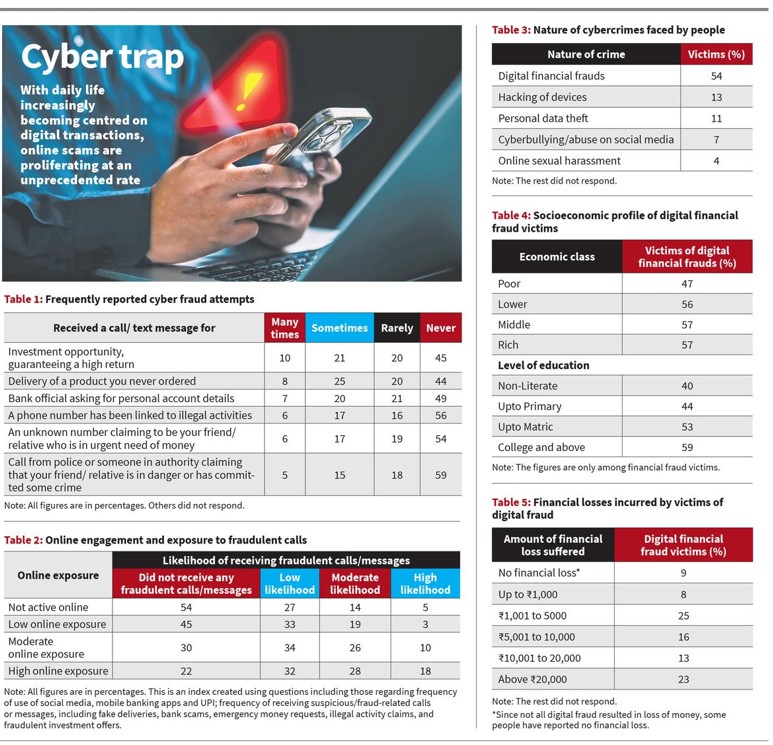
- Delivery scams: 33% frequently received calls about deliveries they had not ordered.
- Investment scams: 31% frequently received high-return investment offers.
- Bank impersonation: 27% frequently received calls asking for personal account details.
- Fake legal or police threats: 23% received calls claiming their phone was linked to illegal activities.
- Fake emergency calls: 23% received calls from unknown numbers claiming to be friends urgently needing money.
- Around 20% frequently received calls from police or other authorities claiming that a friend or relative was in danger or involved in a crime.
However, roughly half to six in ten respondents said they had never received these types of scam calls.
Which Country Ranks No. 1 in Cybercrime?
According to the first-ever World Cybercrime Index, developed by researchers from the University of Oxford and UNSW, Russia ranks first globally for overall cybercrime threat levels, highlighting its prominent position in the global cybercrime landscape.
Digital Exposure and Cyber Fraud
Greater use of the internet was associated with higher exposure to scams. People who spend more time online create a larger digital footprint, giving fraudsters more opportunities to target them.
- Among high internet users:
- 18% reported high scam exposure.
- 28% reported moderate exposure.
- Among people who do not use the internet:
- 5% reported high exposure.
- 14% reported moderate exposure.
This shows that digital connectivity itself can increase exposure to fraud attempts.
How Fraudsters Exploit the Digital Footprint
Modern fraud often depends less on technical hacking and more on social engineering. Fraudsters use familiar institutions, relationships, and situations to make false claims appear genuine. Common methods include:
- Investment scams: Exploit the desire for quick financial gains.
- Delivery scams: Exploit trust in e-commerce.
- Bank impersonation: Use the credibility of financial institutions.
- Fake police calls: Use fear of authority.
- Fake emergency calls: Exploit personal relationships and urgency.
The common strategy is to make fraudulent communication appear familiar and legitimate.
Forms of Cybercrime Experienced
Around 13% of respondents reported being direct victims of cybercrime during the previous two to three years. Among these victims, financial fraud was the most common form.
Reported forms included:
- Financial fraud: 54%
- Device hacking: 13%
- Personal data theft: 11%
- Cyberbullying or social-media abuse: 7%
- Online sexual harassment: 4%
Who is More Vulnerable to Financial Fraud?
The study indicates that financial fraud is not limited to economically disadvantaged or less educated groups. People with greater financial resources and higher education levels also reported significant exposure to scams, including the growing Digital Arrest Scam, highlighting that anyone can become a target of cyber fraud.
- 57% of the wealthiest respondents were victims of financial fraud.
- Around 47% of economically disadvantaged respondents were victims.
- Among people without formal education, 40% reported financial fraud.
- Among college graduates, 59% reported financial fraud.
This suggests that fraudsters also target people based on their digital participation and access to financial resources, rather than only exploiting a lack of awareness.
Financial Impact of Cyber Fraud
Cyber fraud can cause significant financial losses for victims. The data shows that cyber fraud can impose a substantial financial burden on individuals.
- More than 80% of cybercrime victims reported some financial loss.
- 23% lost more than ₹20,000.
- 8% lost up to ₹1,000.
- 25% lost between ₹1,001 and ₹5,000.
- Around 29% lost between ₹5,000 and ₹20,000.
Conclusion
The growing use of digital services has created new opportunities for economic activity but has also expanded the attack surface for cyber fraud. The evidence shows that both highly connected and financially vulnerable groups can face significant risks. Tackling cyber fraud therefore requires stronger digital awareness, data protection, institutional safeguards and effective reporting mechanisms, along with greater awareness of social-engineering techniques used by fraudsters.
Test your understanding
Questions from this article
Prelims practiceQuestion: With reference to Who is more Vulnerable to Financial Fraud?, consider the following statements:
- The rapid growth of digital transactions has increased exposure to online scams and privacy risks
- NCRB data shows that registered cybercrime cases increased by 17.9%, from 86,420 in 2023 to 1,01,928 in 2024, even as overall registered crime declined by 6%
Which of the statements given above is/are correct?
- 1 only
- 2 only
- Both 1 and 2
- Neither 1 nor 2
View answer and explanation
Suggested answer: (c) Both 1 and 2
Explanation: Learn who is most vulnerable to cyber fraud, including seniors, students, online shoppers, and digital payment users, along with key risks and prevention tips
Mains practiceQuestion: Discuss Who is more Vulnerable to Financial Fraud? with reference to Why in the News?, Scale of Cyber Scams, Frequently Encountered Scams and Which Country Ranks No. 1 in Cybercrime?. (150 words, 10 marks)
View answer-writing approach
Answer approach:
- Introduce the topic using its meaning and context.
- Explain Why in the News?, Scale of Cyber Scams, Frequently Encountered Scams and Which Country Ranks No. 1 in Cybercrime?.
- Use facts and examples given in the article.
- Conclude with a balanced way forward.
Frequently asked questionsFrequently asked questions
What is Who is more Vulnerable to Financial Fraud??
Learn who is most vulnerable to cyber fraud, including seniors, students, online shoppers, and digital payment users, along with key risks and prevention tips
Why is Who is more Vulnerable to Financial Fraud? relevant for UPSC preparation?
NCRB data shows that registered cybercrime cases increased by 17.9%, from 86,420 in 2023 to 1,01,928 in 2024, even as overall registered crime declined by 6%
What key points should aspirants remember about Who is more Vulnerable to Financial Fraud??
The article covers Why in the News?, Scale of Cyber Scams, Frequently Encountered Scams and Which Country Ranks No. 1 in Cybercrime?.