UPSC Current Affairs
Healthcare in India: Evolution, Financing and Challenges
India's healthcare system combines a long medical tradition with a large modern public and private delivery network. This guide connects its historical foundations with present questions of financing, access, quality, workforce, infrastructure and financial protection.
VRAuthor Desk
8 min read
In brief: India's healthcare system combines a long medical tradition with a large modern public and private delivery network. This guide connects its historical foundations with present questions of financing, access, quality, workforce, infrastructure and financial protection.
India's healthcare system combines a long medical tradition with a large modern public and private delivery network. This guide connects its historical foundations with present questions of financing, access, quality, workforce, infrastructure and financial protection.
HEALTHCARE FINANCING
Government Spending:
- The Health Ministry has been allocated ₹90,958.63 crore in the 2024-2025 budget, an increase from ₹80,517.62 crore in the 2023-24 revised estimates.
- Government health expenditure in India increased to 1.9% of GDP in 2023-24, up from 1.28% in 2018-19, as per the Economic Survey 2023-24.
- India spends about 1.3% to 1.9% of its GDP on public healthcare, which is far below the global average.
BUDGETARY ALLOCATION For the fiscal year 2024-25, the budget has increased the allocation for the
National Health Mission (NHM) by approximately
Rs 4,000 crore, raising the total from
Rs 31,550 crore to
Rs 36,000 crore. This increase aims to:
- Strengthen primary and secondary healthcare: NHM plays a pivotal role in providing accessible healthcare across rural and urban areas.
- Reduce out-of-pocket expenditure: By focusing on preventive and curative healthcare, the initiative aims to alleviate financial burdens on the public, particularly in underserved areas.
HEALTHCARE INFRASTRUCTURE India’s
healthcare infrastructure is underdeveloped, especially in rural areas, contributing to poor healthcare outcomes.
- Hospitals and Clinics: Most hospitals and medical colleges are concentrated in urban Rural areas have fewer hospitals, and many are inadequately equipped.
- Rural-Urban Disparity: Approximately 70% of India’s population lives in rural areas, but less than 40% of healthcare infrastructure is in these regions. There are fewer doctors and nurses in rural areas, and most healthcare professionals are located in urban centers.
Challenges:
- Inadequate sanitation, unreliable electricity, and poor infrastructure in remote areas lead to ineffective healthcare delivery.
- Long waiting times for treatment at public hospitals in cities further exacerbates the healthcare burden.
HEALTHCARE WORKFORCE India faces a
severe shortage of trained healthcare professionals:
- Doctors and Nurses: doctor-population ratio in the country is around 1:836 which is better than the WHO standard of 1:1000. But The number of nurses is also insufficient to meet demand, particularly in rural areas.
- Rural vs Urban Disparity: Most healthcare professionals prefer to work in urban areas, leaving rural areas severely underserved. This results in a brain drain, where the most talented healthcare workers are drawn to cities and abroad.
HEALTHCARE INDICATORS India has made progress in improving health outcomes, but challenges remain:
- Life Expectancy: As of 2024, life expectancy in India is around 67.7 years according to data from the World Bank, which indicates the average lifespan of a newborn child in India is currently estimated at 67.7 years.
- Maternal Mortality Rate (MMR): India has made significant progress in reducing its Maternal Mortality Ratio (MMR) from 384 in 2000 to 103 in 2020. However, it still lags behind many other countries.
- Infant Mortality Rate (IMR): India's infant mortality rate (IMR) in 2024 is 25.799 deaths per 1,000 live births, a 3.08% decline from 2023.
CHALLENGES IN HEALTHCARE SERVICES DELIVERY
Access and Inequality:
- The divide between urban and rural healthcare is the biggest challenge. Rural areas face long distances, high costs, and poor quality of care. Economic inequality also leads to a divide in access to healthcare between rich and poor.
Quality of Care:
- The quality of care in government hospitals is often subpar due to lack of resources, overcrowding, and outdated infrastructure. Meanwhile, private hospitals offer better quality but are often out of reach for lower-income groups.
Financial Barriers:
- Out-of-pocket spending remains high for the middle class, despite the government’s efforts to provide health coverage. Ayushman Bharat and other schemes are improving coverage, but affordability remains an issue for large sections of the population.
Workforce Issues:
- Shortage of trained professionals in rural areas is a critical barrier. The government has made efforts to address this with incentives and training programs, but it is still insufficient.
Infrastructure Gaps:
- Rural healthcare facilities lack essential equipment, and many remote areas do not have access to reliable health services. The COVID-19 pandemic has exposed the system’s weaknesses in terms of preparedness and the lack of effective healthcare infrastructure.
FUTURE OF HEALTHCARE IN INDIA
Government Policies and Initiatives:
- National Health Policy 2017 outlines a vision for Universal Health Coverage (UHC) and aims to strengthen the healthcare system. This policy encourages preventive care, improving health services, and increasing the availability of healthcare workers.
- Ayushman Bharat 2.0: The government plans to expand insurance schemes further and strengthen healthcare delivery at the grassroots level. There is a push for better infrastructure and enhanced medical facilities.
Telemedicine and Digital Health:
- The role of telemedicine and digital health is increasing, especially post-COVID-19. E-health records, mobile apps, and teleconsultations have made healthcare services more accessible, especially in remote areas.
Technological Advancements:
- AI and Machine Learning are transforming healthcare by helping doctors make accurate diagnoses and predicting disease outcomes.
- Digital Health Infrastructure: Investments in electronic health records (EHR), telemedicine, and online consultations are helping to improve healthcare accessibility and reduce patient waiting times.
RECOMMENDATIONS FOR STRENGTHENING HEALTHCARE SYSTEM
- Improving Access: Expand healthcare facilities in rural areas and strengthen transportation infrastructure to make healthcare more accessible.
- Enhancing Quality: Standardize healthcare quality across both public and private sectors. Provide incentives for healthcare professionals to work in rural areas.
- Increasing Financing: Increase government spending on healthcare, encourage public-private partnerships, and expand health insurance coverage.
- Focus on Preventive Care: Increase focus on prevention, including vaccination, anti-smoking campaigns, and lifestyle disease management.
- Promote Digital Healthcare: Invest in telemedicine and mobile health apps to improve access and healthcare delivery, especially in remote regions.
evolved over a long period of time, influenced by ancient traditions, foreign invasions, and modern developments.
HEALTHCARE IN ANCIENT PERIOD
Indus Valley Civilization (c. 3300–1300 BCE) - Advanced Knowledge: The Indus Valley Civilization, one of the earliest urban civilizations, had a high level of medical knowledge.
- Archaeological findings, such as surgical instruments and evidence of surgical practices, suggest that they practiced surgery and had an understanding of human anatomy.
- Public Health: The people of the Indus Valley built well-planned cities with drainage systems, which indicates their awareness of sanitation and public health.
The Vedic Period - Introduction of Ayurveda: During the Vedic period, the Aryans had knowledge of medicine, which was recorded in the Vedas (sacred texts).
- Among these, the Atharva Veda is particularly important as it includes hymns and prayers that describe treatments for various diseases and ways to prevent harm from natural disasters.
- The Ayurveda system of medicine emerged from these texts.
- The word "Ayurveda" comes from two Sanskrit words: 'Ayur' meaning life and 'Veda' meaning knowledge.
- Thus, Ayurveda is the "science of life," focusing on maintaining health and treating disease using natural methods.
- Concept of Health: The Vedic texts emphasized the balance of mind, body, and spirit for good
Key Medical Texts:
-
- Charaka Samhita: One of the most important texts of Ayurveda, which deals with internal medicine and discusses how to maintain good health and treat various diseases.
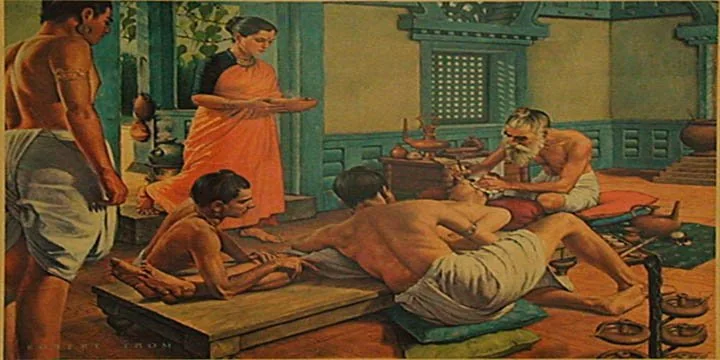
- Sushruta Samhita: Another foundational Ayurvedic text, written by the ancient physician Sushruta, is considered one of the earliest texts on surgery and the "father of surgery" in India.
- Sushruta made major contributions to surgery, especially in the fields of plastic surgery and surgical instruments.
- He is credited with pioneering procedures like nose reconstruction (a form of plastic surgery) and cataract surgery.
- He described over 300 surgical instruments used in various operations, making him one of the earliest surgeons in history.
Buddhist Period (563–477 BCE) - Lord Buddha’s Role in Medicine: Lord Buddha himself took a deep interest in the health and well-being of others.
- Hospitals in Monasteries: Buddha’s teachings included caring for the sick, which led to the creation of Buddhist Viharas (monasteries).
- These monasteries were not just centers for meditation but also places where the sick could be cared for. Medical education was an integral part of these centers.
King Ashoka and Hospitals (273–232 BCE) - Emperor Ashoka’s Contributions: During the reign of Emperor Ashoka, one of India’s greatest rulers, there was a notable effort to establish hospitals and care systems for the people.
- Ashoka built hospitals for the sick, especially to care for the poor and the handicapped.
- These hospitals were among the earliest forms of organized medical care in India.
- Ashoka’s support for health care was significant because it showed a royal commitment to the welfare of the common people, particularly those who could not afford treatment.
AYURVEDA: THE FOUNDATION OF INDIAN TRADITIONAL MEDICINE The foundation of
Indian traditional medicine, Ayurveda, focuses on achieving a balance between the
body’s three primary energies : Vata, Pitta, and Kapha. Ayurveda uses personalized treatments, including:
- Herbal Remedies: Use of plants and herbs like turmeric, ginger, and neem for medicinal purposes.
- Panchakarma: A therapeutic procedure to cleanse the body of toxins and restore balance.
- Diet and Lifestyle: Ayurveda emphasizes a balanced diet, proper sleep, exercise, and meditation for overall well-being.
Medicinal Plants and Natural Remedies - Ancient Indian medicine extensively used herbal remedies from plants. India’s vast biodiversity made it a hub for medicinal plants.
- Famous medicinal plants include Ashwagandha, Aloe Vera, Tulsi (Holy Basil), and Neem, all of which are still used in modern Ayurvedic treatments.
Why This Topic Matters for UPSC
- Prelims: Revise definitions, institutions, locations, reports and factual features connected with Healthcare in India: Evolution, Financing and Challenges.
- Mains: Link the topic with Health, Social Sector, Governance and organise the answer under background, significance, challenges and way forward.
- Interview: Explain the issue in balanced language and distinguish verified facts from opinion.
Key Takeaway
India's healthcare system combines a long medical tradition with a large modern public and private delivery network. This guide connects its historical foundations with present questions of financing, access, quality, workforce, infrastructure and financial protection.
- Prelims: Revise the key facts and terminology.
- Mains: Connect the topic with Health, Social Sector, Governance.
- Revision: Prepare notes under background, features, significance, challenges and way forward.
Test your understanding
Questions from this article
Prelims practiceWith reference to Healthcare In India, consider the following statements:
- Advanced Knowledge: The Indus Valley Civilization, one of the earliest urban civilizations, had a high level of medical knowledge.
- Archaeological findings, such as surgical instruments and evidence of surgical practices, suggest that they practiced surgery and had an understanding of human anatomy.
- Public Health: The people of the Indus Valley built well-planned cities with drainage systems, which indicates their awareness of sanitation and public health.
Which of the statements given above are correct?
- 1 and 2 only
- 2 and 3 only
- 1 and 3 only
- 1, 2 and 3
View answer
Answer: (d) 1, 2 and 3. All three statements are drawn from the article.
Mains practiceDiscuss the background, key issues and significance of Healthcare In India for India.
Answer in 250 words.
View answer approach
- HEALTHCARE IN ANCIENT PERIOD
- Key Medical Texts:
- body’s three primary energies : Vata, Pitta, and Kapha. Ayurveda uses personalized treatments, including:
- Note:
Frequently asked questionsFrequently asked questions
What is Healthcare in India?
India's healthcare system combines a long medical tradition with a large modern public and private delivery network. This guide connects its historical foundations with present questions of financing, access, quality, workforce, infrastructure and financial protection.
Why is Healthcare in India important for UPSC?
It connects current developments with Health, Social Sector, Governance and supports factual revision as well as analytical answer writing.
How should aspirants prepare Healthcare in India?
Prepare a short definition, key facts, institutional or legal framework, significance, challenges and a balanced way forward. Revise the specific developments and examples explained in the article.