Under the Constitution of India and the established Collegium system, the State Government has a limited consultative and procedural role in the appointment of a High Court Chief Justice. It cannot appoint, approve, reject, or veto a candidate recommended by the Supreme Court Collegium.
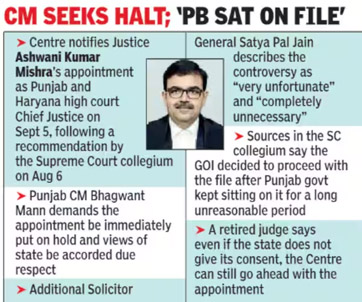
The Punjab government has objected to the appointment of the new chief justice of the Punjab and Haryana high court, saying that the government views were not awaited.
Why in the News?
- The Punjab Cabinet objected to the appointment of Justice Ashwani Kumar Mishra as Chief Justice of the Punjab and Haryana High Court.
- Punjab argued that the appointment was notified without adequately considering the State government’s views.
- The issue raises an important constitutional question: Does the State government have the power to approve or reject the appointment of a High Court Chief Justice?
Role of State Government
- The State government has a consultative role, but cannot appoint or veto the appointment.
- Under Article 217, a High Court judge is appointed by the President after consultation with:
- For judges other than the Chief Justice, the Chief Justice of that High Court is also consulted.
How Does the State Government Enter the Process?
- Under Article 163, the Governor ordinarily acts on the aid and advice of the State Council of Ministers.
- Therefore, the State government’s views can form part of the Governor’s consultation with the President.
- However, State government consent is not mandatory.
- Article 217 uses “consultation”, not “consent” or “approval”.
- Therefore: State Government Consultation → No Veto Power
Watch : Appointment of High Court Chief Justice
Evolution of Judicial Appointments
The appointment of High Court Chief Justices in India has evolved from executive-led appointments to a judiciary-driven collegium system, with the constitutional framework primarily governed by Article 217 of the constitution.
1. First Judges Case - 1981
S.P. Gupta v. Union of India
- The Supreme Court of India held that “consultation” does not mean “concurrence”.
- This gave the Executive greater influence in judicial appointments.
2. Second Judges Case - 1993
Supreme Court Advocates-on-Record Association v. Union of India
- Established the Collegium system.
- Gave primacy to the judiciary in judicial appointments.
- The CJI’s opinion was required to be an institutional opinion, formed with the two senior-most Supreme Court judges.
3. Third Judges Case - 1998
Re: Special Reference No. 1 of 1998
- Further clarified the Collegium system.
For Supreme Court appointments:
- CJI + 4 senior-most Supreme Court judges
For High Court appointments:
- CJI + 2 senior-most Supreme Court judges
Attempt to Replace the Collegium
National Judicial Appointments Commission (NJAC)
- In 2014, Parliament enacted:
- 99th Constitutional Amendment
- NJAC Act
- The proposed NJAC included:
- CJI
- Two senior-most Supreme Court judges
- Union Law Minister
- Two eminent persons
Supreme Court Decision – 2015
Supreme Court Advocates-on-Record Association v. Union of India
- The Supreme Court struck down the 99th Amendment and NJAC Act by 4:1 majority.
- It held that greater executive involvement could compromise judicial independence.
- Judicial independence was treated as part of the Basic Structure of the Constitution.
- The Collegium system was restored.
Present System
| Institution | Role |
|---|
| Collegium | Primacy in recommending judicial appointments |
| CJI | Leads the Supreme Court Collegium |
| President | Formally appoints High Court judges |
| Governor | Constitutional consultation channel |
| State Government | Provides views through the Governor |
| Union Executive | Processes appointments and formally advises the President |
| State Government | No veto power |
Key Constitutional Principle
The present appointment system seeks to balance:
- Judicial independence
- Executive/State consultation
The judiciary has primacy in recommending appointments, while the executive participates in the constitutional process.
Conclusion
The role of the state government in Punjab and Haryana High Court chief justice is an important constitutional process. Under the article 217 of the constitution, the chief justice is formally appointed by the president of India. The appointment follows the collegium system, in which the supreme court collegium recommends the name of a suitable judge. The state government does not have the power to appoint or reject the candidate. However, its role is mainly consultative. The views of the state government may be sought during the appointment process under the memorandum of procedure (MoP). The issue recently became controversial after the Punjab government raised objections over the appointment of the chief justice of the Punjab and Haryana high court, arguing that its views were not taken before the appointment. The controversy highlights an important question about the balance between the union and state governments in judicial appointments. It also shows the importance of consultation while maintaining the independence of the judiciary.
Test your understanding
Questions from this article
Prelims practiceQuestion: With reference to Appointment of High Court Chief Justice- Role of State Government, consider the following statements:
- Under the Constitution of India and the established Collegium system, the State Government has a limited consultative and procedural role in the appointment of a High Court Chief Justice
- It cannot appoint, approve, reject, or veto a candidate recommended by the Supreme Court Collegium
Which of the statements given above is/are correct?
- 1 only
- 2 only
- Both 1 and 2
- Neither 1 nor 2
View answer and explanation
Suggested answer: (c) Both 1 and 2
Explanation: Learn about the appointment of High Court Chief Justices, the role of the State Government, the constitutional process, consultation with the judiciary, and key provisions governing the appointment of Chief Justice of India
Mains practiceQuestion: Discuss Appointment of High Court Chief Justice- Role of State Government with reference to Why in the News?, Role of State Government, How Does the State Government Enter the Process? and Evolution of Judicial Appointments. (150 words, 10 marks)
View answer-writing approach
Answer approach:
- Introduce the topic using its meaning and context.
- Explain Why in the News?, Role of State Government, How Does the State Government Enter the Process? and Evolution of Judicial Appointments.
- Use facts and examples given in the article.
- Conclude with a balanced way forward.
Frequently asked questionsFrequently asked questions
What is Appointment of High Court Chief Justice- Role of State Government?
Learn about the appointment of High Court Chief Justices, the role of the State Government, the constitutional process, consultation with the judiciary, and key provisions governing the appointment of Chief Justice of India
Why is Appointment of High Court Chief Justice- Role of State Government relevant for UPSC preparation?
It cannot appoint, approve, reject, or veto a candidate recommended by the Supreme Court Collegium
What key points should aspirants remember about Appointment of High Court Chief Justice- Role of State Government?
The article covers Why in the News?, Role of State Government, How Does the State Government Enter the Process? and Evolution of Judicial Appointments.