UPSC Current Affairs
Youth Discontent and the Changing Face of Protest: Effects of Protests
Explore youth discontent and the changing face of protest, including its causes, digital activism, emerging movements, social impact, and role in shaping governance, democracy, and public policy.
VRArpit Adlakha
3 min read
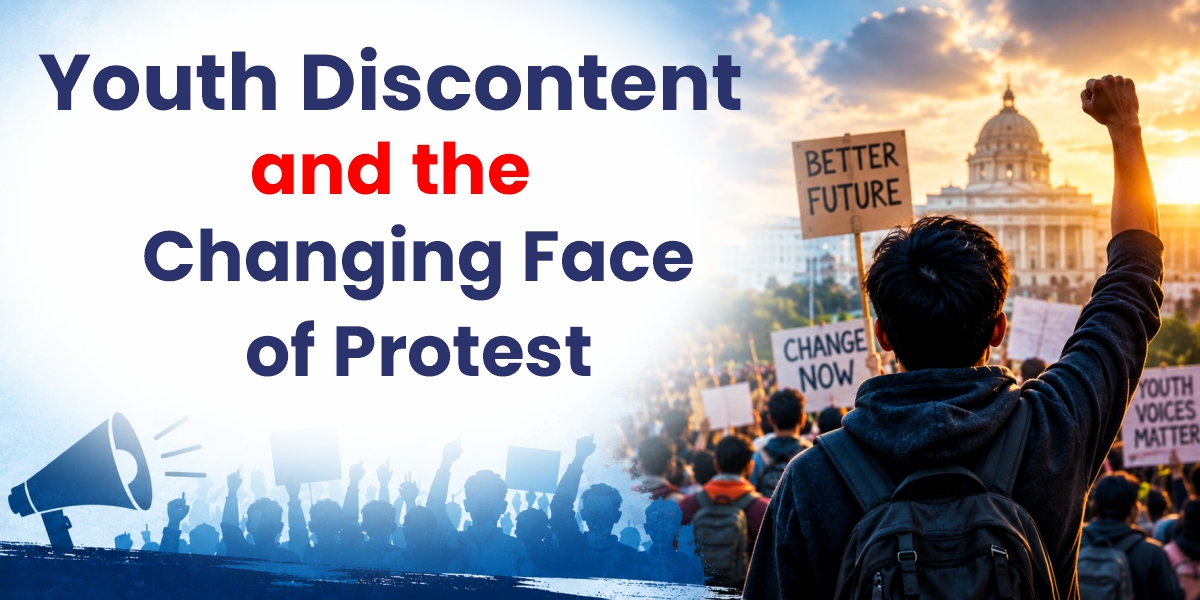
Student protests over examination and recruitment irregularities show growing concerns about unemployment, corruption, unfair practices and institutional failure. Social media helps local grievances reach a wider audience and can quickly increase public participation.
Why in the News?
- Youth-led protests are increasingly taking new forms, with Gen Z using digital platforms to mobilise and amplify dissent.
- Recent protests in India, Nepal and Bangladesh highlight growing youth dissatisfaction with governance, institutional performance and perceived inequality.
- In India, protests linked to examination and recruitment irregularities indicate growing frustration among students.
Changing Nature of Protests
- Earlier: Protests were generally organised through political parties, unions and established civil-society organisations.
- Emerging pattern: Youth-led protests are increasingly:
- Spontaneous
- Decentralised
- Digitally coordinated
- Less dependent on traditional political organisations.
- Social media enables protests to spread rapidly beyond their original location.
Major Drivers of Youth Discontent
1. Perceived Institutional Failure
- Young people may perceive institutions as unable to address:
- Examination irregularities
- Recruitment problems
- Corruption
- Poor public-service delivery.
- Perception of collusion or unfairness can intensify public anger.
2. Declining Institutional Trust
- Failure to respond effectively to grievances can deepen the belief that institutional safeguards are weakening.
- Excessive centralisation of power and authority may further contribute to such perceptions.
3. Governance Deficit
- When authorities fail to recognise or address legitimate grievances, relatively narrow protests can potentially expand into broader anti-establishment movements.
Watch : Youth Discontent and the Changing Face of Protest
Recent Indian Examples
Student Protests
- Student protests have emerged over examination and recruitment irregularities in several States.
- The article highlights protests in Jharkhand, Chhattisgarh and Bihar.
- The Cockroach Janta Party (CJP)-linked agitation and Jantar Mantar protest reflected youth anger over issues such as examination management.
Jharkhand
- The agitation over recruitment irregularities had a recognisable leadership.
- Devendranath Mahato undertook a hunger strike and was subsequently hospitalised.
- The State government's decision to scrap the examinations demonstrated the pressure created by the agitation.
Role of Social Media
- Rapid mobilisation: Grievances can reach large audiences quickly.
- Decentralised organisation: Protests can operate without traditional political structures.
- Narrative formation: Digital platforms influence how grievances are perceived and communicated.
- Wider participation: Local issues can acquire national visibility.
Digital platforms → rapid mobilisation → wider participation → potential escalation
Lessons from Nepal and Bangladesh
- Student and youth-led movements in Nepal and Bangladesh contributed to the removal of long-established regimes.
- The broader lesson is that prolonged youth dissatisfaction can become politically significant when combined with:
- Institutional failures
- Economic or social grievances
- Perceived suppression of dissent
- Weak political responsiveness.
State Response- Key Concern
- The article highlights the use of indiscriminate force against student protesters as a major concern.
- Excessive force can:
- Intensify resentment.
- Produce a backlash against authorities.
- Expand a limited grievance into a broader movement.
- At the same time, legitimate restrictions may be required when protests become violent or threaten public safety.
The ‘Single Spark’ Problem
- Localised grievances can sometimes connect with wider dissatisfaction.
- The article uses the historical spread of Naxalism as an illustration of how a movement can grow from relatively small beginnings into a major security challenge.
- Therefore, authorities need to distinguish between:
- Legitimate democratic dissent
- Violent or unlawful mobilisation
- Genuine security threats
Key Challenges
- Youth unemployment and recruitment concerns
- Examination irregularities
- Perceived corruption and favouritism
- Institutional distrust
- Centralisation of authority
- Excessive use of force
- Rapid digital mobilisation
- Possibility of different grievances converging into a broader movement
Key Significance
- Institutional responsiveness
- Address grievances quickly and transparently.
- Fair examinations and recruitment
- Strengthen examination security, accountability and grievance-redress mechanisms.
- Proportionate policing
- Use force only when necessary and proportionate to the situation.
- Dialogue with youth
- Establish institutional channels for regular engagement with students and young citizens.
- Digital governance
- Use social-media monitoring for early identification of grievances while protecting legitimate expression.
- Strengthen democratic institutions
- Preserve institutional checks and balances and public confidence in governance.
- Evidence-based policy
- Address the underlying causes of dissatisfaction rather than treating every protest merely as a law-and-order problem.
Conclusion
Youth protests are changing with the growing use of digital platforms. Unlike earlier protests led mainly by political parties, unions and organisations, many youth movements are now spontaneous, decentralised and organised through social media. In India, student protests over examination and recruitment irregularities show growing concerns about unemployment, corruption, unfair practices and institutional failure. Social media helps local grievances reach a wider audience and can quickly increase public participation. Recent movements in Nepal and Bangladesh also show how prolonged youth dissatisfaction can become politically important when institutions fail to respond. Excessive use of force can further increase resentment.
Governments need to address genuine grievances quickly, ensure fair recruitment and examinations, maintain proportionate policing and create better channels for dialogue with young people. Strengthening democratic institutions and addressing the root causes of dissatisfaction can help prevent local grievances from becoming wider conflicts.
Test your understanding
Questions from this article
Prelims practiceQuestion: With reference to Youth Discontent and the Changing Face of Protest: Effects of Protests, consider the following statements:
- Student protests over examination and recruitment irregularities show growing concerns about unemployment, corruption, unfair practices and institutional failure
- Social media helps local grievances reach a wider audience and can quickly increase public participation
Which of the statements given above is/are correct?
- 1 only
- 2 only
- Both 1 and 2
- Neither 1 nor 2
View answer and explanation
Suggested answer: (c) Both 1 and 2
Explanation: Explore youth discontent and the changing face of protest, including its causes, digital activism, emerging movements, social impact, and role in shaping governance, democracy, and public policy
Mains practiceQuestion: Discuss Youth Discontent and the Changing Face of Protest: Effects of Protests with reference to Why in the News?, Changing Nature of Protests, Major Drivers of Youth Discontent and 1. Perceived Institutional Failure. (150 words, 10 marks)
View answer-writing approach
Answer approach:
- Introduce the topic using its meaning and context.
- Explain Why in the News?, Changing Nature of Protests, Major Drivers of Youth Discontent and 1. Perceived Institutional Failure.
- Use facts and examples given in the article.
- Conclude with a balanced way forward.
Frequently asked questionsFrequently asked questions
What is Youth Discontent and the Changing Face of Protest: Effects of Protests?
Explore youth discontent and the changing face of protest, including its causes, digital activism, emerging movements, social impact, and role in shaping governance, democracy, and public policy
Why is Youth Discontent and the Changing Face of Protest: Effects of Protests relevant for UPSC preparation?
Social media helps local grievances reach a wider audience and can quickly increase public participation
What key points should aspirants remember about Youth Discontent and the Changing Face of Protest: Effects of Protests?
The article covers Why in the News?, Changing Nature of Protests, Major Drivers of Youth Discontent and 1. Perceived Institutional Failure.