The UK has a system of devolution in which Scotland, Wales and Northern Ireland have their own governments and legislatures. At the same time, the UK Parliament at Westminster remains sovereign. Referendums have been used to decide important questions related to devolution, independence and the UK’s relationship with the European Union

Why in the News?
The issue of constitutional change has again come into focus in the United Kingdom. Scotland, Wales and Northern Ireland are seeking discussions on their future constitutional arrangements and the possibility of referendums
Scotland, Wales and Northern Ireland have jointly called for the UK government to “prepare, plan and facilitate” constitutional change in the three nations.
The move has brought the issue of UK territorial unity and possible constitutional referendums back into national politics.
Key Developments
The three devolved nations have taken a joint position on the need for greater constitutional discussions. Their governments are also led by parties that support greater autonomy or changes in their relationship with the UK
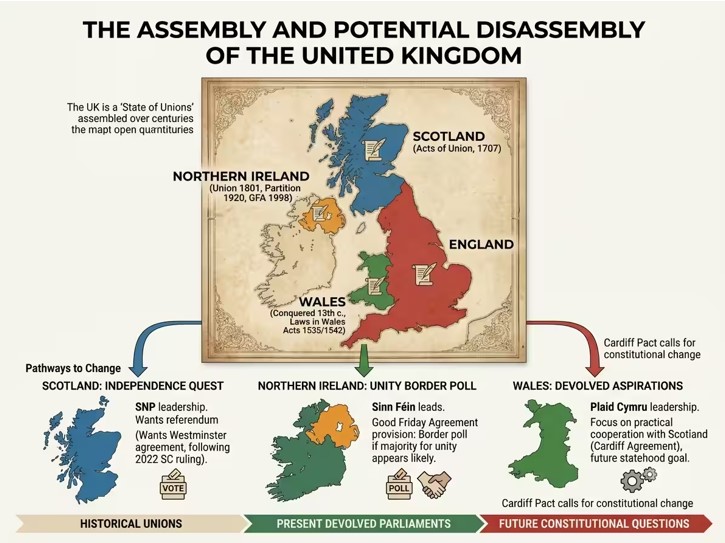
- Scotland, Wales and Northern Ireland signed a Memorandum of Understanding (MoU) in Cardiff.
- They are seeking greater constitutional change and the possibility of future referendums.
- The three devolved governments are led by parties that support greater autonomy or separation from the UK:
- Scotland: Scottish National Party (SNP) – supports Scottish independence.
- Wales: Plaid Cymru – supports Welsh independence.
- Northern Ireland: Sinn Féin – supports Irish reunification.
- UK Prime Minister Andy Burnham has stated that there is currently no consensus for another Scottish independence referendum.
- He also referred to the Good Friday Agreement (1998) in relation to Northern Ireland.
Scotland
Scotland has already held a referendum on independence, making it an important part of the current constitutional debate. The legal position on holding another referendum was also clarified by the UK Supreme Court in 2022
Northern Ireland
Northern Ireland follows a different constitutional framework because its status is closely linked to the Good Friday Agreement. The agreement provides a legal and political framework for considering any future change in Northern Ireland’s constitutional position.
Northern Ireland has a different constitutional arrangement from Scotland and Wales.
The Good Friday Agreement, 1998 provides the framework for Northern Ireland's constitutional status.
It allows a referendum on Irish reunification if there is sufficient basis to believe that a majority may favour leaving the UK and joining a united Ireland.
Northern Ireland's earlier major constitutional votes include:
Wales
Wales has developed its own devolved political institutions through a series of referendums. The Senedd is the Welsh legislature and deals with areas of devolved responsibility.
- Wales has held three referendums, mainly related to devolution.
- Plaid Cymru supports greater Welsh autonomy and independence.
- The Welsh legislature is known as the Senedd.
Referendums in the UK
The UK does not have a single written constitution that sets out a permanent process for nationwide referendums. As a result, Parliament generally needs to pass separate legislation when a referendum is to be held.
- The UK has no single written constitutional document and has no permanent procedure for holding a nationwide referendum.
- Each referendum generally requires separate legislation passed by Parliament.
Three UK-wide Referendums
| Year | Issue | Result |
|---|
| 1975 | Whether to remain in the European Communities | Remain |
| 2011 | Alternative Vote system for parliamentary elections | Rejected |
| 2016 | Whether to remain in the European Union | Leave |
1975 Referendum
- Held on 5 June 1975.
- Voters decided whether the UK should remain in the European Communities, the predecessor of the European Union.
- The government officially supported remaining.
2011 Referendum
- Asked whether parliamentary elections should use the Alternative Vote (AV) system.
- Voters rejected the proposal.
2016 Brexit Referendum
- Asked whether the UK should remain in the European Union.
- Voters chose Leave.
- The UK formally left the EU in 2020.
- Prime Minister David Cameron, who had supported Remain, resigned after the result.
Legal Framework for UK Referendums
The UK’s constitutional structure combines a sovereign central Parliament with devolved governments in Scotland, Wales and Northern Ireland. Devolution gives these governments powers in specific areas, but Westminster remains constitutionally sovereign.
Political Parties, Elections and Referendums Act (PPERA), 2000
The political parties election and referendums Act, 2000 is an important law governing political parties, elections and referendums in the UK. It also created the Electoral commission and set rules for regulating referendum campaigns and political party funding.
- Passed under the government of Tony Blair.
- Established the Electoral Commission.
- Created rules for regulating elections and referendums.
- However, it did not create an automatic mechanism for holding a national referendum.
- Parliament must still pass specific legislation to authorise each UK-wide referendum.
Major Acts
Different UK-wide referendums have been held under separate acts of parliament. These acts provide the specific legal authority and rules needed to conduct each referendum.
- Referendum Act 1975 European Communities referendum.
- Parliamentary Voting System and Constituencies Act 2011 Alternative Vote referendum.
- European Union Referendum Act 2015 Brexit referendum.
Devolution and Referendums
Are UK Referendums Legally Binding?
- UK referendums are generally advisory rather than legally binding.
- Parliament remains sovereign.
- Therefore, Parliament retains the legal power to:
- implement the result,
- amend the resulting legislation, or
- repeal it later.
- However, a referendum result can create strong political pressure on the government.
Example: Brexit
The 2016 Leave vote was followed by:
- triggering of Article 50,
- parliamentary legislation,
- and ultimately the UK's withdrawal from the EU in 2020.
Key Constitutional Point
- The UK is a unitary sovereign state with devolved governments, rather than a federation.
- Devolved Governments
- Scotland
- Wales
- Northern Ireland
- They have their own legislatures and governments with powers transferred from Westminster.
- However, Westminster/UK Parliament remains sovereign under the UK's constitutional system.
Conclusion
Scotland, Wales and Northern Ireland have come together to demand more constitutional powers and the possibility of future referendums. They signed a Memorandum of Understanding (MoU) in Cardiff. Scotland supports greater autonomy and has already held an independence referendum in 2014. In that referendum, 55% voted against independence and 45% supported it. In 2022, the UK Supreme Court said that Scotland cannot hold another independence referendum without the permission of the UK Parliament. Northern Ireland has a different system under the 1998 Good Friday Agreement. It allows a referendum on joining a united Ireland if there is enough support for it. Wales has also held referendums on devolution. The UK does not have a single written constitution or a permanent system for national referendums. Each referendum needs a separate law passed by Parliament. Even when a referendum is advisory, its result can create strong political pressure on the government.
Test your understanding
Questions from this article
Prelims practiceQuestion: With reference to UK Constitutional Referendums and Devolution- Key Facts & Analysis, consider the following statements:
- Scotland, Wales and Northern Ireland have jointly called for the UK government to “prepare, plan and facilitate” constitutional change in the three nations
- The move has brought the issue of UK territorial unity and possible constitutional referendums back into national politics
Which of the statements given above is/are correct?
- 1 only
- 2 only
- Both 1 and 2
- Neither 1 nor 2
View answer and explanation
Suggested answer: (c) Both 1 and 2
Explanation: Explore UK Constitutional Referendums and Devolution, including the Scottish, Welsh and Northern Ireland referendums, powers of devolved governments, major constitutional changes and their impact on UK governance
Mains practiceQuestion: Discuss UK Constitutional Referendums and Devolution- Key Facts & Analysis with reference to Why in the News?, Key Developments, Scotland and Northern Ireland. (150 words, 10 marks)
View answer-writing approach
Answer approach:
- Introduce the topic using its meaning and context.
- Explain Why in the News?, Key Developments, Scotland and Northern Ireland.
- Use facts and examples given in the article.
- Conclude with a balanced way forward.
Frequently asked questionsFrequently asked questions
What is UK Constitutional Referendums and Devolution- Key Facts & Analysis?
Explore UK Constitutional Referendums and Devolution, including the Scottish, Welsh and Northern Ireland referendums, powers of devolved governments, major constitutional changes and their impact on UK governance
Why is UK Constitutional Referendums and Devolution- Key Facts & Analysis relevant for UPSC preparation?
The move has brought the issue of UK territorial unity and possible constitutional referendums back into national politics
What key points should aspirants remember about UK Constitutional Referendums and Devolution- Key Facts & Analysis?
The article covers Why in the News?, Key Developments, Scotland and Northern Ireland.