India significantly reduced its crude oil imports from the United States and Russia in September 2026, while increasing purchases from the United Arab Emirates (UAE). This shift coincided with the enactment of the Lindsey O. Graham Sanctioning Russia and Iran Act of 2026, also referred to as the Russia Sanctions Act. During this period, the UAE's share in India's total oil imports reached a record high of 26.5%. Russia and the UAE together accounted for around 60% of India's oil imports.
Why in the News?
India reduced its Russian oil imports by nearly 18% in September 2026 compared with August.
- India imported no crude oil from the United States during September.
- The UAE's share of India's total oil imports rose to 26.5%, its highest level ever.
- These changes coincided with the enactment of the Lindsey O. Graham Sanctioning Russia and Iran Act of 2026.
Lindsey O. Graham Sanctioning Russia and Iran Act of 2026
The United States enacted the Lindsey O. Graham Sanctioning Russia and Iran Act of 2026 to increase economic pressure on countries importing large quantities of Russian oil and gas. The tariffs are currently on hold. India's official oil import data for October 2026 is expected next month. Key Developments:
- September 16, 2026: The U.S. House of Representatives passed the legislation.
- September 18, 2026: U.S. President Donald Trump signed it into law.
- Key Provision: The Act empowers the United States to impose tariffs of up to 100% on countries such as India and China that import large quantities of Russian oil and gas.
- October 16, 2026: President Trump signed an executive order temporarily waiving the tariffs. He also submitted a certification to the U.S. Congress stating that the pause was in the U.S. national interest..
India's Crude Oil Imports: September 2026
India imported 209.4 lakh tonnes of crude oil in September 2026.
- The volume was 9.5% higher than in August 2026.
- It was 4.1% higher than in September 2025.
Rising Oil Import Bill
Despite the increase in the volume of crude oil imports, elevated international oil prices caused India's import bill to rise much faster. This reflects the growing financial burden of high global oil prices on India's import expenditure.
- India's oil import bill reached nearly $14.3 billion in September 2026.
- It was 16.4% higher than in August 2026.
- It increased by 33% compared with September 2025, when crude oil prices were relatively lower.
Declining Share of Russian Oil
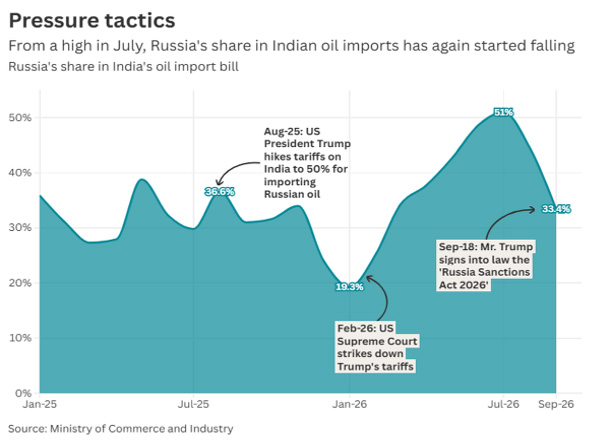
Russia's share in India's crude oil imports has broadly followed changes in U.S. policies towards Russian oil purchases. In volume terms, India reduced its Russian oil imports by nearly 18% in September compared with August, even though its overall crude oil imports increased. The earlier rise in Russian oil imports also coincided with the closure of the Strait of Hormuz during the West Asia conflict. This created supply constraints through the route.
- February 2026: The United States removed Russian oil-linked penal tariffs on India. Before their removal, India had been reducing its Russian oil imports in line with U.S. pressure.
- July 2026: Russia's share reached an all-time high of around 51%.
- August 2026: It declined to 44%.
- September 2026: It further declined to 33%, coinciding with the enactment of the Russia Sanctions Act.
India Reduces U.S. Oil Imports and Increases UAE Purchases
India imported no crude oil from the United States in September 2026.
- Before September, American oil accounted for slightly more than 5% of India's crude oil imports on average over the preceding 12 months.
- The decline in U.S. oil imports also coincided with the enactment of the Russia Sanctions Act.
India increased its purchases from the UAE amid the decline in imports from the United States and Russia. Increase in UAE Oil Imports:
- Oil imports from the UAE increased by 67% compared with August 2026.
- They also increased by 109% compared with September 2025.
- The UAE's share reached 26.5% of India's total oil imports, an all-time high.
Changing Pattern of India's Oil Sourcing
This reflects a change in India's crude oil sourcing pattern amid geopolitical tensions and changing U.S. policies. The shift in oil imports has increased India's dependence on a limited number of suppliers.
- Russia and the UAE together accounted for around 60% of India's total crude oil imports in September 2026.
- Russia's share declined to 33%.
- The UAE's share increased to 26.5%.
- The United States' share fell to zero.
Significance for India
- Energy Security: Diversifying oil suppliers is important for maintaining stable energy supplies.
- Economic Impact: High crude oil prices increase India's import bill and put pressure on the economy.
- Geopolitical Balancing: India must balance its energy requirements with its relations with the United States, Russia, and other oil-producing countries.
- Supply Concentration: Heavy dependence on Russia and the UAE makes India vulnerable to disruptions affecting these suppliers or their supply routes.
- Strategic Flexibility: Access to multiple suppliers helps India respond to changing international sanctions and geopolitical developments.
Conclusion
India's crude oil import pattern in September 2026 reflects changes in global energy trade amid geopolitical tensions and U.S. sanctions policy. The decline in imports from Russia and the United States, along with the sharp rise in purchases from the UAE, highlights the changing pattern of India's oil sourcing. Maintaining diversified supplies, energy security and affordable imports remains important for India's economic and strategic interests.
Test your understanding
Questions from this article
Prelims practiceQuestion: Consider the following statements regarding India's crude oil imports and energy security:
- India imports a significant share of its crude oil requirements, making it vulnerable to fluctuations in international oil prices.
- High dependence on crude oil imports can widen India's current account deficit.
- Diversification of oil import sources eliminates India's exposure to geopolitical risks.
- Increasing the share of renewable energy can help reduce India's long-term dependence on imported fossil fuels.
Which of the statements given above are correct?
- 1 and 2 only
- 1, 2 and 4 only
- 2, 3 and 4 only
- 1, 2, 3 and 4
View answer and explanation
Suggested answer: (b) 1, 2 and 4 only
Explanation:
- Statement 1 – Correct: India's dependence on imported crude oil makes its economy vulnerable to global price fluctuations and supply disruptions.
- Statement 2 – Correct: Higher oil import expenditure can increase the import bill and put pressure on the current account deficit.
- Statement 3 – Incorrect: Diversifying import sources reduces dependence on individual suppliers but does not eliminate geopolitical risks or global supply disruptions.
- Statement 4 – Correct: Expanding renewable energy, electric mobility, and alternative fuels can reduce long-term dependence on imported fossil fuels.
Mains practiceQuestion: India’s heavy dependence on oil imports poses significant challenges to its energy security and economic stability. Discuss the major challenges arising from this dependence and suggest measures to reduce India's energy import dependency.(15 marks, 250 words)
View answer-writing approach
Answer approach:
- Introduction: Mention India’s high crude oil import dependence.
- Body: Discuss challenges – energy insecurity, rising import bills, current account deficit, inflation and geopolitical risks. Suggest measures – renewable energy, biofuels, electric mobility, domestic exploration and diversified imports.
- Conclusion: Emphasise the need for a diversified and sustainable energy mix to strengthen India’s energy security.
Frequently asked questionsFrequently asked questions
What is UAE’s Share in India’s Oil Imports Rises as US, Russian Supplies Fall?
Understand UAE’s Share in India’s Oil Imports Rises as US, Russian Supplies Fall with a clear explanation, key facts, exam relevance, preparation strategy and practical guidance for UPSC aspirants
Why is UAE’s Share in India’s Oil Imports Rises as US, Russian Supplies Fall relevant for UPSC preparation?
This shift coincided with the enactment of the Lindsey O
What key points should aspirants remember about UAE’s Share in India’s Oil Imports Rises as US, Russian Supplies Fall?
The article covers Why in the News?, Lindsey O. Graham Sanctioning Russia and Iran Act of 2026, India's Crude Oil Imports: September 2026 and Rising Oil Import Bill.