India has avoided a potential food crisis by importing enough urea and liquefied natural gas (LNG) to support domestic urea production. However, rising prices of another critical commodity, sulphur, are now affecting the availability of DAP, SSP and other complex fertilisers. The increase in sulphur prices is linked to the Russia-Ukraine and West Asia conflicts, which have affected oil refineries and gas-processing infrastructure.

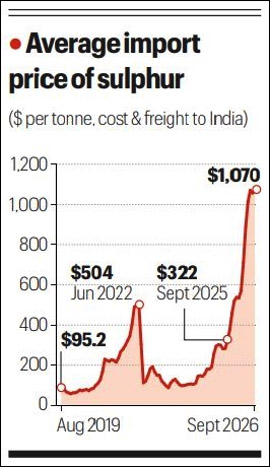
- Since the beginning of 2026, the landed price of imported sulphur in India has doubled to around $1,050-1,100 per tonne.
Why in the News?
Sulphur has emerged as a new concern for India's Fertiliser Sector because it is an essential input for producing phosphatic fertilisers.
- Landed sulphur prices in India have doubled since the beginning of 2026.
- Prices have reached around $1,050-1,100 per tonne.
- Ukrainian attacks have targeted Russian oil refineries and gas complexes.
- Iran has targeted the energy infrastructure of Saudi Aramco, QatarEnergy and Abu Dhabi National Oil Company.
- Rising sulphur prices are affecting the availability of DAP, SSP and complex fertilisers.
Why is Sulphur Important?
Only about one-tenth of global sulphur output is directly mined. Most sulphur is recovered as a byproduct of petroleum refining and natural gas processing.
| Source of Sulphur | Share |
|---|
| Petroleum oil refining | 56% |
| Natural gas processing | 34% |
| Direct mining | 10% |
Environmental rules require the removal of sulphur from crude oil and raw natural gas during the production of clean, low-emission fuels. The recovered sulphur is important for agriculture because most of it is converted into sulphuric acid, which is a key chemical used in the production of fertilisers containing phosphorus.
Role of Sulphur in Phosphatic Fertilisers
- The primary source of phosphorus is rock phosphate. However, mined rock phosphate cannot be directly used as fertiliser.
- It has to be broken down into a water-soluble form so that plants can absorb it. This is done by reacting rock phosphate with sulphuric acid.
- The process can be broadly understood as:
Sulphur → Sulphuric Acid → Phosphoric Acid → DAP / Other Phosphatic Fertilisers Sulphur and sulphuric acid are therefore essential for producing:
- DAP
- SSP
- 20:20:0:13
- 10:26:26
- 12:32:16
- Other major complex fertilisers
From Byproduct to Scarce Commodity
- India consumes around 3.8-3.9 million tonnes (mt) of sulphur annually. The fertiliser industry accounts for around 2-2.1 mt of this consumption.
- Sulphur was earlier available at relatively low prices because it was obtained as a byproduct of the oil and gas industry.
- Import prices were generally below $200 per tonne.
- During several months in 2019 and 2020, prices were even below $100 per tonne.
- Sulphur is flammable and therefore cannot be stored for very long.
- Sulphuric acid also has storage and disposal challenges.
- In 2020, India imported sulphuric acid from non-ferrous metal smelters in Japan and South Korea at prices as low as minus $20 per tonne on a free-on-board basis at the port of origin.
Watch : Global Sulphur Crisis 2026
Impact of the Russia-Ukraine War
The situation changed after the Russia-Ukraine war.
- Sulphur prices increased to around $400-500 per tonne during March-June 2022.
- The increase was temporary.
- Prices returned to below $200 per tonne from late 2022 through early 2025.
- Ukraine increased targeted strikes on Russian oil refineries from around August 2025.
- By December 2025, landed sulphur prices had crossed $500 per tonne.
- Prices increased further after the US-Iran war.
Iran has similarly targeted oil and gas infrastructure in its Persian Gulf neighbouring countries.
Current Prices
According to the fertiliser industry official cited in the source:
- Sulphur: around $1,070 per tonne
- Sulphuric acid: around $330-350 per tonne
- Two months earlier, prices had reached around $1,150 per tonne for sulphur and $420 per tonne for sulphuric acid.
The EV Battery Link
Geopolitical tensions are not the only reason for the rise in sulphur and sulphuric acid prices.
Demand for sulphuric acid has also increased because of its use in extracting nickel from laterite ores and processing it into mixed hydroxide precipitate (MHP), which is used for electric vehicle batteries.
- Nickel-related demand for sulphuric acid increased from 3.5 mt in 2021 to 16 mt in 2025.
- Much of this demand comes from Indonesia.
- Indonesia has the world's largest nickel reserves.
- It has high-pressure acid leaching plants that process nickel ore into MHP.
Thus, both supply-side disruptions from wars and higher demand from nickel processing are putting pressure on the sulphuric acid market.
India's Sulphur Supply
- Indian fertiliser companies source sulphur from domestic oil refineries.
- They also source sulphuric acid from the smelting complexes of:
- Hindustan Zinc Ltd
- Birla Copper
- These sources are located in Rajasthan and Gujarat.
- However, the bulk of India's requirements are imported.
How India Produces Phosphatic Fertilisers
Companies such as IFFCO, Coromandel International and Paradeep Phosphates Ltd have integrated fertiliser manufacturing facilities. They import sulphur and rock phosphate and process them into fertilisers. The production process is:
- Sulphur is converted into sulphuric acid.
- Sulphuric acid is reacted with rock phosphate.
- This produces SSP or phosphoric acid.
- Phosphoric acid is further used to produce DAP and other high-phosphorus complex fertilisers.
Key Production Figures
- 1 tonne of sulphur produces around 3 tonnes of sulphuric acid.
- The reaction is exothermic, meaning it releases heat.
- The heat can be captured and used by boilers to generate high-pressure steam for power.
- Around 2.6-2.8 tonnes of sulphuric acid are required to produce 1 tonne of phosphoric acid.
- India has around 2.2 mt of domestic phosphoric acid manufacturing capacity.
- India requires around 4.3-4.5 mt of phosphoric acid.
- This supports production of around 15-16 mt of phosphatic fertilisers.
Dependence on Rock Phosphate
- IFFCO, Coromandel International and Paradeep Phosphates have secured supplies of rock phosphate through joint ventures or strategic tie-ups in:
- However, securing rock phosphate alone is not sufficient.
- Rock phosphate cannot be used to make fertilizer without sulphur.
Major Challenges
The current situation creates pressure on India's fertiliser supply chain.
- Rising prices: Sulphur and sulphuric acid prices have increased sharply.
- Import dependence: The bulk of India's sulphur requirements is imported.
- Geopolitical disruptions: Attacks on oil and gas infrastructure are affecting sulphur availability.
- Export restrictions: Russia has banned exports of sulphur and sulphuric acid to protect its own fertiliser production, while China has also restricted exports of sulphuric acid.
- Rising demand: Growing sulphuric acid demand for nickel processing is adding pressure to global supplies.
- Fertiliser availability: Higher sulphur prices are affecting the availability of DAP, SSP and other complex fertilisers.
Conclusion
Sulphur has emerged as a new challenge for India's fertiliser sector amid disruptions to energy infrastructure in Russia and West Asia. Since sulphur is mainly recovered as a byproduct of oil refining and natural gas processing, disruptions in these sectors can directly affect its supply. India has a new fertiliser problem Sulphur, as rising global prices and supply pressures add to the challenges facing the fertiliser industry. At the same time, rising demand for sulphuric acid from nickel processing for EV batteries is adding further pressure. India depends heavily on imported sulphur, while sulphur is essential for converting rock phosphate into fertiliser through sulphuric acid. The industry is currently counting on an end to the wars and subdued fertiliser demand from El Nino for some easing of global prices.
Test your understanding
Questions from this article
Prelims practiceQuestion: With reference to Global Sulphur Crisis 2026- Rising Prices Challenge India's Fertiliser Sector, consider the following statements:
- India has avoided a potential food crisis by importing enough urea and liquefied natural gas (LNG) to support domestic urea production
- However, rising prices of another critical commodity, sulphur, are now affecting the availability of DAP, SSP and other complex fertilisers
Which of the statements given above is/are correct?
- 1 only
- 2 only
- Both 1 and 2
- Neither 1 nor 2
View answer and explanation
Suggested answer: (c) Both 1 and 2
Explanation: The Global Sulphur Crisis 2026 as rising prices and supply constraints challenge India’s fertiliser sector. Understand sulphur’s role in fertiliser production, import dependence, rising costs, impact on farmers, and implications for India’s agricultural security
Mains practiceQuestion: Discuss Global Sulphur Crisis 2026- Rising Prices Challenge India's Fertiliser Sector with reference to Why in the News?, Why is Sulphur Important?, Role of Sulphur in Phosphatic Fertilisers and From Byproduct to Scarce Commodity. (150 words, 10 marks)
View answer-writing approach
Answer approach:
- Introduce the topic using its meaning and context.
- Explain Why in the News?, Why is Sulphur Important?, Role of Sulphur in Phosphatic Fertilisers and From Byproduct to Scarce Commodity.
- Use facts and examples given in the article.
- Conclude with a balanced way forward.
Frequently asked questionsFrequently asked questions
What is Global Sulphur Crisis 2026- Rising Prices Challenge India's Fertiliser Sector?
The Global Sulphur Crisis 2026 as rising prices and supply constraints challenge India’s fertiliser sector. Understand sulphur’s role in fertiliser production, import dependence, rising costs, impact on farmers, and implications for India’s agricultural security
Why is Global Sulphur Crisis 2026- Rising Prices Challenge India's Fertiliser Sector relevant for UPSC preparation?
However, rising prices of another critical commodity, sulphur, are now affecting the availability of DAP, SSP and other complex fertilisers
What key points should aspirants remember about Global Sulphur Crisis 2026- Rising Prices Challenge India's Fertiliser Sector?
The article covers Why in the News?, Why is Sulphur Important?, Role of Sulphur in Phosphatic Fertilisers and From Byproduct to Scarce Commodity.