The handling of women protesters by police has raised questions about the use of force, women's safety and the protection of journalists during protests. The issue has come before the Supreme Court after allegations that women protesters and journalists were manhandled by male police officers during protests in Delhi. The case highlights the balance between police powers to maintain public order and the fundamental rights of citizens and journalists.
Why in the News?
On November 25, 2026, the Delhi Police told the Supreme Court that there is no strict legal requirement that only women police officers must handle women during crowd-control operations.
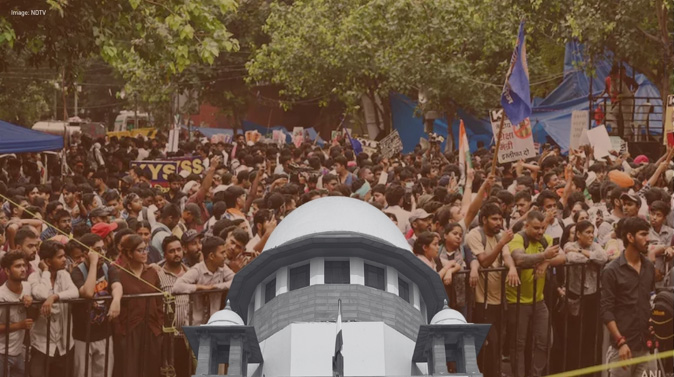
- The submission came in response to allegations that women protesters and journalists were manhandled by male police officers during protests demanding the resignation of Chief Election Commissioner (CEC) Gyanesh Kumar.
- The protests followed allegations of irregularities in the functioning of the Election Commission.
- Petitions have been filed by the Network of Women in Media, India, the Delhi Union of Journalists, the Free Speech Collective and the Kerala Union of Working Journalists, among others.
What is the Delhi Police's Stand?
The Delhi Police has argued that the legal requirement for women police personnel to handle women during searches and arrests does not automatically apply to crowd-control operations.
- The police stated that there is no statutory mandate requiring only women personnel to handle women in crowd-control situations.
- It referred to the Bharatiya Nagarik Suraksha Sanhita (BNSS), 2023, which prescribes requirements relating to searches and arrests of women.
- According to the police, these requirements should not be treated as a strict rule for all crowd-control operations.
What Are the Concerns Raised by the Media Organisations?
The Network of Women in Media, India has sought protection of journalists' fundamental rights, particularly those of women journalists, while reporting during protests.
Major Concerns:
1. Obstruction of Journalistic Work:
- Journalists were allegedly obstructed and forcibly removed while covering protests.
- The petitioner argued that law-and-order powers cannot be used as a blanket justification to interfere with journalistic activities.
2. Detention and Assault:
- The petition raised allegations of arbitrary detention and assault of journalists covering the protests.
- It sought protection against forcible removal, detention and physical harassment.
3. Sexual Harassment of Women Journalists:
- The petitioner stated that sexual harassment affects the dignity and personal security of women journalists.
- It can discourage women from participating in journalism on equal terms and without fear.
4. Distinction Between Journalists and Reel-Makers:
- Delhi Police had sought to distinguish between journalists and "reel-makers" during the protests at Jantar Mantar in October.
- The petitioner rejected this distinction and argued that the label was being used as a justification for obstruction and detention.
Which Fundamental Rights Are Involved?
The petition argues that police action against journalists affects several fundamental rights guaranteed under the Constitution.
| Constitutional Provision | Right Protected |
| Article 14 | Right to equality before the law. |
| Article 19(1)(a) | Freedom of speech and expression, including press freedom. |
| Article 19(1)(d) | Right to move freely throughout the territory of India. |
| Article 21 | Right to life and personal liberty, including dignity and bodily integrity. |
The petitioner argued that obstruction, assault and detention affect journalists' personal liberty and bodily integrity.
- Such actions also restrict their freedom to practise their profession and gather and communicate information.
- Sexual harassment of women journalists further affects their dignity and personal security.
What Did the Supreme Court Say Earlier?
The petitioner referred to the Supreme Court's October 11 direction. The Court had directed that lawyers, journalists and other professionals should not be obstructed or hindered while carrying out their professional duties.
- The petitioner argued that police powers to maintain law and order must be exercised within the limits prescribed by law.
Challenges
1. Balancing Public Order and Fundamental Rights:
- Police must maintain public order during protests.
- However, these powers should not become a reason for arbitrary interference with citizens' rights.
2. Safety of Women Journalists:
- Allegations of assault and sexual harassment can create fear among women journalists.
- This may discourage their equal participation in the profession.
3. Freedom of the Press:
- Obstruction and detention of journalists can affect their ability to gather and communicate information.
- It may also create a chilling effect on independent reporting.
4. Lack of Clear Crowd-Control Safeguards:
- The difference between legal requirements for searches and arrests and those for crowd-control operations has raised questions about safeguards for women.
Way Forward
Police authorities should establish clear safeguards for handling women during crowd-control operations. Journalists should be allowed to perform their professional duties without arbitrary obstruction, detention or assault.
- Appropriate arrangements should be made to ensure the safety and dignity of women during police operations.
- Allegations of assault, harassment and unlawful detention should be examined through proper procedures.
Conclusion
The issue highlights the need to balance public order and police powers with fundamental rights. While the police have a responsibility to manage protests, this cannot become a blanket justification for obstructing journalists or violating the dignity of women. Clear safeguards and accountability are essential to protect women's safety, press freedom and the right to peaceful expression.
Test your understanding
Questions from this article
Prelims practiceQuestion: With reference to fundamental rights during police crowd-control operations, consider the following statements:
- Article 19(1)(a) guarantees freedom of speech and expression, including press freedom.
- Article 21 protects life, personal liberty, and human dignity.
- BNSS, 2023, requires only women police personnel to handle women in every crowd-control operation.
- Article 14 guarantees equality before the law.
Which of the statements given above are correct?
- 1 and 2 only
- 1, 2 and 4 only
- 2, 3 and 4 only
- 1, 2, 3 and 4
View answer and explanation
Suggested answer: (b) 1, 2 and 4 only
Explanation:
- Statements 1, 2 and 4 are correct.
- Statement 3 is incorrect. According to the Delhi Police's stand in the given issue, BNSS provisions relating to searches and arrests do not automatically apply to every crowd-control operation.
Mains practiceQuestion: How can the police balance public order during protests with the fundamental rights and dignity of citizens, particularly women and journalists? Discuss. (150 words)
View answer-writing approach
Answer approach:
- Introduction: Police must maintain public order while protecting constitutional freedoms.
- Challenges: Excessive force, women's safety, arbitrary detention, and obstruction of press freedom.
- Way Forward: Gender-sensitive policing, clear crowd-control guidelines, police accountability, and protection of journalists.
- Conclusion: Ensure a balance between public order, individual dignity, and fundamental rights.