The new rule is mainly about the Merchant Discount Rate on selected Person-to-Merchant transactions and will start on 15 October 2026. The standard MDR is 0.4% for eligible merchant payments above ₹2,000, with a maximum charge of ₹300 for transactions of ₹75,000 and above. Merchant Discount Rate (MDR) on UPI is a fee charged on certain digital payment transactions, generally paid by the merchant to payment service providers. Its introduction for specified UPI transactions is significant for the financial sustainability of India’s digital payments ecosystem, with implications for merchants, fintech companies, payment infrastructure, and consumers.
Merchant Discount Rate (MDR) on UPI Unified Payments Interface
Effective October 15, 2026, the National Payments Corporation of India (NPCI) has introduced a 0.4% Merchant Discount Rate (MDR) for specified high-value Person-to-Merchant (P2M) UPI transactions. The move represents a shift from the zero-MDR framework introduced in 2020 and has important implications for India’s digital payments ecosystem. The revised MDR framework is aimed at supporting the financial sustainability of UPI, while helping fund critical areas such as payment infrastructure, cybersecurity, fraud prevention, and transaction security. For UPSC aspirants, the development is significant from the perspective of Digital India, financial inclusion, fintech regulation, digital public infrastructure, and the evolving economics of UPI.
The change also highlights the challenge of balancing affordable digital payments for consumers and merchants with the need to create a sustainable financial model for maintaining and securing India’s rapidly expanding digital payments infrastructure.
Why in the News?
- The National Payments Corporation of India (NPCI) has announced a new Merchant Discount Rate (MDR) framework for certain UPI transactions from 15 October 2026.
- An MDR of 0.4% will apply to UPI payments of ₹2,000 or more made to mid-sized and large merchants.
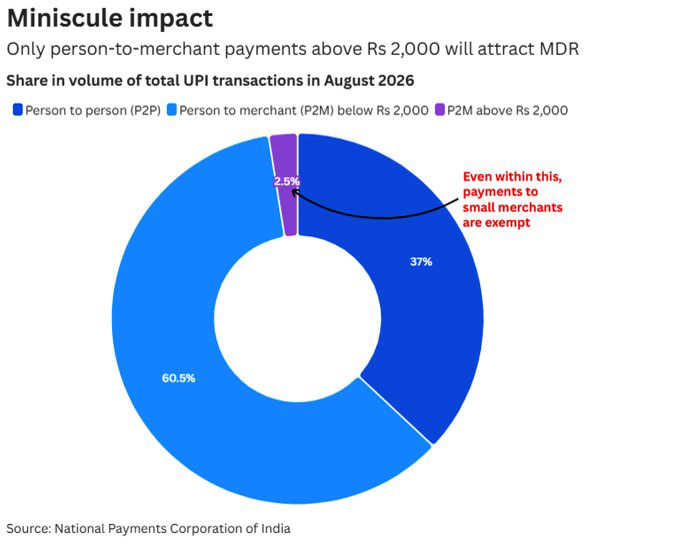
- Only about 2.5% of UPI transactions by volume will be affected.
Watch : UPI Merchant Discount Rate (MDR) Explained
Which UPI Transactions Will Remain Free?
- Person-to-Person (P2P) transactions: Remain completely free, irrespective of transaction value.
- Merchant payments below ₹2,000: No MDR.
- Small merchants: Street vendors and other small merchants receiving up to ₹1 lakh per month through UPI QR codes under the Person-to-Person-Merchant (P2PM) category will remain exempt.
MDR Rates Under the New Framework
| Transaction Category | MDR |
|---|
| Mid/Large merchants ≥ ₹2,000 | 0.4% |
| Essential & thin-margin sectors ≥ ₹2,000 | ₹5 per transaction |
| Capital-market transactions | 0.02%, capped at ₹300 |
| P2P transactions | Nil |
| Merchant payments < ₹2,000 | Nil |
| Eligible small P2PM merchants | Nil |
Essential and Thin-Margin Sectors
These sectors are characterised by high transaction volumes, essential consumer demand and, in several cases, relatively low margins. Applying a flat MDR on essential services can provide greater predictability in transaction costs. The ₹5 flat MDR applies to sectors such as:
- Railways
- Telecommunications
- Insurance
- Fuel
- Agricultural inputs
Capital-Market Transactions
Capital-market payments often involve relatively high transaction values, making a percentage-based MDR with a cap a way to balance payment-system costs with the value of transactions. The 0.02% MDR, subject to a ₹300 maximum, applies to payments involving:
- Mutual funds
- Stockbrokers
- Dealers
- Equities
How Much of UPI Will Be Affected?
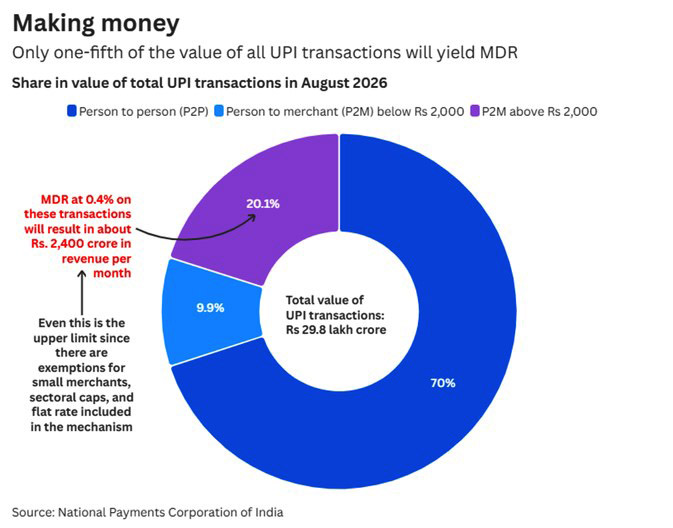
- Transactions subject to MDR constitute only around 2.5% of total UPI transaction volume.
- However, they represent around 20% of the total value of UPI transactions.
- The estimated maximum revenue from MDR is around ₹2,400 crore per month.
Key point: The charge affects a small share of transactions by volume but a much larger share by value.
Who Gets the MDR?
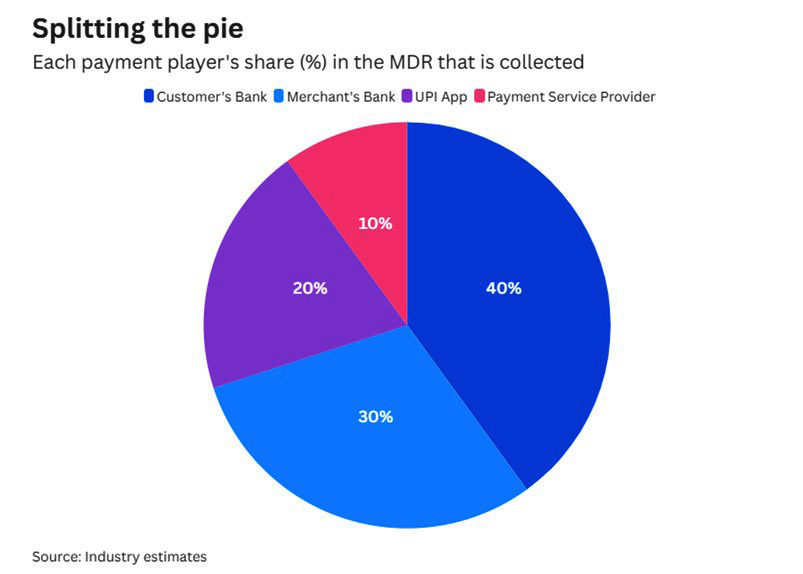
The MDR collected is distributed among participants in the UPI ecosystem.
- Largest share → Payer’s bank
- Second-largest share → Merchant’s bank
- Then → UPI app
- Then → Other payment processors
Banks Likely to Benefit
The benefits of MDR are likely to vary across banks depending on their share of payer and merchant accounts, transaction volumes and participation in high-value merchant payments.
Payer’s Bank
Among banks used by customers for UPI transactions:
- Yes Bank has the largest share.
- ICICI Bank follows.
Merchant’s Bank
Among banks used by merchants for receiving UPI payments:
- Yes Bank leads.
- Followed by:
- Axis Bank
- ICICI Bank
- HDFC Bank
Why Private Banks Benefit?
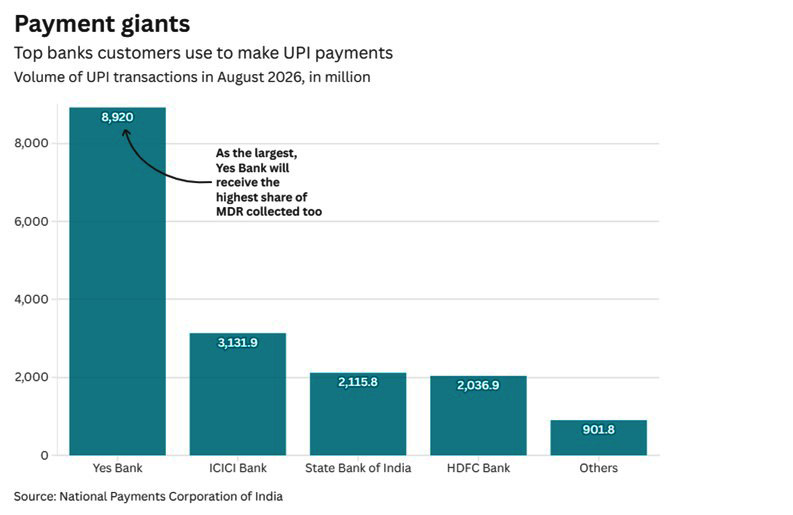
- MDR revenue is distributed primarily to the payer’s bank and the merchant’s bank.
- Banks with a large share of UPI transactions can therefore receive a larger portion of the MDR revenue.
- The data indicates that private banks, particularly Yes Bank, are positioned to gain significantly.
UPI Apps Likely to Benefit
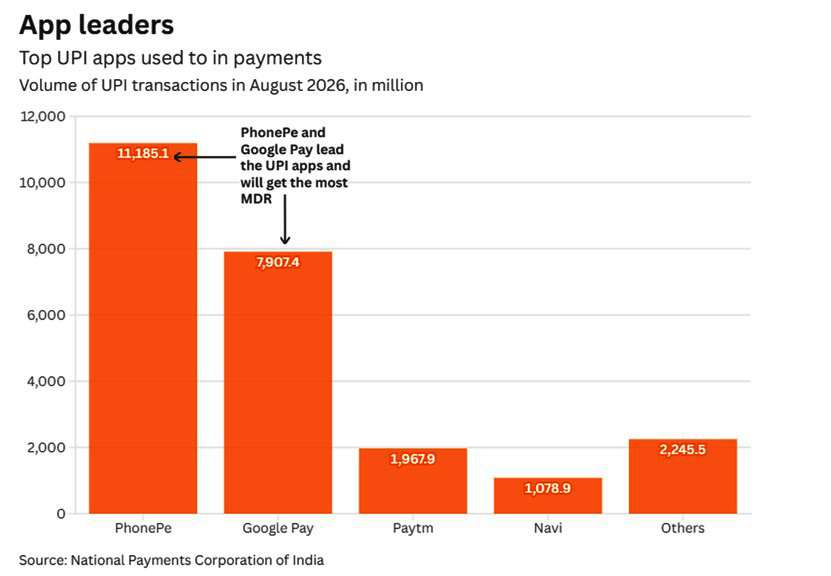
- PhonePe and Google Pay together account for nearly 80% of UPI transaction volume.
- Since UPI apps receive a share of MDR, these platforms are positioned to receive a significant portion of the revenue generated.
Why is the Impact Limited for Most Users?
The proposed MDR framework follows a targeted approach, rather than imposing transaction charges universally across UPI. The financial impact is concentrated on highervalue merchant transactions rather than everyday UPI users.
- P2P payments remain free.
- Merchant payments below ₹2,000 remain free.
- Eligible small merchants remain exempt.
- Therefore, the MDR primarily targets higher-value transactions involving larger merchants.
Key Significance
The proposed framework represents a shift towards making UPI financially sustainable while preserving its public-good character. By targeting revenue generation primarily from high-value merchant transactions, it seeks to balance the commercial interests with accessibility and affordability.
- Introduces a potential revenue stream into the UPI ecosystem.
- Provides financial incentives for banks and payment applications participating in high-value merchant transactions.
- Maintains zero-cost access for ordinary P2P transfers and small-value merchant payments.
- Attempts to generate revenue without imposing MDR across the entire UPI ecosystem.
Conclusion
The new rule, Merchant Discount Rate (MDR) on Select UPI (P2M) Transactions, is mainly about Merchant Discount Rate on selected Person-to-Merchant transactions and will start from 15 October 2026. The standard MDR is 0.4% for eligible merchant payments above ₹2,000, with a maximum charge of ₹300 for transactions of ₹75,000 and above. P2P payments remain free, payments up to ₹2,000 remain outside the regular MDR, and eligible small merchants are protected. The government says the purpose is to create a more sustainable UPI system and support its infrastructure, security, and future growth. Opposition leaders, however, have raised concerns that merchants may try to recover the cost from customers through higher prices.
Test your understanding
Questions from this article
Prelims practiceQuestion: With reference to Merchant Discount Rate (MDR) on Unified Payments Interface (UPI), consider the following statements:
- The new rule is mainly about the Merchant Discount Rate on selected Person-to-Merchant transactions and will start on 15 October 2026
- The standard MDR is 0.4% for eligible merchant payments above ₹2,000, with a maximum charge of ₹300 for transactions of ₹75,000 and above
Which of the statements given above is/are correct?
- 1 only
- 2 only
- Both 1 and 2
- Neither 1 nor 2
View answer and explanation
Suggested answer: (c) Both 1 and 2
Explanation: Understand Merchant Discount Rate (MDR) on UPI, its meaning, implications for merchants and consumers, and significance for India’s digital payments ecosystem, fintech sector, financial inclusion, and UPSC preparation
Mains practiceQuestion: Discuss Merchant Discount Rate (MDR) on Unified Payments Interface (UPI) with reference to Merchant Discount Rate (MDR) on UPI Unified Payments Interface, Why in the News?, Which UPI Transactions Will Remain Free? and MDR Rates Under the New Framework. (150 words, 10 marks)
View answer-writing approach
Answer approach:
- Introduce the topic using its meaning and context.
- Explain Merchant Discount Rate (MDR) on UPI Unified Payments Interface, Why in the News?, Which UPI Transactions Will Remain Free? and MDR Rates Under the New Framework.
- Use facts and examples given in the article.
- Conclude with a balanced way forward.
Frequently asked questionsFrequently asked questions
What is Merchant Discount Rate (MDR) on Unified Payments Interface (UPI)?
Understand Merchant Discount Rate (MDR) on UPI, its meaning, implications for merchants and consumers, and significance for India’s digital payments ecosystem, fintech sector, financial inclusion, and UPSC preparation
Why is Merchant Discount Rate (MDR) on Unified Payments Interface (UPI) relevant for UPSC preparation?
The standard MDR is 0.4% for eligible merchant payments above ₹2,000, with a maximum charge of ₹300 for transactions of ₹75,000 and above
What key points should aspirants remember about Merchant Discount Rate (MDR) on Unified Payments Interface (UPI)?
The article covers Merchant Discount Rate (MDR) on UPI Unified Payments Interface, Why in the News?, Which UPI Transactions Will Remain Free? and MDR Rates Under the New Framework.