UPSC Current Affairs
Renewed Violence in Manipur: Local Groups Demand Resignation of Chief Minister
Renewed violence in Manipur has sparked widespread protests, with local organisations and opposition parties calling for the immediate resignation of Manipur Chief Minister Yumnam Khemchand Singh. The latest round of violence intensified after a gun attack on October 19, 2026, killed three Meitei civilians who were collecting firewood in the Sunurok area of Kangpokpi district.
VRKalpana Sharma
5 min read
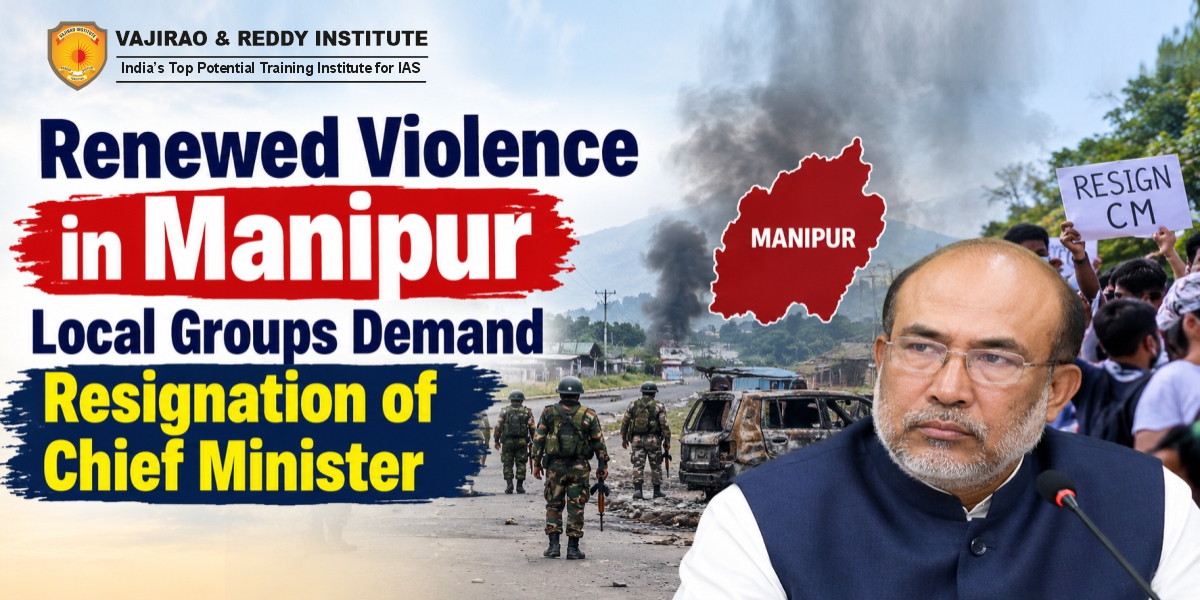
The security situation in Manipur has deteriorated following a fresh outbreak of violence. At least nine people have died. The murders have triggered protests and brought the city of Imphal to a near standstill. Angry locals placed two bodies outside the chief minister's house in protest, which the police forcibly removed.
Why in the News?
Fresh ethnic violence erupted in Manipur due to renewed tensions between Naga and Kuki- Zo communities.
- The Congress on Sunday (October 25, 2026) demanded the resignation of Manipur Chief Minister Y. Khenchand Singh and accused his government of failing to contain the renewed violence in the state.
- Tensions arose on Sunday (October 11, 2026) following two days of armed conflict between Kuki and Naga communities that claimed nine lives across three districts.
- According to reports, two members of Kuki National Army-Burma, a Myanmar-based armed group, were also killed in a gunfight at the India-Myanmar border.
Reason Behind the Ethnic Crisis in Manipur
The conflict in Manipur is due to long-standing ethnic clashes, which erupted in full scale in May 2023. The conflict has evolved since then from a bilateral dispute into a regional crisis that has drawn surrounding communities like Nagas into it by creating new fault lines.
Root Causes of the Conflict
- The Hill-Valley divide: Manipur’s unique geography creates sharp segregation of hill and Valley communities. The majority Meitei community makes up about 53% of the population but is confined to the Imphal Valley, which makes up 10% of the state’s land. The tribal groups like Kuki-Zo and Naga communities make up 40% of the state population residing in hill districts, which make up around 90% of the land.
- The Scheduled Tribe (ST) Status Spark: The immediate cause for the May 2023 clashes was the Manipur High Court directive regarding granting the Meitei community “Scheduled Caste” status. The Kuki and Naga tribes strongly opposed this for fear that it would allow more politically and economically dominant Meiteis to purchase land in the hills and monopolize government job quotas.
- Asymmetric Politics: The Meiteis hold the lion's share of political power, controlling 40 out of the 60 seats in the state legislative assembly. Thus, the hill-and-valley divide was also visible in legislative power.
- The "War on Drugs": Following the 2021 military coup in neighboring Myanmar, there was a large influx of Chin refugees into Manipur. The Meitei-led state government launched forest eviction drives and an anti-drug campaign targeting illegal poppy cultivation. Kuki groups alleged that these policies are in disguise to selectively target their community.
Reasons Behind the Recent Renewed Clashes
- The New "Naga-Kuki" Front: While the initial war was between the Meitei and Kuki communities, the Tangkhul Naga community has now also been involved in the clashes. Armed clashes have broken out in the hill districts over territorial boundaries, land rights, and residency control, adding a highly volatile third dimension to the unrest.
- Lapse of the Suspension of Operations (SoO) Pact: There was the 2008 Suspension of Operations agreement between the government and Kuki insurgent groups, which kept militant cadres inside designated camps with their weapons locked away. The lapse and non-renewal of this agreement have led to severe public anxiety, protests, and a vacuum in militant deterrence.
- Political Instability: The political landscape remains deeply fractured. Following the resignation of former Chief Minister N. Biren Singh and a period of central President's Rule, the political transition has failed to bring about reconciliation. Kuki-Zo groups continue to demand complete territorial separation via an Autonomous Union Territory, a concession the central government rejects to preserve Manipur’s territorial integrity.
- Economic Blockades & Humanitarian Crises: Rival groups have established hard checkpoints along national highways. Naga and Meitei nationalist groups have placed economic blockades on Kuki-dominated hill areas, choking off supplies of food, vital medicine, and essential goods, which has led to preventable deaths and localized health emergencies.
Impact of Renewed Violence
Renewed ethnic violence in Manipur has further deepened the communal polarisation. Increased death toll.
- Humanitarian impact: Over 300 to 350 people have died since the conflict began in May 2023, with fresh clashes involving Meitei, Kuki-Zo, and Naga communities resulting in additional deaths. These clashes have displaced many people, spreading widespread post-traumatic stress disorder.
- Social and ethnic polarisation: repeated divisions can deepen community divisions and reduce trust between the communities.
- Economic consequences: violence can disrupt transport, markets, agriculture, education, and small businesses. Shutdowns and road blockades can affect the movement of essential goods and raise costs for households.
Prolonged instability can discourage investment, weaken employment potential, and delay development projects.
- Internal security implications: Manipur's location is very sensitive- it is on an international border, and the violence hitting Myanmar further raises concerns for regional stability and border management,
Government Response
The state government has appealed for peace and deployed additional security personnel in affected districts. The Chief Minister also met the Prime Minister in October amid the renewed violence, according to reports.
Key Government Responses:
- Call for Dialogue: The Centre and state government are trying to facilitate dialogue between Kuki, Meitei and Naga Communities to engage in direct talks for lasting peace.
- State Administration and Leadership: The BJP-led state government under Chief Minister Yumnam Khemchand Singh has coordinated with security advisers and the Governor to address the violence.
- The Congress party has strongly criticized the government's handling of the crisis, demanding the resignation of Chief Minister Yumnam Khemchand Singh.
Way Forward Measures to Restore Peace in Manipur
To ensure lasting peace between the communities, the focus should be on resolution of grievances and trust-building rather than just military actions:
- Strengthen civilian protection: Authorities and security deployment should ensure the protection of vulnerable settlements to prevent loss of human life.
- Ensure time-bound and impartial investigations: A transparent process should investigate killings and violence-related cases to ensure justice and restoration of public confidence.
- Establish inclusive peace dialogue: Peace efforts should include representatives of Meitei, Kuki, Naga, and other affected communities.
- Enforce agreements with credible monitoring: The government should review and monitor the relevant agreement and ceasefire.
- Improve border management: Cooperation with Myanmar, where feasible, can support action against cross-border criminal and armed networks.
- Strengthen local peacebuilding: Targeted investment in roads, communications, healthcare, education and employment can reduce isolation and improve access to public services.
Conclusion
Renewed violence in Manipur reflects the complexity of ethnic relations, territorial concerns, armed-group activity and governance challenges in a strategically important northeastern state. The October 2026 incidents underline the urgent need to protect civilians, investigate crimes impartially, enforce relevant agreements and rebuild trust among communities.
Test your understanding
Questions from this article
Prelims practiceQuestion: With reference to the renewed ethnic violence in Manipur and the constitutional framework governing internal security in India, consider the following statements:
- Article 355 places a duty on the Union to protect every state against external aggression and internal disturbance.
- Public order and police are primarily subjects under the State List of the Seventh Schedule.
- Article 21 protects the right to life and personal liberty of every person.
- Article 342 empowers Parliament alone to identify Scheduled Tribes in the first instance, without any role for the President.
Which of the statements given above are correct?
- 1 and 2 only
- 1, 2 and 3 only
- 2, 3 and 4 only
- 1, 2, 3 and 4
View answer and explanation
Suggested answer: (b) 1, 2 and 3 only
Explanation: Explanation:
- Statement 1 — Correct: Article 355 defines the Union's duty to protect states against external aggression and internal disturbance.
- Statement 2 — Correct: Public order and police fall primarily under the State List, although the Union has relevant constitutional and statutory responsibilities.
- Statement 3 — Correct: Article 21 protects the life and personal liberty of every person, subject to the procedure established by law.
- Statement 4 — Incorrect: Under Article 342, the President specifies Scheduled Tribes in relation to a state or Union Territory in the first instance, and Parliament can subsequently include or exclude communities by law.
Mains practiceQuestion: “Renewed ethnic violence in Manipur highlights the complex challenges of maintaining internal security in India's northeastern states.” Discuss the underlying causes and examine the measures needed to restore peace, strengthen border management and promote ethnic reconciliation.
View answer-writing approach
Answer approach:
- Introduction: Briefly explain Manipur’s ethnic diversity and recurring violence.
- Causes: Ethnic tensions, land disputes, armed groups, cross-border insurgency and governance gaps.
- Measures: Strengthen border security, ensure impartial policing, promote dialogue, rehabilitate displaced people and encourage inclusive development.
- Conclusion: Emphasise peace, constitutional values and ethnic reconciliation.
Frequently asked questionsFrequently asked questions
What is Renewed Violence in Manipur: Local Groups Demand Resignation of Chief Minister?
Renewed violence in Manipur has sparked widespread protests, with local organisations and opposition parties calling for the immediate resignation of Manipur Chief Minister Yumnam Khemchand Singh. The latest round of violence intensified after a gun attack on October 19, 2026, killed three Meitei civilians who were collecting firewood in the Sunurok area of Kangpokpi district
Why is Renewed Violence in Manipur: Local Groups Demand Resignation of Chief Minister relevant for UPSC preparation?
The murders have triggered protests and brought the city of Imphal to a near standstill
What key points should aspirants remember about Renewed Violence in Manipur: Local Groups Demand Resignation of Chief Minister?
The article covers Why in the News?, Reason Behind the Ethnic Crisis in Manipur, Root Causes of the Conflict and Reasons Behind the Recent Renewed Clashes.