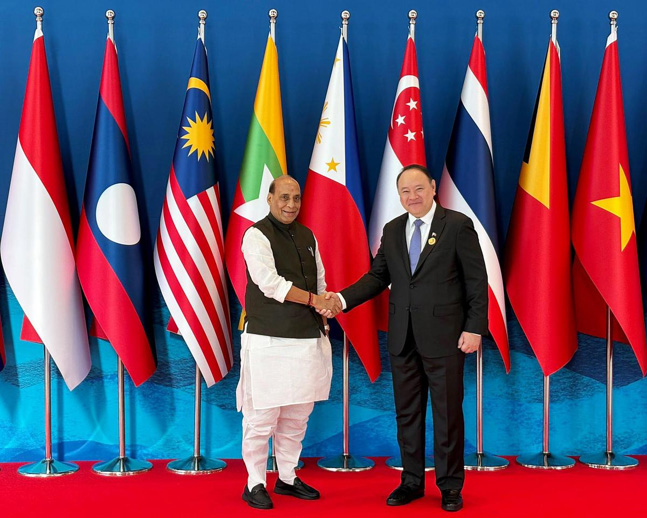
India is ready to share its battle-tested counter-terrorism expertise with the Association of Southeast Asian Nations (ASEAN) and its dialogue partners. Defence Minister Rajnath Singh highlighted India's experience during the ASEAN Defence Ministers' Meeting-Plus (ADMM-Plus) conclave in Cebu, the Philippines. He also reaffirmed India's commitment to maritime security, freedom of navigation and a secure Indo-Pacific region.
Why in the News?
Defence Minister Rajnath Singh offered to share India's practical counter-terrorism expertise with ASEAN and ADMM-Plus partners.
- He described Operation Sindoor (2025) as a clear declaration of India's approach towards state-sponsored terrorism.
- He emphasised cooperation in intelligence sharing, joint military exercises and capacity-building.
- He reiterated India's role as a trusted net security provider in the Indian Ocean Region and the wider Indo-Pacific.
India's Counter-Terrorism Cooperation with ASEAN
India's counter-terrorism experience comes from decades of confronting cross-border security challenges. Rajnath Singh stated that India's strategies had been tested through actual operations rather than being limited to theoretical knowledge. India proposed strengthening collective counter-terrorism capabilities through:
- Joint military exercises to improve operational coordination.
- Capacity-building programmes to strengthen the capabilities of partner countries.
- Intelligence sharing to improve information exchange and cooperation against terrorist threats.
Operation Sindoor
Operation Sindoor (2025) was highlighted as an example of India's approach to combating terrorism. According to Rajnath Singh, the operation destroyed a large number of terrorist infrastructure facilities and demonstrated India's firm response to state-sponsored terrorism.
India's Vision for the Indo-Pacific
India supports a secure, stable and resilient Indo-Pacific in which peace and prosperity are achieved through collective efforts. Rajnath Singh highlighted the importance of maritime security, particularly as international trade routes face emerging threats and disruptions. India stated that its emphasis on international maritime law was not directed against any particular country but was intended to protect regional peace, security and prosperity. India reaffirmed its commitment to:
- Acting as a trusted net security provider in the Indian Ocean Region and the wider Indo-Pacific.
- Protecting maritime trade routes and regional stability.
- Upholding the United Nations Convention on the Law of the Sea (UNCLOS).
- Safeguarding freedom of navigation and overflight.
- Promoting a rules-based maritime order that protects the collective interests of regional stakeholders.
South China Sea and Maritime Security
India's emphasis on UNCLOS comes amid concerns among several ASEAN members and other democratic countries over China's growing military activities in the contested South China Sea.
- Adherence to UNCLOS is important for establishing a rules-based maritime order and protecting freedom of navigation and overflight.
- Disruptions to maritime routes can affect international trade, regional economies and security.
Significance for India
India's offer to share counter-terrorism expertise and its emphasis on maritime security reflect its broader regional objectives:
- Strengthening defence partnerships: Expanding cooperation with ASEAN countries and their dialogue partners.
- Combating terrorism: Improving collective capabilities through training, intelligence sharing and operational cooperation.
- Enhancing maritime security: Supporting safe and uninterrupted movement through important trade routes.
- Promoting a rules-based order: Reinforcing UNCLOS and freedom of navigation in the Indo-Pacific.
- Expanding India's regional role: Strengthening India's position as a security partner in the Indian Ocean Region and the wider Indo-Pacific.
Conclusion
India's offer to share its counter-terrorism expertise with ASEAN and its dialogue partners reflects its commitment to regional security cooperation. Through joint exercises, intelligence sharing and capacity-building, India aims to strengthen collective responses to terrorism while promoting maritime security, freedom of navigation and stability in the Indo-Pacific.
Test your understanding
Questions from this article
Prelims practiceQuestion: With reference to the ASEAN Defence Ministers' Meeting (ADMM) and ADMM-Plus, consider the following statements:
- ADMM is the highest defence consultative and cooperative mechanism among ASEAN member states.
- ADMM-Plus includes ASEAN member states and eight dialogue partners.
- India is a member of ADMM-Plus.
- ADMM-Plus focuses exclusively on military exercises and does not address non-traditional security threats.
Which of the statements given above are correct?
- 1 and 2 only
- 1, 2 and 3 only
- 2, 3 and 4 only
- 1, 2, 3, and 4
View answer and explanation
Suggested answer: (b) 1, 2 and 3 only
Explanation:
- Statement 1 – Correct: ADMM is the highest defence consultative
and cooperative mechanism within ASEAN.
- Statement
2 – Correct: ADMM-Plus consists of ASEAN's 11 member states and eight
dialogue partners.
- Statement
3 – Correct: India is one of the eight dialogue partners of ASEAN under
ADMM-Plus.
- Statement 4 – Incorrect: ADMM-Plus also addresses
non-traditional security challenges through cooperation in areas such as
cybersecurity, counter-terrorism, humanitarian assistance and disaster
management.
Mains practiceQuestion: Multilateral defence cooperation is increasingly important in addressing non-traditional security threats. Discuss with reference to ADMM-Plus. (10 marks, 150 words)
View answer-writing approach
Answer approach:
Introduction: ADMM-Plus as a regional
defence cooperation platform.
Body: Non-traditional threats –
Counter-terrorism, cyber security, disaster management, maritime security –
Joint exercises and information sharing.
Challenges: Geopolitical rivalries and
trust deficit.
Conclusion: Strengthening regional cooperation for
a secure Indo-Pacific.
Frequently asked questionsFrequently asked questions
What is India Ready to Strengthen ASEAN’s Counter-Terrorism Efforts?
India has expressed its readiness to share its battle-tested counter-terrorism expertise with ASEAN member states and their dialogue partners. Addressing the 13th ASEAN Defence Ministers’ Meeting-Plus (ADMM-Plus) in Cebu, Philippines, Defence Minister Rajnath Singh highlighted that India’s counter-terrorism capabilities have been developed through decades of experience in tackling complex cross-border security.
Why is India Ready to Strengthen ASEAN’s Counter-Terrorism Efforts relevant for UPSC preparation?
Defence Minister Rajnath Singh highlighted India's experience during the ASEAN Defence Ministers' Meeting-Plus (ADMM-Plus) conclave in Cebu, the Philippines
What key points should aspirants remember about India Ready to Strengthen ASEAN’s Counter-Terrorism Efforts?
The article covers Why in the News?, India's Counter-Terrorism Cooperation with ASEAN, Operation Sindoor and India's Vision for the Indo-Pacific.