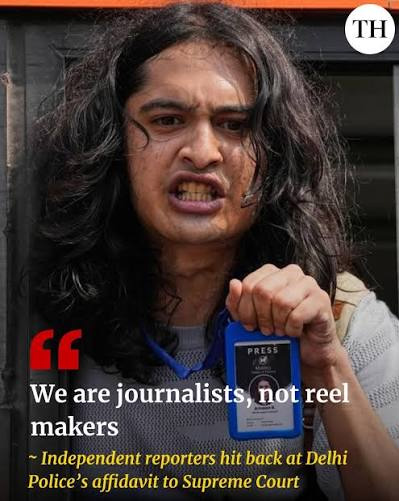
The Delhi Police has argued before the Supreme Court that social media content creators who make reels cannot automatically claim the same legal protections as professional journalists. The issue relates to allegations of police obstruction during protests against the Chief Election Commissioner (CEC) at Jantar Mantar, Delhi.
Why in the News?
The Delhi Police submitted an affidavit before the Supreme Court distinguishing professional journalists from social media content creators or reel-makers.
- The affidavit was filed in response to petitions by:
- Network of Women in Media.
- Free Speech Collective.
- Delhi Union of Journalists.
- Kerala Union of Working Journalists.
The petitions alleged that journalists were obstructed while covering protests against the Chief Election Commissioner at Jantar Mantar.
- On October 11, 2026, the Supreme Court directed that lawyers, journalists and other professionals should not be hindered while performing their duties.
Key Arguments of Delhi Police
The Delhi Police stated that professional journalists and social media content creators are different categories. The police also clarified that individuals making and uploading reels are free to do so, but they cannot automatically claim the protections available to professional journalists.
- Journalists: They perform professional duties of gathering, recording and reporting information.
- Reel-makers: They create social media content, often for commercial purposes and monetisation.
- The police argued that merely carrying a camera and microphone does not automatically make someone a journalist.
- It stated that the distinction between journalism and content creation should be examined on the basis of the intention behind the activity.
Delhi Police's Position on Allegations of Obstruction
The police denied deliberately obstructing journalists during the protests. It stated that journalists from national, international, regional, accredited and unaccredited media organisations were allowed to cover the protests. The police also stated that individuals carrying cameras were sometimes asked to maintain a reasonable distance from operational areas to avoid interfering with law-enforcement activities.
- It cited media coverage by organisations such as BBC, The Indian Express, The Quint and Brut India.
- Any interference, if it occurred, was described as inadvertent and due to mistaken identity or crowd-control requirements.
- Individuals apprehended due to mistaken identity were released after verification.
- The police maintained that some individuals claiming to be journalists were actually participating in protests and raising slogans.
Guidelines for Journalists Issued by Delhi Police
On October 5, 2026, Delhi Police issued guidelines for journalists through social media platforms. The police described these measures as facilitative and precautionary, aimed at identifying genuine journalists and ensuring their safety. Major provisions:
- Journalists must carry valid identity cards.
- Identity cards should be visibly displayed at all times.
- Journalists must not obstruct police operations.
- They should maintain a reasonable and safe distance from sensitive operational areas.
- PIB accreditation is not compulsory for identification.
- Identity cards issued by respective media organisations can also be accepted.
Constitutional Provisions Involved
Article 19(1)(a): Freedom of Speech and Expression
- Guarantees all citizens the right to freedom of speech and expression.
- Freedom of the press is recognised as an important part of this fundamental right.
- It protects the right of journalists to gather, record and disseminate information.
Article 19(2): Reasonable Restrictions
- Allows the State to impose reasonable restrictions on freedom of speech and expression.
- Restrictions can be imposed on grounds such as public order, security of the State, and sovereignty and integrity of India.
Working Journalist: Legal Framework
The Delhi Police referred to the definition of a working journalist under the Occupational Safety, Health and Working Conditions Code, 2020. It argued that the term has a specific meaning in the digital era.
- The affidavit highlighted journalist accreditation guidelines as a possible basis for distinguishing professional journalists from content creators.
Key Issues Involved
- Press Freedom: Ensuring that journalists can report protests without unnecessary interference.
- Identification of Journalists: Establishing a clear method to distinguish professional journalists from content creators.
- Social Media and Journalism: Determining whether social media content creators performing reporting activities should receive similar protections.
- Public Order: Balancing press freedom with the need to maintain law and order during protests.
- Digital Media Regulation: Addressing the changing nature of journalism in the digital age.
Conclusion
The issue highlights the growing challenge of distinguishing professional journalism from social media content creation in the digital era. While freedom of the press is an important part of Article 19(1)(a), the matter also raises questions about journalist identification, public order, and the scope of press protections. The Supreme Court consideration of these issues may have implications for journalism and media freedom in India.
Test your understanding
Questions from this article
Prelims practiceQuestion: With reference to freedom of the press in India, consider the following statements:
- Freedom of the press is explicitly mentioned as a separate right under Article 19 of the Constitution.
- Freedom of the press is derived from Article 19(1)(a) of the Constitution.
- Freedom of the press is subject to reasonable restrictions under Article 19(2).
Which of the statements given above is/are correct?
- 1 and 2 only
- 2 and 3 only
- 1 and 3 only
- 1, 2 and 3
View answer and explanation
Suggested answer: (b) 2 and 3 only
Explanation:
- Statement 1 – Incorrect: The Constitution does not explicitly mention freedom of the press as a separate right.
- Statement 2 – Correct: Press freedom is interpreted as part of the freedom of speech and expression under Article 19(1)(a).
- Statement 3 – Correct: It is subject to reasonable restrictions under Article 19(2), including sovereignty and integrity of India, security of the State, public order, defamation, contempt of court, etc.
Mains practiceQuestion: “Press freedom is essential for a functioning democracy, yet it must operate within constitutional limits. Examine the significance of press freedom in India and the challenges it faces.” (150 words)
View answer-writing approach
Answer approach:
- Introduction: Link press freedom with Article 19(1)(a) and democratic accountability.
- Significance: Watchdog role, transparency, informed citizenry, exposing corruption, and strengthening participatory democracy.
- Challenges: Misinformation, political pressure, media concentration, threats to journalists, frivolous cases, and declining editorial independence.
- Way forward: Independent institutions, journalist safety, media ethics, transparency in ownership, and responsible regulation without censorship.
Frequently asked questionsFrequently asked questions
What is Delhi Police on Press Freedom- Reel-Makers and Journalistic Protections?
The Delhi Police has told the Supreme Court that social media content creators cannot automatically claim the legal protections available to professional journalists. The issue raises important questions about press freedom, journalist identification, and the balance between reporting and public order
Why is Delhi Police on Press Freedom- Reel-Makers and Journalistic Protections relevant for UPSC preparation?
The issue relates to allegations of police obstruction during protests against the Chief Election Commissioner (CEC) at Jantar Mantar, Delhi
What key points should aspirants remember about Delhi Police on Press Freedom- Reel-Makers and Journalistic Protections?
The article covers Why in the News?, Key Arguments of Delhi Police, Delhi Police's Position on Allegations of Obstruction and Guidelines for Journalists Issued by Delhi Police.