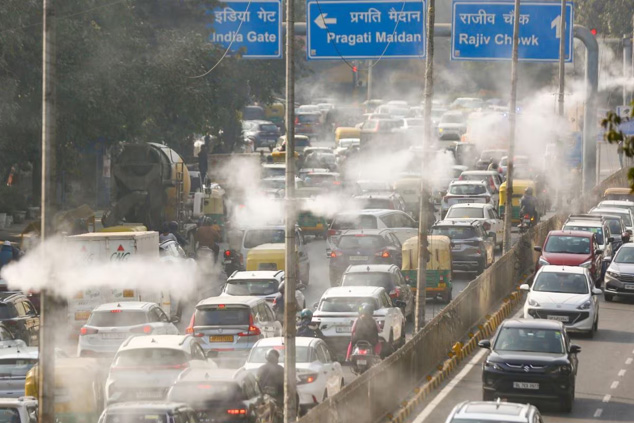
Air pollution in Delhi intensified in November 2026, with the Air Quality Index (AQI) reaching 307 and entering the 'Very Poor' category. The deterioration was also observed in neighbouring cities of the Delhi National Capital Region (NCR). In response, authorities have implemented additional winter pollution-control measures to reduce emissions from vehicles, construction activities and other sources.
Why in the News?
According to the Central Pollution Control Board (CPCB), Delhi recorded an AQI of 307 at 7 am on November 2, 2026, placing it in the 'Very Poor' category.
- Out of 58 monitoring stations with valid readings, 53 recorded AQI levels above 200.
- Around 37 stations recorded AQI levels above 300.
- Jahangirpuri was the most polluted location in Delhi, with an AQI of 417, falling under the 'Severe' category.
- The deterioration in air quality was also observed in neighbouring cities, including Noida, Ghaziabad, Greater Noida and Gurugram.
- The latest readings came a day after expanded winter pollution-control measures came into force on November 1.
Air Quality Index (AQI)
The Air Quality Index (AQI) is a tool used to communicate the quality of air and its possible health effects on people.
- It converts complex air pollution data into a single numerical value.
- It helps people understand the level of air pollution and associated health risks.
- In India, the Air Quality Index (AQI) is monitored and reported by the Central Pollution Control Board (CPCB).
AQI Categories in India:
| AQI Range | Category |
| 0–50 | Good |
| 51–100 | Satisfactory |
| 101–200 | Moderate |
| 201–300 | Poor |
| 301–400 | Very Poor |
| 401–500 | Severe |
Health Impacts:
- Very Poor (301-400): Prolonged exposure can cause respiratory illness.
- Severe (401-500): Can affect even healthy people and seriously impact those with existing respiratory or cardiovascular conditions.
Air Pollution Situation in Delhi and NCR
According to the Central Pollution Control Board (CPCB), the AQI of Delhi has reached a 24-hour average of 330, placing it in the Very Poor category. Meanwhile, real-time readings range between 382 and 415, with areas such as Rohini, Punjabi Bagh, and Jahangirpuri recording pollution levels in the Severe category. Most Polluted Locations in Delhi:
| Location | AQI |
| Jahangirpuri | 417 |
| Punjabi Bagh | 398 |
| Rohini | 397 |
| Alipur | 379 |
| R K Puram | 368 |
| Sonia Vihar | 367 |
| Mundka | 376 |
| Vivek Vihar | 374 |
| Narela | 371 |
| Bawana | 361 |
- Jahangirpuri recorded the highest AQI at 417, placing it in the Severe category.
- Tikri Kalan recorded the lowest AQI among reporting Delhi stations at 159.
- Ghummanhera recorded 182, while Maidan Garhi recorded 186. Air Quality in NCR Cities:
| City | AQI | Category |
| Noida | 308 | Very Poor |
| Delhi | 307 | Very Poor |
| Ghaziabad | 276 | Poor |
| Greater Noida | 267 | Poor |
| Gurugram | 225 | Poor |
| Manesar | 214 | Poor |
| Faridabad | 118 | Moderate |
Cities with the Highest and Lowest AQI in India
According to the CPCB dataset, pollution levels were particularly high in parts of Uttar Pradesh and Haryana, raising concerns over the worsening Delhi-NCR Pollution Alert situation. Several regions reported elevated AQI levels, highlighting the growing impact of winter pollution, vehicular emissions, industrial activities, and crop residue burning. The deteriorating air quality has increased the need for effective pollution-control measures across the National Capital Region.
Highest AQI:
| City | State | AQI |
| Baghpat | Uttar Pradesh | 358 |
| Gajraula | Uttar Pradesh | 358 |
| Kaithal | Haryana | 324 |
| Hapur | Uttar Pradesh | 320 |
| Baraut | Uttar Pradesh | 318 |
| Noida | Uttar Pradesh | 308 |
| Delhi | Delhi | 307 |
Lowest AQI:
| City | State | AQI |
| Gangtok | Sikkim | 18 |
| Aizawl | Mizoram | 19 |
| Nayagarh | Odisha | 24 |
| Darbhanga | Bihar | 29 |
| Vapi | Gujarat | 31 |
These cities recorded air quality in the Good category.
Delhi's Winter Pollution-Control Measures
The expanded winter pollution-control measures took effect on November 1, 2026, to reduce pollution during the winter season.
1. Restrictions on Vehicles
- Non-BS-VI vehicles registered outside Delhi face restrictions on entering and operating in the capital.
- Exemptions are provided for CNG and electric vehicles and specified categories.
- Vehicles must carry a valid Pollution Under Control Certificate (PUCC).
- The 'No PUC, No Fuel' policy is being enforced.
2. Work from Home and Office Attendance
- Government and private offices are required to follow 50% physical attendance.
- The remaining employees are to work from home.
3. Restrictions on Construction Activities
- Dust-generating demolition and outdoor construction activities face restrictions from November 1 to January 31.
- Essential public infrastructure activities are covered under specified exemptions.
4. Parking Charges
- Parking charges at authorised parking sites are being increased to discourage private vehicle usage.
5. Staggered Office Timings
- Government offices are required to implement staggered working hours to help reduce traffic congestion.
Additional Construction Restrictions Across NCR
Apart from Delhi's winter action plan, the Centre has announced additional restrictions across the National Capital Region.
- A complete suspension of construction and demolition activities will be implemented across NCR.
- The restriction will remain in force from November 5 to November 20, 2026.
- The measure aims to reduce dust pollution during the winter season.
Graded Response Action Plan (GRAP)
The Graded Response Action Plan (GRAP) is a set of emergency measures implemented to control air pollution in Delhi-NCR.
- It operates in different stages depending on the severity of air pollution.
- Restrictions become progressively stricter as air quality deteriorates.
- It includes measures targeting vehicular emissions, construction dust, industrial pollution and other sources.
Recent Changes in GRAP Framework:
- The revised framework has tightened vehicle-related restrictions.
- Certain restrictions on buses and diesel generator sets have been brought into an earlier stage.
- The objective is to take preventive action before pollution levels become more severe.
Conclusion
The deterioration in Delhi's air quality highlights the recurring challenge of Winter Pollution in Delhi NCR National Capital Region. The implementation of vehicle restrictions, construction curbs, work-from-home measures and GRAP provisions reflects the need for coordinated action. However, long-term improvement requires continuous monitoring, better transport systems, control of construction dust and effective coordination among Delhi and neighbouring states.
Test your understanding
Questions from this article
Prelims practiceQuestion: With reference to Pollution crisis in India, Consider the following statements:
- The AQI in India classifies air quality into six categories, ranging from Good to Severe.
- The AQI is calculated by considering eight major air pollutants, including PM2.5, PM10, nitrogen dioxide, sulphur dioxide and carbon monoxide.
- GRAP is a set of emergency measures implemented in Delhi-NCR to control air pollution, with actions linked to different AQI levels.
- The Commission for Air Quality Management (CAQM) is responsible for implementing and monitoring GRAP in Delhi-NCR.
- Under GRAP, restrictions on construction activities and vehicular movement may be imposed during severe air pollution episodes.
Which of the statements given above are correct?
- 1, 2 and 3 only
- 1, 2, 3 and 4 only
- 1, 2, 3, 4 and 5 only
- 2, 3, 4 and 5 only
View answer and explanation
Suggested answer: (c) 1, 2, 3, 4 and 5 only
Explanation:
- Statement 1 – Correct: India's AQI has six categories: Good (0–50), Satisfactory (51–100), Moderately Polluted (101–200), Poor (201–300), Very Poor (301–400) and Severe (401–500).
- Statement 2 – Correct: AQI considers eight pollutants: PM10, PM2.5, NO2, SO2, CO, Ozone, Ammonia and Pb.
- Statement 3 – Correct: GRAP introduces graded emergency measures according to the severity of air pollution in Delhi-NCR.
- Statement 4 – Correct: CAQM oversees the implementation of GRAP in Delhi-NCR.
- Statement 5 – Correct: Measures may include restrictions on construction, certain vehicles, industrial activities and other pollution-generating activities.
Mains practiceQuestion: “Delhi’s air pollution is not merely an environmental concern but also a serious public health and governance challenge.” Discuss the major causes of air pollution in Delhi and suggest comprehensive measures to address the problem. (15 marks, 250 words)
View answer-writing approach
Answer approach:
- Introduction: Highlight Delhi's air pollution as a serious environmental and public health challenge.
- Causes: Vehicular emissions, industrial pollution, stubble burning, construction dust, waste burning and unfavourable weather conditions.
- Measures: Strict implementation of GRAP, promotion of public transport and clean fuels, control of construction dust, stubble management and regional cooperation.
- Conclusion: Adopt a coordinated, year-round approach involving governments, industries and citizens to ensure clean air.
Frequently asked questionsFrequently asked questions
What is Delhi AQI Hits 307 as Winter Pollution Curbs Come Into Effect?
Delhi overall Air Quality Index (AQI) climbed to 324, placing it in the very poor category and prompting the Commission for Air Quality Management (CAQM) to implement Stage 2 of the Graded Response Action Plan (GRAP). After recording an initial morning reading of 307, pollution levels continued to rise throughout the day. This marks the first time Delhi has entered the Very Poor air quality category during the.
Why is Delhi AQI Hits 307 as Winter Pollution Curbs Come Into Effect relevant for UPSC preparation?
The deterioration was also observed in neighbouring cities of the Delhi National Capital Region (NCR)
What key points should aspirants remember about Delhi AQI Hits 307 as Winter Pollution Curbs Come Into Effect?
The article covers Why in the News?, Air Quality Index (AQI), Air Pollution Situation in Delhi and NCR and Cities with the Highest and Lowest AQI in India.