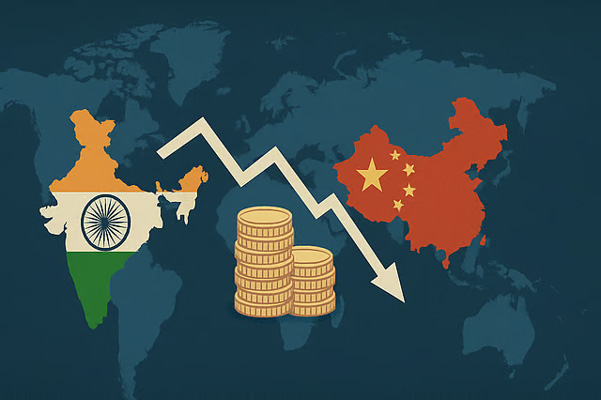
India’s trade deficit with China has crossed $100 billion in the first 9 months of 2026. Although Indian exports to China have increased significantly, imports continue to grow faster in absolute terms. India remains concerned about limited market access for its businesses and its dependence on Chinese goods, particularly electronics, machinery and industrial inputs.
Why in the News?
According to China’s General Administration of Customs (GAC), India’s trade deficit with China reached $105.93 billion between January and September 2026. Total bilateral trade increased by 25.4% to $144.45 billion during this period.
What is the trade deficit ?
A trade deficit occurs when the total value of a country's imports exceeds the value of its exports over a specific period.
- The Formula: Trade Balance = Total Value of Exports - Total Value of Imports
- Negative Result: If the result is negative (meaning you bought more from abroad than you sold), it is a trade deficit.
- Opposite: The reverse of a trade deficit is a trade surplus (when exports exceed imports).
1. India-China Trade- Key Figures
India’s exports to China have already reached approximately the previous year’s total. However, imports remain much higher than exports.
- In 2025, India’s trade deficit with China stood at a record $116.12 billion.
- If the trend continues, the deficit in 2026 is on track to exceed the previous year’s level.
| Indicator (January–September 2026) | Value |
| Total bilateral trade | $144.45 billion |
| India’s imports from China | $125.19 billion |
| India’s exports to China | $19.26 billion |
| Trade deficit | $105.93 billion |
| Growth in total trade | 25.4% |
| Growth in imports | 23.3% |
| Growth in exports | 40.7% |
2. Major Exports and Imports
India’s exports to China have grown across several product categories. India’s imports from China include large quantities of electronics, machinery, and industrial inputs. India needs intermediate goods from China for its manufacturing sector. However, continued dependence on finished products is a concern because it can increase reliance on Chinese suppliers. Major exports in 2026 include:
- Seafood products
- Naphtha
- Printed circuit boards (PCBs)
3. Why is India Concerned About the Trade Deficit?
The main concern is not simply the difference between imports and exports. India is also concerned about limited market access for Indian businesses and dependence on Chinese supplies.
- Limited market access: Indian companies face difficulties in expanding their exports to China.
- Import dependence: India relies on Chinese intermediate goods and finished products, including electronics and machinery.
- Supply-chain risks: Chinese export controls in sectors such as fertilisers and rare earths could affect the availability of essential supplies.
- Trade imbalance: India’s imports from China remain far higher than its exports, creating a persistent deficit.
4. Diplomatic Efforts to Address Trade Concerns
The trade imbalance was discussed during talks between Prime Minister Narendra Modi and Chinese President Xi Jinping on the sidelines of the BRICS summit in September 2026.
- Both leaders stressed the need to address structural trade imbalances, supply-chain concerns and the lack of predictable market access.
- They also discussed promoting cultural exchanges, business links and greater movement of people between the two countries.
- China’s Foreign Ministry stated that both sides should address their economic and trade concerns in a balanced manner and support stable trade relations.
Conclusion
India’s growing exports to China indicate opportunities for expanding bilateral trade. However, the large trade deficit, limited market access, and dependence on Chinese supplies remain important concerns. Improving export competitiveness, diversifying supply chains, and securing predictable market access will be important for addressing the imbalance.
Test your understanding
Questions from this article
Prelims practiceQuestion: With reference to China’s Rising Exports Deepen India’s Trade Deficit in 2026, consider the following statements:
- India’s trade deficit with China has crossed $100 billion in the first 9 months of 2026
- Although Indian exports to China have increased significantly, imports continue to grow faster in absolute terms
Which of the statements given above is/are correct?
- 1 only
- 2 only
- Both 1 and 2
- Neither 1 nor 2
View answer and explanation
Suggested answer: (c) Both 1 and 2
Explanation: How China’s rising exports are widening India’s trade deficit in 2026, examining import trends, key sectors, economic challenges, and implications for India-China trade relations
Mains practiceQuestion: Discuss China’s Rising Exports Deepen India’s Trade Deficit in 2026 with reference to Why in the News?, What is the trade deficit ?, 1. India-China Trade- Key Figures and 2. Major Exports and Imports. (150 words, 10 marks)
View answer-writing approach
Answer approach:
- Introduce the topic using its meaning and context.
- Explain Why in the News?, What is the trade deficit ?, 1. India-China Trade- Key Figures and 2. Major Exports and Imports.
- Use facts and examples given in the article.
- Conclude with a balanced way forward.
Frequently asked questionsFrequently asked questions
What is China’s Rising Exports Deepen India’s Trade Deficit in 2026?
How China’s rising exports are widening India’s trade deficit in 2026, examining import trends, key sectors, economic challenges, and implications for India-China trade relations
Why is China’s Rising Exports Deepen India’s Trade Deficit in 2026 relevant for UPSC preparation?
Although Indian exports to China have increased significantly, imports continue to grow faster in absolute terms
What key points should aspirants remember about China’s Rising Exports Deepen India’s Trade Deficit in 2026?
The article covers Why in the News?, What is the trade deficit ?, 1. India-China Trade- Key Figures and 2. Major Exports and Imports.