India has shifted from being a net maize exporter to a net importer for the first time in decades, with imports reaching nearly 0.9-0.97 million tons. The shift is mainly driven by rising domestic industrial demand, particularly from the government’s ethanol blending programme, along with growing requirements from the poultry and starch industries. India becomes a net importer of Maize from net exporter India, once known to be an exporter of maize, has become a net importer.
Reason: India’s E20 policy.
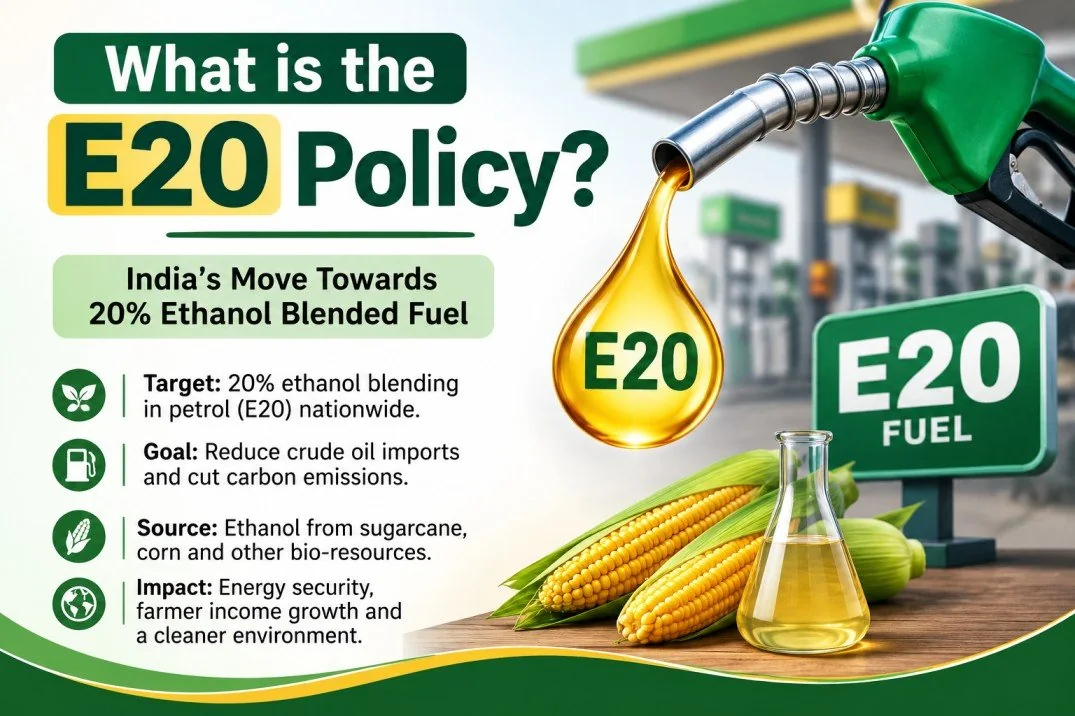
What is the E20 Policy?
India’s E 20 petrol policy requires a nationwide blend of 20% ethanol with 80% petrol. Introduced to reduce crude oil imports, cut carbon emissions, and support farmers, E20 is now the standard retail fuel. The government has ruled out parallel supplies of E10 or Pure Petrol due to logistical challenges. This simply means if one buys 1 liter of E20 fuel, it comprises 800 ml petrol & 200 ml ethanol.
This will reduce the import of crude oil for which India is heavily dependent. (India imports 85-88% of its fuel requirement). India has achieved this blending target 5 years in advance.
What is the Connection between Maize Import increase and E20 Policy?
The core connection is that India’s aggressive E 20 policy has significantly increased maize demand for ethanol production, making maize a key biofuel feedstock. As domestic demand increasingly exceeds local supply, India has shifted from being a net maize exporter to a net importer. Ethanol is produced from multiple sources like: –
- Sugarcane
- Rice husk
- Agri residue
- Maize.
How much Ethanol is being Produced from Maize in India?
Maize has rapidly emerged as a major feedstock for India’s grain-based ethanol production, accounting for roughly 45%–50% of total biofuel allocations. Ethanol Blending in India, driven by the national 20% blending target (E20), is reducing dependence on sugarcane for ethanol production. This shift can support rural incomes while raising concerns about water use, food security, and competing demand for maize. Around half of Ethanol production is being done with ethanol currently in India. Hence the increase in imports of Maize. The benefit as compared to sugarcane is that maize is less water intensive. From exporter of Maize to a net importer Over the years India’s maize story has turned upside down for India. Let’s a look at How much Ethanol is being Produced from Maize in India year by year: –
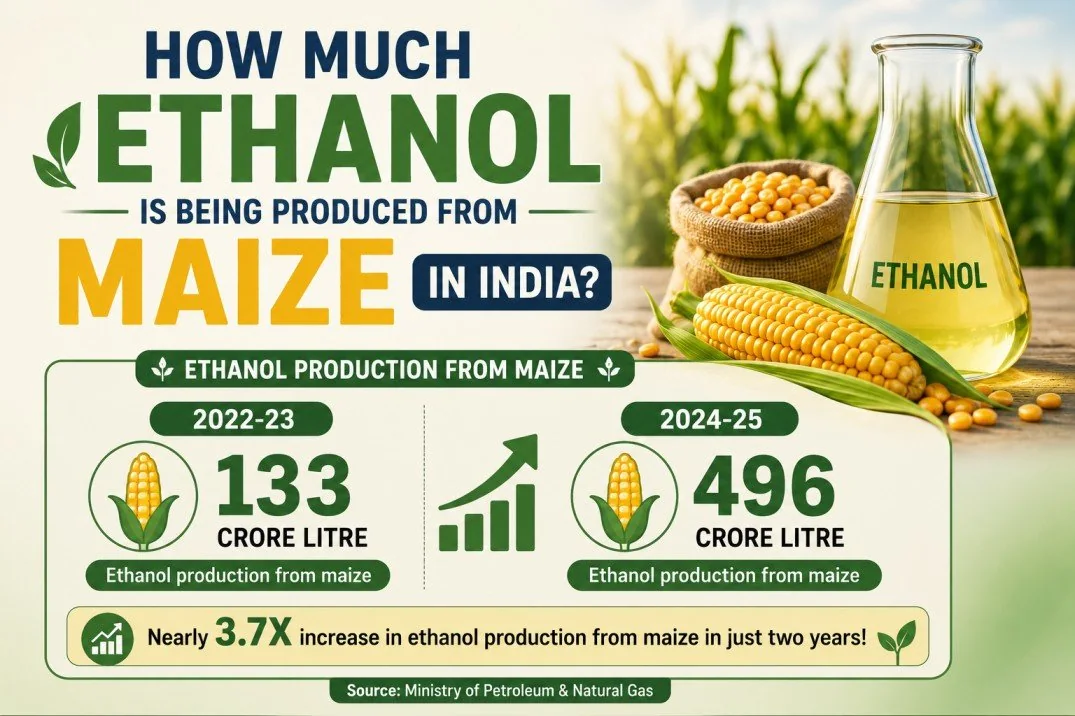
| Year | Export/Import value |
|---|
| 2022-23 | $764 Mn Export |
| 2024-25 | $ 205 Mn Export but $220 Mn import (from Ukraine & Myanmar) |
Maize is used in the following sectors apart from producing ethanol:
- Domestic consumption
- Poultry feedstock
- Distilleries
Hence competition for maize consumption is there. This can further increase the price of Maize which will be further passed on down the value chain.
Why have Prices of E20 Fuel not Reduced despite a Drop in International Crude Oil prices?
E20 fuel prices have not fallen significantly because the policy is aimed at long-term energy security rather than cheaper fuel. When global crude prices are relatively low, around $70 per barrel, domestically produced ethanol bought at fixed prices can cost more than conventional petrol. This higher ethanol cost can offset potential savings at the pump. International crude oil prices have dropped but the blending of ethanol in petrol is making it more expensive since the price of per liter ethanol is high. Ethanol produced from maize costs Rs. 71.86 per liter. However, it was promised vice versa before E20 was mandated. So, we should resume buying unblended petrol since it will be cheaper. Let’s a look at Why have prices of E20 fuel prices fallen despite lower International Crude Oil Prices: –
1. Fixed Ethanol Costs
The Ministry of Petroleum and Natural Gas procures ethanol from domestic producers at relatively stable, government-set prices, typically around ₹65–₹72 per liter. This pricing mechanism supports farmers and provides greater stability for the ethanol supply chain.
2. Low Crude Price Threshold
Ethanol becomes economically competitive with conventional petrol mainly when global crude oil prices rise sharply, reaching around 130 per barrel. At lower crude prices, the relatively fixed cost of domestically procured ethanol can limit potential savings for consumers.
3. The Insurance Buffer
According to the Press Information Bureau (PIB), ethanol blending acts as a buffer against fluctuations in global crude oil prices. By reducing dependence on imported crude, blending can help protect consumers from sharp fuel price increases during geopolitical disruptions and global supply shocks.
Conclusion
The government says that E20 policy has saved over Rs. 1 lakh crore in forex apart from increasing farmer’s income. But the gain in forex will not sustain if we import the raw material required for making ethanol. Per hectare productivity of maize shall increase. The farmers and government have benefitted, but what about the motorists? This simply makes E20 policy a policy with contrasting realities.
Test your understanding
Questions from this article
Prelims practiceWith reference to India’s E20 policy, consider the following statements:
- E20 petrol contains 20% ethanol and 80% petrol.
- Maize is one of the feedstocks used for ethanol production.
- India’s growing ethanol demand has no connection with maize imports.
Which of the statements given above are correct?
- 1 and 2 only
- 2 and 3 only
- 1 and 3 only
- 1, 2 and 3
View answer
Answer: (a) 1 and 2 only. The article explains that rising maize demand for ethanol production is a central reason India has shifted from a net maize exporter to a net importer.
Mains practiceIndia’s E20 policy reflects both energy-security gains and competing demands on agricultural resources. Discuss with reference to maize production, imports, food security and fuel prices.
Answer in 250 words.
View answer approach
- Introduce the E20 blend and its energy-security objective.
- Explain why maize demand for ethanol has increased.
- Discuss the shift from maize exports to imports and competition with food, poultry and distillery uses.
- Examine fixed ethanol costs, farmer-income support and the effect on motorists.
- Conclude with the need to raise maize productivity and balance energy, farm and food-security goals.
Frequently asked questionsFrequently asked questions
What is India’s E20 policy?
India’s E20 petrol policy requires a nationwide blend of 20% ethanol with 80% petrol. It was introduced to reduce crude oil imports, cut carbon emissions and support farmers.
Why has India become a net importer of maize?
India’s E20 policy has increased maize demand for ethanol production. As domestic demand from ethanol, poultry, starch and distillery uses exceeds local supply, India has shifted from being a net maize exporter to a net importer.
Why have E20 fuel prices not fallen with crude oil prices?
Ethanol is procured at relatively stable government-set prices. When global crude prices are comparatively low, the fixed cost of domestically produced ethanol can offset potential savings from cheaper crude oil.