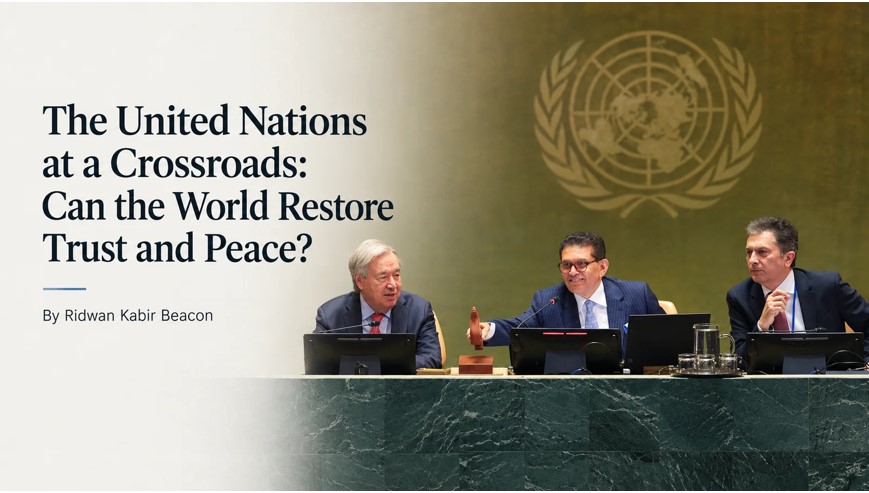
The United Nations (UN) is facing growing concerns over declining trust in its ability to address global challenges. The theme of the 81st UN General Assembly is “Restoring Trust, Managing Transformation: a UN that delivers for all”, highlighting the need to improve the organisation’s effectiveness, transparency and representation. The UN was created after the Second World War to provide a platform for dialogue, develop international rules and make relations between states more predictable. However, several institutional and political challenges have weakened confidence in the organisation.
Why in the News?
Rebuilding trust in the United Nations requires addressing persistent governance challenges, financial vulnerabilities, and the underrepresentation of the Global South in global decision-making. The 81st UN General Assembly is focusing on restoring trust in the UN system.
- Surveys indicate declining trust and favourability towards the UN.
- Concerns include Security Council deadlock, weak accountability and unequal influence among member states.
- Developing countries remain under-represented in UN decision-making despite accounting for most of the world's population.
- The UN has been urged to improve transparency, accountability and representation.
Declining Trust in the UN
Recent surveys indicate growing concerns about the UN’s ability to deliver results and address global problems. A UN Foundation poll found that 52% of respondents believed the organisation was struggling to deliver results and supported deep structural reforms. Other concerns include:
- Weak enforcement of international law.
- Concerns over protection of human rights.
- Perception that powerful countries have disproportionate influence.
- Questions over the UN’s ability to effectively address global crises.
Another survey by the Rockefeller Foundation and Focaldata found that 58% of respondents believed the UN could lead efforts to solve global problems.
Security Council Deadlock
The UN Security Council (UNSC) has faced repeated deadlocks, particularly because of the veto power of its permanent members. This has affected confidence in the wider UN system.
- Permanent members can block substantive decisions through the veto.
- The General Assembly adopted Resolution A/76/262, requiring permanent members to explain their use of the veto before the Assembly.
- Continued deadlock has raised questions about the effectiveness and representativeness of the existing global security architecture.
Concerns Over Internal Accountability
Questions have also been raised about transparency and oversight within the UN itself.
These concerns cover areas such as:
- Recruitment
- Procurement
- Allocation of resources
- Peacekeeping operations
- Internal accountability
Past controversies involving procurement irregularities and sexual exploitation and abuse by peacekeepers have increased concerns about institutional accountability. The broader issue is whether individual misconduct is being addressed without adequately dealing with the systemic weaknesses that allow such problems to occur.
Financial Influence Over the UN
The financial contributions of powerful countries can also influence the functioning of the UN system. Major donors may exercise influence through funding, recruitment and support for specific programmes. A 2024 report of the Advisory Committee on Administrative and Budgetary Questions (ACABQ) noted that, in one UN agency, 8 out of 9 technical experts recruited were sponsored by a single government.
This raises questions about:
- Independence of UN programmes.
- Transparency of donor-funded activities.
- Influence of major contributors.
- Risk of institutional dependence on powerful countries.
Financial dependence can also make UN officials more cautious when dealing with major donor countries.
Under-Representation of the Global South
The Global South remains under-represented in UN decision-making despite being home to the majority of the world’s population.
- Developing countries account for around 84% of the global population.
- They hold only about 44% of UN civil service leadership positions.
- Only around one-third of UN leadership in Africa is African.
- Only about two-fifths of cities hosting UN headquarters are located in the Global South.
This creates a gap between where much of the UN’s work is implemented and where significant decision-making power is concentrated.
Humanitarian Role of the UN
Despite these challenges, the UN continues to play an important role in humanitarian assistance and protection. During 2025-26, the UN reportedly provided humanitarian assistance and protection to around 98 million people. However, concerns remain about:
- Effectiveness of aid delivery.
- The share of funds reaching local actors.
- Greater involvement of communities in humanitarian programmes.
UN and Conflict Resolution
The UN has continued to provide humanitarian and diplomatic interventions during major conflicts, but its ability to facilitate broader peace processes remains a concern.
- In conflicts involving Ukraine, Gaza and Iran, the UN has undertaken specific interventions, including efforts related to humanitarian assistance and preventing wider environmental or economic damage.
- However, these interventions have not always developed into sustained mechanisms for dialogue and peacemaking between conflicting parties.
Need for Greater Transparency and Reform
Restoring trust requires reforms within the UN as well as stronger engagement with people outside governments. Key areas for improvement include:
- Greater financial transparency.
- Stronger institutional accountability.
- More balanced representation of the Global South.
- Greater independence from powerful donor countries.
- Stronger oversight of recruitment and procurement.
- Greater involvement of local communities and civil society.
- More effective conflict-prevention and peacebuilding mechanisms.
Conclusion
The UN remains an important institution for international cooperation, humanitarian assistance, peace and global governance, but declining trust reflects concerns over its effectiveness, accountability and representation. The 81st General Assembly’s focus on restoring trust highlights the need for institutional reforms that make the organisation more transparent, inclusive and responsive. Strengthening the voice of the Global South and improving accountability can be important steps towards making the UN more credible and effective in addressing global challenges.
Test your understanding
Questions from this article
Prelims practiceQuestion: With reference to Rebuilding Trust in the United Nations- Challenges, Reforms & Way Forward, consider the following statements:
- The United Nations (UN) is facing growing concerns over declining trust in its ability to address global challenges
- The theme of the 81st UN General Assembly is “Restoring Trust, Managing Transformation: a UN that delivers for all”, highlighting the need to improve the organisation’s effectiveness.
Which of the statements given above is/are correct?
- 1 only
- 2 only
- Both 1 and 2
- Neither 1 nor 2
View answer and explanation
Suggested answer: (c) Both 1 and 2
Explanation: Why rebuilding trust in the United Nations matters including governance challenges, representation gaps, financial concerns, proposed reforms for global cooperation
Mains practiceQuestion: Discuss Rebuilding Trust in the United Nations- Challenges, Reforms & Way Forward with reference to Why in the News?, Declining Trust in the UN, Security Council Deadlock and Concerns Over Internal Accountability. (150 words, 10 marks)
View answer-writing approach
Answer approach:
- Introduce the topic using its meaning and context.
- Explain Why in the News?, Declining Trust in the UN, Security Council Deadlock and Concerns Over Internal Accountability.
- Use facts and examples given in the article.
- Conclude with a balanced way forward.
Frequently asked questionsFrequently asked questions
What is Rebuilding Trust in the United Nations- Challenges, Reforms & Way Forward?
Why rebuilding trust in the United Nations matters including governance challenges, representation gaps, financial concerns, proposed reforms for global cooperation
Why is Rebuilding Trust in the United Nations- Challenges, Reforms & Way Forward relevant for UPSC preparation?
The theme of the 81st UN General Assembly is “Restoring Trust, Managing Transformation: a UN that delivers for all”, highlighting the need to improve the organisation’s effectiveness, transparency and representation
What key points should aspirants remember about Rebuilding Trust in the United Nations- Challenges, Reforms & Way Forward?
The article covers Why in the News?, Declining Trust in the UN, Security Council Deadlock and Concerns Over Internal Accountability.