UPSC Current Affairs
Will Europe ever return ‘looted’ Asian artifacts?
Context: During the recent visit of Cambodian Prime Minister to France in January President Emmanuel Macron pledged support for returning more Khmer artifacts and also for technical assistance to expand the National Museum of Cambodia. France president is often cited as the first European leader to lend a voice to long-standing demands from Asian states for the return of their antiquities. Also he gave a speech in 2017 in which he noted that he would “do everything possible” to return the cultural heritage that colonial France had looted.
VRAuthor Desk
3 min read
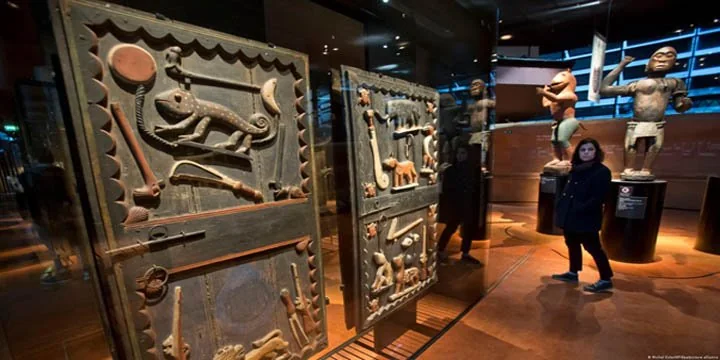
Context: During the recent visit of Cambodian Prime Minister to France in January President Emmanuel Macron pledged support for returning more Khmer artifacts and also for technical assistance to expand the National Museum of Cambodia. France president is often cited as the first European leader to lend a voice to long-standing demands from Asian states for the return of their antiquities. Also he gave a speech in 2017 in which he noted that he would “do everything possible” to return the cultural heritage that colonial France had looted.
Context:
- During the recent visit of Cambodian Prime Minister to France in January President Emmanuel Macron pledged support for returning more Khmer artifacts and also for technical assistance to expand the National Museum of Cambodia.
- France president is often cited as the first European leader to lend a voice to long-standing demands from Asian states for the return of their antiquities.
- Also he gave a speech in 2017 in which he noted that he would “do everything possible” to return the cultural heritage that colonial France had looted.
- A few months back, the Musee Guimet in Paris, France’s national museum of Asian art, had agreed to return the head and body of a seventh-century Khmer statue to Cambodia on a five-year loan agreement (which had been taken in the 1880s).
- In 2017, Berlin also followed suit and agreed to return to the southern African nation of Namibia artifacts taken during a genocide in the early 20th century.
- Last year two museums in the Netherlands, including the Rijksmuseum, handed back hundreds of artifacts to Indonesia and Sri Lanka which were former Dutch colonies.
- However it is sad to note that Dutch museums returning hundreds of artifacts to Indonesia last year it refused to hand over the remains of the “Java Man” which is the first known fossil of the Homo Erectus species discovered during the colonial era.
- Last year the Austrian government said it would propose a national legislation governing the restitution of objects in national museums acquired by colonialism by March 2024.
- It is being said that the repatriation of artifacts provides an ample opportunity to rebrand for Western governments.
What’s the legal basis for returning artifacts?
- The 1970 UNESCO Convention on the Means of Prohibiting and Preventing the Illicit Import, Export and Transfer of Ownership of Cultural Property is the principal legal source dealing when a country makes a claim to have its possessions returned.
- But sadly this convention does not apply retrospectively, so it does not include the peak phase of colonialism.
About the 1970 Convention:
- The 1970 Convention on the Means of Prohibiting and Preventing the Illicit Import, Export and Transfer of Ownership of Cultural Property urges the State Parties to take measures to prohibit and prevent the illicit trafficking of cultural property.
- It provides a common framework for the States Parties on the measures to be taken in order to prohibit and prevent the import, export and transfer of cultural property.
- The return and restitution of cultural property is central to the Convention.
- The convention’s duty is not only to remember but to fundamentally safeguard the identity of peoples and promote peaceful societies whereby the spirit of solidarity will be strengthened.
- Hence the 1970 Convention is fully in line with the Sustainable Development Goals defined in the United Nations 2030 Agenda.
- Articles 7 and 13 of the 1970 convention consist of the provisions for restitution.
- Prelims: Key facts, institutions, locations and terminology in the article.
- Mains: Connect the topic with Economy, International Relations, Polity & Governance.
- Revision: Use the article headings to prepare concise notes and answer-writing points.
Test your understanding
Questions from this article
Prelims practiceWith reference to Will Europe ever return ‘looted’ Asian artifacts?, consider the following statements:
- During the recent visit of Cambodian Prime Minister to France in January President Emmanuel Macron pledged support for returning more Khmer artifacts and also for technical assistance to expand the National Museum of…
- France president is often cited as the first European leader to lend a voice to long-standing demands from Asian states for the return of their antiquities.
- Also he gave a speech in 2017 in which he noted that he would “do everything possible” to return the cultural heritage that colonial France had looted.
Which of the statements given above are correct?
- 1 and 2 only
- 2 and 3 only
- 1 and 3 only
- 1, 2 and 3
View answer
Answer: (d) 1, 2 and 3. All three statements are drawn from the article.
Mains practiceDiscuss the background, key issues and significance of Will Europe ever return ‘looted’ Asian artifacts? for India.
Answer in 250 words.
View answer approach
- Context:
- What’s the legal basis for returning artifacts?
- About the 1970 Convention:
Frequently asked questionsFrequently asked questions
Why is Will Europe Ever Return ‘Looted’ Asian Artifacts in the news?
Context: During the recent visit of Cambodian Prime Minister to France in January President Emmanuel Macron pledged support for returning more Khmer artifacts and also for technical assistance to expand the National Museum of Cambodia. France president is often cited as the first European leader to lend a voice to long-standing demands from Asian states for the return of their antiquities.
What are the key facts about Will Europe Ever Return ‘Looted’ Asian Artifacts?
Also he gave a speech in 2017 in which he noted that he would “do everything possible” to return the cultural heritage that colonial France had looted. A few months back, the Musee Guimet in Paris, France’s national museum of Asian art, had agreed to return the head and body of a seventh-century Khmer statue to Cambodia on a five-year loan agreement (which had been taken in the 1880s). In 2017, Berlin also followed suit and agreed to return to the southern African nation of Namibia artifacts taken during a genocide in the early 20th century.
Why is Will Europe Ever Return ‘Looted’ Asian Artifacts important for UPSC preparation?
The topic connects current developments with Economy, International Relations, Polity & Governance and is relevant for both objective revision and analytical answer writing.