WHO says that the Ebola outbreak that emerged in the Democratic Republic of Congo (DRC) is growing “ more complex,” with cases now present in East and West Africa. This warning came after Nigeria, the first West African country, reported its first case of Imported Ebola virus of the same strain that originated in the DRC. The outbreak is spreading now from Central African countries like Kenya and DRC to the West African countries, highlighting the public health concern.
Why in the News?
Nigeria confirmed its first imported case of Ebola Bundibugyo virus disease in the Federal Capital Territory, Abuja.
- The patient is a woman who travelled from Uganda and arrived in Abuja on 3–5 October. She developed symptoms on 7 October and sought private medical care on 11 October. Laboratory confirmation came on 20 October.
- The case is linked to the Bundibugyo strain; this was the same strain that caused a major outbreak in DRC recently.
- However, a single imported case may not lead to an outbreak, but stricter preventive measures are required.
Why does WHO call it “complex”?
This outbreak of Ebola began in the DRC in mid-May 2026. After the first outbreak in the DRC, cases have increased in neighbouring countries due to transmission. Cases have been reported in East African countries including Uganda and Kenya, and now in Nigeria in West Africa. WHO calls it complex because:
- The virus is spreading faster in other regions due to transmission, making contact tracing harder.
- Nigeria is Africa’s most populous country, so there are more chances of direct transmission which can cause public health concern.
- The Bundibugyo strain which is spreading now has no approved vaccine or specific treatment, unlike some other Ebola strains for which vaccines exist.
- Health systems in several African countries are under pressure due to limited preparedness capacity.
What is Ebola disease?
Ebola, also known as Ebola virus disease (EVD), is a rare and severe zoonotic illness caused by orthoebolaviruses. The current 2026 outbreak is caused by the Bundibugyo virus.
- Origin: Ebola virus was first identified in 1976 in Central Africa. It was discovered during two separate outbreaks, one in the Democratic Republic of the Congo (DRC) and another in South Sudan. The virus was named after the Ebola River in the DRC, near the area of the first identified outbreak.
- Symptoms: Sudden fever, fatigue, muscle pain, headache, sore throat, vomiting, diarrhea, a rash, impaired kidney and liver function, and internal or external bleeding.
- Incubation period: 2 to 21 days (averaging 8 to 10 days).
- Transmission: Spreads through broken skin or mucous membranes with blood or bodily fluids (urine, saliva, vomit, semen) of infected people
- Fatality: EVD is highly lethal, with average fatality rates around 50%. Past outbreaks have recorded fatality rates varying between 25% and 90%.
- Prevention: Prophylactic vaccines like ERVEBO are available for the Zaire strain for prevention. During an outbreak, spread should be prevented through contact tracing, safe burials, and strict personal protective equipment (PPE) use.
- Treatment: Early rehydration, symptom management, and intensive care drastically improve survival rates.
FDA-approved monoclonal antibody treatments (such as Inmazeb or Ebanga) exist for specific species like the Zaire ebolavirus.
How does the Ebola virus spread?
Ebola spreads mainly through direct contact with the blood or other body fluids of an infected person.
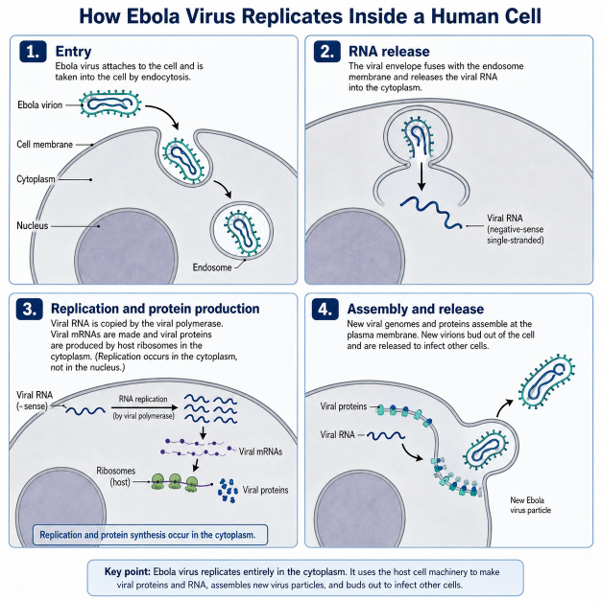
Mechanism of Ebola infection
Ebola is a virus that enters human cells, multiplies inside them, weakens the immune system, and can damage important organs.
- Entry into the cell: The Ebola virus attaches to the cell and enters it through a process called endocytosis.
- Release of RNA: Inside the cell, the virus releases its genetic material, called RNA, into the cytoplasm.
- Replication and protein production:
- The viral RNA is copied to make new viral genetic material.
- The virus uses the host cell's machinery to produce viral proteins.
- These materials are needed to make new viruses.
4. Assembly and release: The newly formed viral RNA and proteins combine to form new virus particles. These particles leave the cell and can infect other cells.
Can Ebola become the next Pandemic?
WHO has declared the Ebola Bundibugyo outbreak a public health emergency of international concern (PHEIC). But, as per WHO, there are fewer chances of it becoming a COVID-19-style pandemic.
Why the risk is limited
- Ebola spreads through direct contact with blood or body fluids, not through ordinary airborne transmission like influenza, measles, or COVID-19. Thus, transmission slows down; it only happens when you are in contact with the infected person for a prolonged period of time.
- People who are infected with the virus are generally not infectious (spread the disease) until the symptoms appear, which makes screening, isolation, and contact tracing more effective and easier than for viruses like COVID and Influenza.
Why it is still serious
DRC alone had 9,552 confirmed cases and 4,602 confirmed deaths as of 18 October 2026, and the outbreak has spread to Uganda, Kenya, Nigeria, and France through travel-linked cases. The main risks are:-
- Weak health systems: Delayed diagnosis, inadequate isolation facilities, and unsafe burial practices can amplify transmission.
- Cross-border movement: Cases have already moved from DRC through Uganda to Kenya and Nigeria, showing that travel can carry the virus to new regions.
- No approved Bundibugyo vaccine or treatment: Unlike Zaire Ebola, for which Ervebo is available, the current Bundibugyo strain has no approved vaccine or specific antiviral treatment.
WHO response
The World Health Organization (WHO) is working with the governments of DRC, Kenya, and Nigeria to control the outbreak of Ebola. WHO has scaled up Ebola readiness in 22 countries across Africa, Asia, and Europe, especially where conflict, displacement, and weak health systems increase the risk of delayed detection and wider transmission. Core response measures:
- Surveillance and case investigation: WHO supports countries in identifying suspected cases early, investigating travel and exposure histories, and confirming infections through laboratory testing.
- Contact tracing: Health teams identify everyone who may have been exposed, monitor them for symptoms, and isolate suspected cases quickly.
- Infection prevention and control (IPC): This includes personal protective equipment, safe patient handling, disinfection, and preventing transmission in hospitals and clinics.
- Community awareness: Shares information about symptoms, transmission, prevention, and safe burial practices.
- Vaccination and treatment: Supports access to vaccines and appropriate treatments where available and recommended.
- International coordination: Issues technical guidance and coordinates cross-border cooperation and emergency preparedness.
Conclusion
Emphasise a proactive, resilient, and inclusive public-health system. Link with India’s One Health Approach. The reported Ebola outbreak highlights the importance of international cooperation, rapid disease surveillance, and effective public health preparedness. The World Health Organization (WHO) plays a crucial role in coordinating responses, sharing accurate information, and supporting affected countries in containing the virus. Strengthening healthcare systems, ensuring early detection, and implementing appropriate infection prevention measures are essential to limiting the risk of further transmission. For the latest developments, readers should follow official WHO and national public health updates to ensure they have accurate information about the outbreak and the measures being taken to protect public health.
Test your understanding
Questions from this article
Prelims practiceQuestion: With reference to the Ebola virus, consider the following statements:
- Ebola virus is an enveloped, negative-sense single-stranded RNA virus.
- It was first identified in 1976, and its name is derived from the Ebola River in the present-day Democratic Republic of the Congo.
- It spreads primarily through direct contact with the blood or other body fluids of an infected person who is ill.
- The World Health Organization (WHO) declaring a Public Health Emergency of International Concern (PHEIC) automatically means that a pandemic has been declared.
- Fruit bats are considered likely natural hosts of Ebola viruses.
Which of the statements given above are correct?
- 1, 2 and 3 only
- 1, 3, 4 and 5 only
- 1, 2, 3 and 5 only
- 2, 3, 4 and 5 only
View answer and explanation
Suggested answer: (c) 1, 2, 3 and 5 only
Explanation: Statements 1, 2, 3 and 5 are correct. Statement 4 is incorrect because a PHEIC is an international public health emergency designation; it does not automatically mean a pandemic has been declared.
Mains practiceQuestion: Discuss the major challenges in preventing and controlling infectious disease outbreaks. Suggest measures to strengthen India’s preparedness for future pandemics. (250 words, 15 marks)
View answer-writing approach
Answer approach:
Introduction: link emerging infectious diseases with global health security concerns. Mention globalisation, urbanisation, etc.
Body:
Mention the challenges in prevention and control.
Measures to strengthen India's preparedness.
Frequently asked questionsFrequently asked questions
What is WHO- Complex Ebola Outbreak Spreads from East Africa to Nigeria, Raises Alarm?
The WHO warning on the complex Ebola outbreak, the reported spread from East Africa to Nigeria, potential health risks, and global public health concerns
Why is WHO- Complex Ebola Outbreak Spreads from East Africa to Nigeria, Raises Alarm relevant for UPSC preparation?
This warning came after Nigeria, the first West African country, reported its first case of Imported Ebola virus of the same strain that originated in the DRC
What key points should aspirants remember about WHO- Complex Ebola Outbreak Spreads from East Africa to Nigeria, Raises Alarm?
The article covers Why in the News?, Why does WHO call it “complex”?, What is Ebola disease? and How does the Ebola virus spread?.