Kerala government on Tuesday (May 7) said that cases of
West Nile fever have been reported from
three districts in the state –
Thrissur, Malappuram and Kozhikode. One person died of the viral disease on Monday and
six other cases have been reported in recent days.
State Health Minister Veena George has now asked these regions to stay vigilant and ordered that
steps be taken for mosquito control, according to a statement released by her office.
According to the health department, West Nile virus
can cause a fatal neurological disease in humans. However, approximately
80 percent of those infected will not show any symptoms.
What is the West Nile Virus?
The West Nile Virus (WNV) is a mosquito-borne,
single-stranded RNA virus. It is a flavivirus and is related to the viruses that
cause Japanese encephalitis and
yellow fever.
How does the West Nile Virus spread?
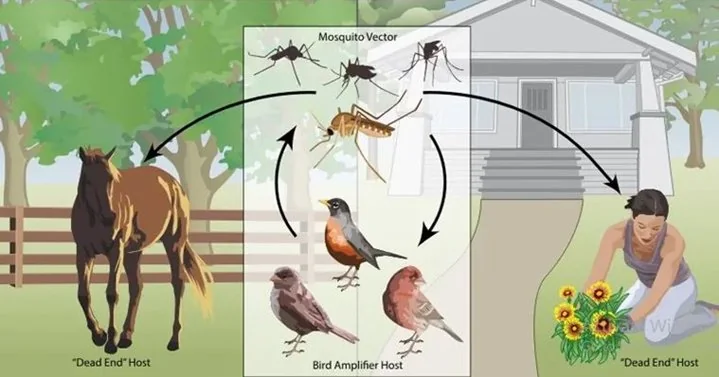
Culex species of mosquitoes act as the
principal vectors for transmission. Infected mosquitoes spread the disease among
humans and animals, including
birds, which are the reservoir host of the virus.
Mosquitoes become infected when they feed on infected birds, which circulate the virus in their blood for a few days. The virus eventually gets into the mosquito’s salivary glands. During later blood meals (when mosquitoes bite), the virus may be injected into humans and animals, where it can multiply and possibly cause illness,” says the World Health Organisation (WHO).
 ARE THERE OTHER WAYS IN WHICH IT CAN BE SPREAD?
WNV can also spread through
blood transfusion, from an infected mother to her child, or through exposure to the virus in laboratories.
CAN IT SPREAD VIA CONTACT?
It is
not known to spread by contact with infected humans or animals. To date, no human-to-human transmission of WNV through casual contact has been documented, says the WHO.
CAN IT SPREAD THROUGH EATING INFECTED ANIMALS?
According to the US Centers for Disease Control and Prevention (CDC), it does not spread “through eating infected animals, including birds.”
WHAT IS THE INCUBATION PERIOD?
According to CDC, incubation period for WNV disease is typically
2 to 6 days, but can be
2 to 14 days, and can be several weeks in immunocompromised people.
WHAT ARE THE SYMPTOMS OF WNV?
The disease is
asymptomatic in 80% of the infected people. The rest develop what is called the
West Nile fever or severe West Nile disease. For them, the symptoms include
fever, headache, fatigue, body aches, nausea, rash, and swollen glands.
“it is estimated that approximately
1 in 150 persons infected with the West Nile Virus will develop a more severe form of disease. Recovery from severe illness might take several weeks or months. Some effects to the central nervous system might be permanent,” says the CDC.
It usually turns
fatal in persons with comorbidities and
immunocompromised persons (such as transplant patients). But the
death rate is relatively low.
WHAT IS THE TREATMENT FOR WNV?
No WNV-specific prophylaxis, treatment or vaccine is available. Only
supportive treatments are given to neuroinvasive WNV patients.
Health authorities globally advice for personal protective measures to reduce the risk of mosquito bites, such as using
mosquito repellents.
Public health departments are to also
ensure larval source reduction, especially at breeding and resting sites for the mosquito vectors.
WHY IS IT CALLED THE WEST NILE VIRUS?
- The virus was first isolated in a woman in West Nile district of Uganda in 1937.
- It was identified in birds (crows and columbiformes like doves and pigeons) in the Nile delta region in 1953.
- Before 1997, WNV was not considered pathogenic for birds, but then, a more virulent strain caused deaths of different bird species in Israel, presenting signs of encephalitis and paralysis.
- In 1999, a WMV strain, believed to be one circulating in Israel and Tunisia, reached New York and produced a large outbreak that spread across the United States and eventually across the Americas, from Canada to Venezuela.
- WNV outbreak sites are found along major bird migratory routes. Today, the virus is found commonly in Africa, Europe, the Middle East, North America, and West Asia.
Test your understanding
Questions from this article
Prelims practiceWith reference to West Nile Fever, consider the following statements:
- The virus was first isolated in a woman in West Nile district of Uganda in 1937.
- It was identified in birds (crows and columbiformes like doves and pigeons) in the Nile delta region in 1953.
- Before 1997, WNV was not considered pathogenic for birds, but then, a more virulent strain caused deaths of different bird species in Israel, presenting signs of encephalitis and paralysis.
Which of the statements given above are correct?
- 1 and 2 only
- 2 and 3 only
- 1 and 3 only
- 1, 2 and 3
View answer
Answer: (d) 1, 2 and 3. All three statements are drawn from the article.
Mains practiceDiscuss the background, key issues and significance of West Nile Fever for India.
Answer in 250 words.
View answer approach
- How does the West Nile Virus spread?
- WHAT IS THE TREATMENT FOR WNV?
- WHY IS IT CALLED THE WEST NILE VIRUS?
Frequently asked questionsFrequently asked questions
Why is West Nile Fever in the news?
Kerala government on Tuesday (May 7) said that cases of West Nile fever have been reported from three districts in the state – Thrissur, Malappuram and Kozhikode. One person died of the viral disease on Monday and six other cases have been reported in recent days.
What are the key facts about West Nile Fever?
State Health Minister Veena George has now asked these regions to stay vigilant and ordered that steps be taken for mosquito control, according to a statement released by her office. According to the health department, West Nile virus can cause a fatal neurological disease in humans. However, approximately 80 percent of those infected will not show any symptoms.
Why is West Nile Fever important for UPSC preparation?
The topic connects current developments with Economy, Polity & Governance, Health and is relevant for both objective revision and analytical answer writing.