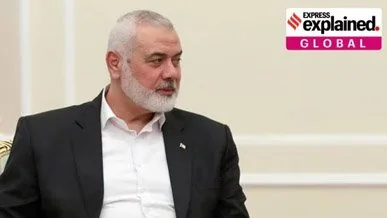
ASSASINATION OF HAMAS LEADER: ISMAIL HANIYEH
Ismail Haniyeh, the
Qatar-based public face of Hamas, was assassinated in Iran in what might mark a
defining moment in the ongoing war between
Israel and the Palestinian militant group.
 WHERE WAS HANIYEH ASSASSINATED?
Haniyeh was
killed in Tehran, where
he had gone to attend the inauguration of the
newly-elected Iranian President Masoud Pezeshkian.
HAS INDIA ISSUED ANY RESPONSE ON THIS EVENT?
While
New Delhi is yet to issue a response with regards to the assassination, Union Transport Minister
Nitin Gadkari is also in Tehran at the moment for Pezeshkian’s inauguration.
WHAT DOES THIS ASSASINATION MEAN FOR DIFFERENT STAKEHOLDERS?
1: For Israel: A success
On
October 7, 2023,
Hamas killed at least 1,200 Israeli civilians and
military personnel, and took about
250 hostages. Since then, the Israeli military has pounded Gaza with air strikes and ground operations, with the stated aim of going after Hamas leaders.
More than 40,000 people have been killed in the process.
From the
Israeli point of view, this is a major victory in its mission to neutralise Hamas — a stated objective behind launching the
Operation Swords of Iron. Haniyeh is the most highly placed Hamas figure to have been killed so far.
2: For Hamas: A provocation
From Hamas’ perspective, however,
this is a major provocation since
Haniyeh was the head of its political bureau, based in Qatar. He was the
public face of Hamas, and was
negotiating the terms of the hostages deal and the ceasefire, while
Yahya Sinwar is the military leader who was responsible for the October 7 attacks.
In a statement,
Hamas mourned the death of Haniyeh, saying he was killed in
“a treacherous Zionist raid on his residence in Tehran” after attending the swearing-in ceremony of the new Iranian president.
Hamas official Sami Abu Zuhri told Reuters that the assassination of Haniyeh in Iran is a grave escalation.
3: Message that Iran not safe
The fact that the
targeted strike took place in Tehran will be seen as a major escalatory move, both by Hamas and Iran. For
Israel, this is a signal that Hamas leaders are not safe in Iran and in Iran’s protection.
In April this year,
Iran and Israel had exchanged a round of missile and drone attacks at each other. Temperatures had cooled since then, but this assassination has the potential to trigger further hostilities.
4: Pressure on Pezeshkian:
Within
Iran and Hamas, there will
now be calls for avenging Haniyeh’s death, which are certain to
put pressure on the newly-elected
moderate President Pezeshkian. The president’s election campaign
focussed on beginning negotiations with the West, primarily for economic reasons given how damaging Western sanctions have been for Iran. He would have hoped to restart dialogue with Europe, to begin with.
But, with
Haniyeh’s assassination, Pezeshkian will be
under pressure from the IRGC and the
hardliners in the Iranian establishment to respond in kind.
Iran will “defend its territorial integrity, dignity, honor, and pride, and will make the terrorist occupiers regret their cowardly act” of assassinating Haniyeh in Tehran, President Pezeshkian said on Wednesday.
5: Lifeline for Netanyahu
This assassination
gives a lifeline to Israel’s Prime Minister
Benjamin Netanyahu.
He has been facing questions about his leadership, and
his political survival was at stake. There has been
growing pressure on him to finally
strike the hostage deal with Hamas, which was being brokered by the
US, Egypt and Qatar, among others.
The assassination has the
potential to upend all such efforts for the time being, and it is expected to prolong the war in Gaza.
This will mean that
Netanyahu will likely stay till the war is over.
6: Questions for Kamala Harris:
The campaign for the
US elections in November is now at a pivotal stage with
Vice President Kamala Harris now the prospective Democratic nominee.
She has
signalled that she will be tougher on Netanyahu, and his war in Gaza, as compared to her predecessor Joe Biden. This is especially crucial as Harris is focussed on
getting the support of younger Democratic voters.
The
assassination complicates things for her. She will now have to think and formulate a response, in case there is an escalation in the region.
7: On West Asia
For the region as a whole,
the assassination is not good news, especially if Iran and Hamas escalate. Such an escalation will impact all of West Asia.
Qatar, Turkey, and the Yemeni Houthis have already condemned the assassination, and the top regional players like
Saudi Arabia, UAE are watching the events closely.
After
more than nine months of war in Gaza, this is a defining moment — after the development in April when there was a risk of escalation — when the region might get drawn into a broader conflict.
8: On India:
India is
still processing the developments, with the South Block mindful of the sensitivities of a response. While
New Delhi does not harbour any positive sentiments about the Hamas leaders, it will be careful in its framing — since the matter involves a
targeted assassination in a foreign soil.
The
immediate Indian concern will be the peace and stability in the region which is home to about
nine million Indian expats, apart from supplying almost
two-third of India’s crude.
ASSASINATION OF SENIOR HEZBOLLAH LEADER IN LEBANON: FUAD SHUKR
Hezbollah,
the Shiite Islamic militant group based in Lebanon, said its senior commander
Fuad Shukr was
killed in an Israeli airstrike in the capital
Beirut, early on Wednesday (July 31).
Israeli Defence Forces (IDF) also posted on their X account how
Shukr, Hezbollah’s
“Most Senior Military Commander” and
“Right-Hand Man” of
Hezbollah General Secretary Hassan Nasrallah, had been “eliminated”.
IS IT SEEN AS A RETALIATION?
The attack is being
seen as retaliation for a rocket strike in
Israel-controlled Golan Heights on Sunday that led to the deaths of 12 children and teenagers.
WHO ARE THE HEZBOLLAH?
Hezbollah, whose name means
‘Party of God’, is a
Shiite Islamic militant organisation from Lebanon.
The think tank
Centre for Strategic and International Studies (CSIS) has described it as
“The world’s most heavily armed non-state actor, with a large and diverse stockpile of unguided artillery rockets, as well as ballistic, anti air, antitank, and anti shipmissiles”
HISTORY
In modern history, Lebanon was under
a French mandate until
1943 and after it ended,
power was divided into various religious groups, with posts such as Prime Minister and President of the country reserved for people of particular religious denominations.
Origin of hezbollah:
Hezbollah originated during the
Lebanese Civil War (1975-1990), which was a result of “long-simmering discontent over the large, armed Palestinian presence in the country”, according to the Council on Foreign Relations (CFR).
- Palestinian refugees in Lebanon were targeting Israel & being targeted by them.
- Their presence also led to Israeli forces invading southern Lebanon in 1978 and again in 1982 to expel Palestinian guerrilla fighters.
- This would lead to the formation of Hezbollah, which was also inspired by the formation of a theocratic Islamic government in Iran in 1979. “Iran and its Islamic Revolutionary Guard Corps (IRGC) provided funds and training to the budding militia,”
AIM
It
opposes Israel and Western influence in West Asia. It has also, along with Russia and Iran,
supported the regime of
President Bashar al-Assad in neighbouring Syria during its civil war.
It became
more visible in
Lebanese politics in the
mid-2000s and
currently holds 13 of the country’s 128-member Parliament. Along with allies,
it is part of the ruling government.
But in recent years, there have been protests against its work in the country with worsening issues of unemployment, government debt and poverty.
GLOBAL RECOGNITION OF HEZBOLLAH
Many
Western governments characterise it as a
terrorist organisation, as does the
Gulf Cooperation Council.
MEMBERS OF GULF COOPERATION COUNCIL
- Bahrain,
- Kuwait,
- Oman,
- Qatar,
- Saudi Arabia and
- UAE.
WHY IS HEZBOLLAH IN THE CONFLICT?
The answer lies in the
Abraham Accords signed in
2020. (Brokered by USA & signed between
Israel & Arab muslim countries like
UAE & Bahrain. Later other Arab countries also recognised & established diplomatic relations with Israel)
The Convergence:
According to a Reuters analysis, the
motivations of Hamas are related to it
opposing the greater engagements between Israel and other West Asian governments in recent years – a significant development considering the fact that most of them lacked diplomatic relations with Israel. It has these goals in common with Hezbollah, which is much better equipped to fight.