UPSC Current Affairs
Vertical Fiscal Imbalance
gap between the revenue collection capabilities and expenditure responsibilities of different levels of government in a federal system. VFI IN INDIA In India, this imbalance manifests as: Revenue vs. Spending: The central government collects the majority of the revenue, while States are responsible for a significant portion of public expenditure.
VRAuthor Desk
3 min read

gap between the revenue collection capabilities and expenditure responsibilities of different levels of government in a federal system. VFI IN INDIA In India, this imbalance manifests as: Revenue vs. Spending: The central government collects the majority of the revenue, while States are responsible for a significant portion of public expenditure.
gap between the revenue collection capabilities and expenditure responsibilities of different levels of government in a federal system.
VFI IN INDIA
In India, this imbalance manifests as:
- Revenue vs. Spending: The central government collects the majority of the revenue, while States are responsible for a significant portion of public expenditure.
- For example,15th Finance Commission noted, States handle 61% of the total expenditure but collect only 38% of the revenue.
- Dependence on Transfers: Due to this imbalance, States are heavily reliant on financial transfers from the central government to meet their spending needs.
WHY SHOULD VFI BE REDUCED?
- Efficiency in Collection and Spending:
- Tax Collection: The central government is more effective at collecting major taxes, such as income and corporate taxes, due to its broader reach and resources.
- Spending Efficiency: States are generally better equipped to handle spending on local services and projects because they are closer to the citizens who use these services.
- Impact of VFI:
- Growing Imbalances: 15th Finance Commission noted, India’s VFI has been growing larger compared to other federations, particularly exacerbated during crises like the COVID-19 pandemic, which widened the gap between State revenues and expenditure needs.
- Finance Commission's Role: The Finance Commission addresses VFI by determining how to allocate tax revenues and grants between the central and State governments.
COMPONENTS OF VFI
- Tax Sharing:
- Net Proceeds: The Finance Commission allocates a portion of the central government's tax revenues to the States based on "Net Proceeds" (total tax revenues minus special charges and collection costs).
- Distribution Among States: The Commission also decides how these funds are distributed among the individual States.
- Grants and Conditional Transfers:
- Article 275 Grants: These are generally short-term, purpose-specific financial aids provided to States in need.
- Article 282 Transfers: The central government may fund specific projects through central schemes, though these often come with conditions attached.
- Unconditional Transfers:
- Tax Sharing: Unlike grants, tax sharing is an unconditional transfer, giving States more flexibility to use the funds as needed.
MEASURING VFI IN INDIA
- How It’s Calculated?
- Formula: VFI is measured using the ratio:
- Numerator: Sum of the revenue collected by States and the revenue transferred from the central government.
- Denominator: Total expenditure required by States.
- Interpretation: If this ratio is less than 1, it indicates that States do not have sufficient revenue from their own collections and transfers to cover their spending needs. The shortfall (1 minus the ratio) represents the extent of VFI.
VFI POST DEVOLUTION OF TAXES
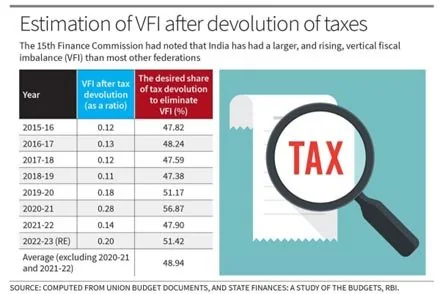 Devolution Shares
: To address VFI effectively, the share of net proceeds allocated to States should be approximately 48.94%. However, the 14th and 15th Finance Commissions recommended lower shares (42% and 41%, respectively).
- Prelims: Key facts, institutions, locations and terminology in the article.
- Mains: Connect the topic with Economy, Polity & Governance.
- Revision: Use the article headings to prepare concise notes and answer-writing points.
Test your understanding
Questions from this article
Prelims practiceWith reference to Vertical Fiscal Imbalance, consider the following statements:
- Revenue vs. Spending: The central government collects the majority of the revenue, while States are responsible for a significant portion of public expenditure. For example,15th Finance Commission noted, States handle…
- For example,15th Finance Commission noted, States handle 61% of the total expenditure but collect only 38% of the revenue.
- Dependence on Transfers: Due to this imbalance, States are heavily reliant on financial transfers from the central government to meet their spending needs.
Which of the statements given above are correct?
- 1 and 2 only
- 2 and 3 only
- 1 and 3 only
- 1, 2 and 3
View answer
Answer: (d) 1, 2 and 3. All three statements are drawn from the article.
Mains practiceDiscuss the background, key issues and significance of Vertical Fiscal Imbalance for India.
Answer in 250 words.
View answer approach
- VFI IN INDIA
- In India, this imbalance manifests as:
- WHY SHOULD VFI BE REDUCED?
- COMPONENTS OF VFI
- MEASURING VFI IN INDIA
Frequently asked questionsFrequently asked questions
Why is Vertical Fiscal Imbalance in the news?
gap between the revenue collection capabilities and expenditure responsibilities of different levels of government in a federal system. VFI IN INDIA In India, this imbalance manifests as: Revenue vs.
What are the key facts about Vertical Fiscal Imbalance?
Spending: The central government collects the majority of the revenue, while States are responsible for a significant portion of public expenditure. For example,15th Finance Commission noted, States handle 61% of the total expenditure but collect only 38% of the revenue. Dependence on Transfers: Due to this imbalance, States are heavily reliant on financial transfers from the central government to meet their spending needs.
Why is Vertical Fiscal Imbalance important for UPSC preparation?
The topic connects current developments with Economy, Polity & Governance and is relevant for both objective revision and analytical answer writing.