UPSC Current Affairs
Unconditional Cash Transfers Welfare Benefits, Fiscal Costs and Political Impact
Unconditional Cash Transfer (UCT) schemes offer direct financial support, empowering women and providing income relief while raising concerns over fiscal pressure, economic sustainability, and unpredictable political outcomes.
VRKalpana Sharma
3 min read
Unconditional Cash Transfer (UCT) schemes offer direct financial assistance to citizens without work or behavioral conditions, providing income support and promoting women’s empowerment while raising concerns over fiscal sustainability and political uncertainty. Unconditional Cash Transfers provide direct financial support to vulnerable populations, improving income security, consumption, and women’s empowerment. However, large-scale UCT programmes can increase fiscal pressure and dependency concerns. Their political impact remains significant, as governments may use welfare transfers to build public support while balancing economic sustainability and social equity.
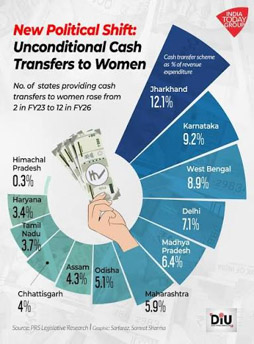
Why in the News?
- Since 2020, Unconditional Cash Transfer (UCT) schemes have increasingly become an electoral strategy, particularly for women voters.
- Despite increasing cash benefits before elections, some incumbent governments implementing such schemes were defeated.
- This highlights the political costs of targeting and beneficiary selection.
What are UCTs?
- Unconditional Cash Transfers provide direct financial assistance without requiring beneficiaries to meet a behavioural condition.
- They can support women’s economic security and partly recognise their unpaid domestic and care work.
- According to the source, States were expected to spend around $18 billion on UCTs in 2025–26, much of it targeted at women.
Why Governments Use UCTs
- Provide immediate income support.
- Improve women’s financial autonomy.
- Recognise unpaid care and domestic work.
- Create a direct connection between welfare delivery and beneficiaries.
- Can become an important electoral instrument.
Major Concerns
1. Fiscal Pressure
- Large UCT commitments may require:
- Expenditure switching
- Higher fiscal deficits
- This can reduce resources available for:
- Employment generation
- Self-employment programmes
- Productive investment
2. Difficulties in Targeting
Governments often cannot directly observe incomes, particularly among informal-sector workers. Therefore, they use proxy indicators such as:
- Land ownership
- Electricity consumption
- Household assets
This creates two types of errors:
| Error | Meaning |
|---|
| Inclusion error | Ineligible households receive benefits |
| Exclusion error | Eligible households are left out |
Political Cost of Targeting
The important issue is that perceived unfairness can be politically damaging even when administrative rules are correctly followed.
- An excluded household may believe it deserved the benefit.
- A beneficiary may be viewed by others as undeserving because of apparent affluence.
- Thus, both actual and perceived targeting errors can generate dissatisfaction.
Example: Kalaignar Magalir Urimai Thittam
- Initially promised ₹1,000 per month to women-headed households.
- Fiscal constraints resulted in eligibility restrictions based on factors such as:
- Income
- Land ownership
- Other criteria
- Around 1.13 crore women were initially covered.
- After complaints, another 16.94 lakh beneficiaries were added in December 2025.
- Expenditure was ₹13,807 crore in 2025–26.
- Despite expansion, dissatisfaction reportedly continued.
Other Examples
- Lakshmir Bhandar: Faced allegations regarding inclusion of non-residential beneficiaries.
- Mukhya Majhi Ladki Bahin Yojana: Faced concerns over inclusion errors.
- Gruha Lakshmi: Faced concerns over exclusion errors.
Economics vs Politics
There is an inherent tension:
- Economic logic: Target benefits → concentrate scarce resources on the most needy.
- Political logic: Broader inclusion → fewer people feel unfairly excluded.
- Hence, better targeting from an economic perspective may sometimes increase political dissatisfaction.
UCTs vs Conditional Transfers
Unconditional Cash Transfers (UCTs) and Conditional Cash Transfers (CCTs) are the two main approaches to modern social welfare and humanitarian assistance, providing direct financial support to low-income and vulnerable populations.
Conditional Cash Transfers (CCTs)
- Benefits are linked to desirable outcomes or behaviours.
- This can generate wider developmental benefits.
- Conditionality may also encourage self-selection, reducing some targeting-related grievances.
Example: Midday Meal Scheme
- Participation is linked to school enrolment.
- It simultaneously promotes:
- School participation
- Nutrition
- Human capital development
- Self-selection can reduce some grievances associated with beneficiary identification.
Way Forward
- Assess UCTs on fiscal sustainability, not only electoral popularity.
- Improve beneficiary databases and grievance-redress mechanisms.
- Minimise inclusion and exclusion errors.
- Combine cash support with:
- Employment opportunities
- Skill development
- Self-employment
- Human-capital investments
- Where appropriate, design welfare programmes around developmental outcomes rather than cash transfers alone.
- Recognise political costs alongside economic and social benefits while designing welfare policies.
Conclusion
Unconditional cash transfers are becoming an important part of welfare policies in India, especially schemes that provide direct financial support to women. The growing use of these schemes has started a debate about their welfare benefits and political costs. Cash transfers can provide immediate support to low-income households and help them manage essential expenses. They also give beneficiaries greater freedom to decide how to use the money. Direct transfers through bank accounts can improve the delivery of welfare benefits and reduce leakages. However, large cash-transfer programmes can increase the financial burden on state governments. Critics argue that excessive spending on such schemes may reduce the funds available for long-term investments in health, education and infrastructure. Their increasing use in election promises has also raised concerns about the “freebies” debate and electoral competition. The key challenge is to balance social welfare, fiscal sustainability and long-term development.
Test your understanding
Questions from this article
Prelims practiceQuestion: With reference to Unconditional Cash Transfers Welfare Benefits, Fiscal Costs and Political Impact, consider the following statements:
- Unconditional Cash Transfer (UCT) schemes offer direct financial assistance to citizens without work or behavioral conditions, providing income support and promoting women’s empowerment.
- Unconditional Cash Transfers provide direct financial support to vulnerable populations, improving income security, consumption, and women’s empowerment
Which of the statements given above is/are correct?
- 1 only
- 2 only
- Both 1 and 2
- Neither 1 nor 2
View answer and explanation
Suggested answer: (c) Both 1 and 2
Explanation: Unconditional Cash Transfer (UCT) schemes offer direct financial support, empowering women and providing income relief while raising concerns over fiscal pressure, economic sustainability, and unpredictable political outcomes
Mains practiceQuestion: Discuss Unconditional Cash Transfers Welfare Benefits, Fiscal Costs and Political Impact with reference to Why in the News?, What are UCTs?, Why Governments Use UCTs and Major Concerns. (150 words, 10 marks)
View answer-writing approach
Answer approach:
- Introduce the topic using its meaning and context.
- Explain Why in the News?, What are UCTs?, Why Governments Use UCTs and Major Concerns.
- Use facts and examples given in the article.
- Conclude with a balanced way forward.
Frequently asked questionsFrequently asked questions
What is Unconditional Cash Transfers Welfare Benefits, Fiscal Costs and Political Impact?
Unconditional Cash Transfer (UCT) schemes offer direct financial support, empowering women and providing income relief while raising concerns over fiscal pressure, economic sustainability, and unpredictable political outcomes
Why is Unconditional Cash Transfers Welfare Benefits, Fiscal Costs and Political Impact relevant for UPSC preparation?
Unconditional Cash Transfers provide direct financial support to vulnerable populations, improving income security, consumption, and women’s empowerment
What key points should aspirants remember about Unconditional Cash Transfers Welfare Benefits, Fiscal Costs and Political Impact?
The article covers Why in the News?, What are UCTs?, Why Governments Use UCTs and Major Concerns.