UPSC Current Affairs
The rooftop solar plan: India’s solar power capacity, target, and the way forward
Ongoing programme In 2014, Prime Minister Modi set a goal of installing 100 GW of solar power in India by 2022, a five-fold increase from the previous target. Of this, 40 GW was expected to come from grid-connected rooftop solar systems. However, this target has been significantly missed.
VRAuthor Desk
3 min read
Ongoing programme In 2014, Prime Minister Modi set a goal of installing 100 GW of solar power in India by 2022, a five-fold increase from the previous target. Of this, 40 GW was expected to come from grid-connected rooftop solar systems. However, this target has been significantly missed.
Ongoing programme
- In 2014, Prime Minister Modi set a goal of installing 100 GW of solar power in India by 2022, a five-fold increase from the previous target. Of this, 40 GW was expected to come from grid-connected rooftop solar systems.
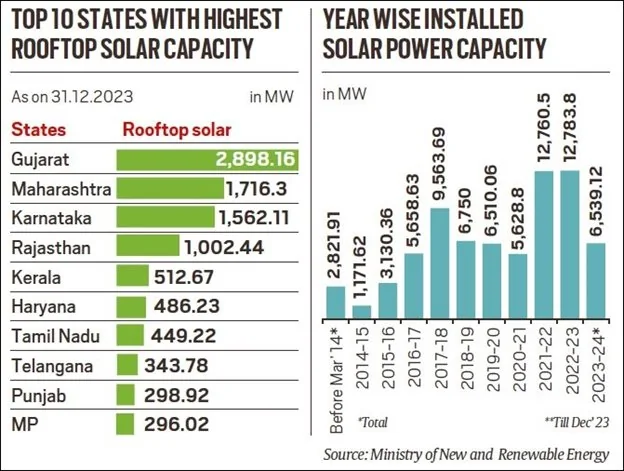
- However, this target has been significantly missed. By the end of last year, the total installed solar capacity was only 73.3 GW, with rooftop solar contributing about 11 GW.
- The shortfall is partly due to disruptions caused by the Covid-19 pandemic and a less than optimal growth rate of solar power. The 40 GW target for rooftop solar systems is now expected to be reached by 2026.
The Suryodaya Yojana
- The new programme announced by Prime Minister Modi, the Pradhan Mantri Suryodaya Yojana, is unique in that it targets a specific number of households for the installation of rooftop solar systems, rather than focusing on installed capacity.
- This approach is similar to initiatives launched in the United States and some European countries in the past. The programme aims to tap into the largely untouched residential sector, which currently accounts for just 20% of rooftop solar installations, with the majority being in the commercial and industrial sectors.
- A report by the Council on Energy, Environment and Water (CEEW) suggests that India’s nearly 25 crore households have the potential to deploy 637 GW of solar energy on rooftops.
- While not all of this is feasible, there is significant scope for growth, with about one-fifth of this potential, or about 118 GW, being achievable.
- The potential for rooftop solar is uniformly distributed across all states and regions, unlike large solar parks which require substantial corporate investments, large land areas, and robust transmission lines.
Energy access and security
- The overall objectives of programs like the Pradhan Mantri Suryodaya Yojana are to ensure energy security, transition to non-fossil fuel sources, and increase energy access.
- India has committed to ensuring that by 2030, about 50% of its electricity generation comes from non-fossil fuel-based sources.
- Currently, this share is at 43%, with renewables contributing about 30% of the total installed capacity. However, with India’s electricity demand expected to rise sharply, renewable energy, particularly solar, needs to grow rapidly.
- However, potential alone is not enough. The government needs to incentivize the installation of rooftop solar on individual households, and financial incentives alone will not suffice.
- Other measures need to be taken to create an enabling environment for greater penetration. Experts believe that learnings from ongoing programs will help design a successful model for the Suryodaya Yojana.
- A key intervention needed is to enable and empower distribution companies without adding financial burden. Improving the financial health of these companies, many of which are struggling, is a prerequisite for the success of the new program.
Conclusion- The Pradhan Mantri Suryodaya Yojana, announced by Prime Minister Modi, marks a significant shift in India’s approach to solar energy. By targeting individual households rather than installed capacity, the program aims to tap into the largely untouched residential sector. However, the success of this initiative will depend not only on financial incentives but also on creating an enabling environment for greater penetration of solar power. This includes empowering distribution companies and improving their financial health.
With India’s commitment to ensuring that 50% of its electricity generation comes from non-fossil fuel-based sources by 2030, programs like these are crucial. They represent a step towards achieving energy security, transitioning to non-fossil fuel sources, and increasing energy access.
- Prelims: Key facts, institutions, locations and terminology in the article.
- Mains: Connect the topic with Health.
- Revision: Use the article headings to prepare concise notes and answer-writing points.
Test your understanding
Questions from this article
Prelims practiceWith reference to The rooftop solar plan: India’s solar power capacity, target, and the way forward, consider the following statements:
- In 2014, Prime Minister Modi set a goal of installing 100 GW of solar power in India by 2022, a five-fold increase from the previous target. Of this, 40 GW was expected to come from grid-connected rooftop solar systems.
- However, this target has been significantly missed. By the end of last year, the total installed solar capacity was only 73.3 GW, with rooftop solar contributing about 11 GW.
- The shortfall is partly due to disruptions caused by the Covid-19 pandemic and a less than optimal growth rate of solar power. The 40 GW target for rooftop solar systems is now expected to be reached by 2026.
Which of the statements given above are correct?
- 1 and 2 only
- 2 and 3 only
- 1 and 3 only
- 1, 2 and 3
View answer
Answer: (d) 1, 2 and 3. All three statements are drawn from the article.
Mains practiceDiscuss the background, key issues and significance of The rooftop solar plan: India’s solar power capacity, target, and the way forward for India.
Answer in 250 words.
View answer approach
- Background and context
- Key facts and institutional framework
- Significance and way forward
Frequently asked questionsFrequently asked questions
Why is The Rooftop Solar Plan: India’S Solar Power Capacity, Target, And The Way Forward in the news?
Ongoing programme In 2014, Prime Minister Modi set a goal of installing 100 GW of solar power in India by 2022, a five-fold increase from the previous target. Of this, 40 GW was expected to come from grid-connected rooftop solar systems.
What are the key facts about The Rooftop Solar Plan: India’S Solar Power Capacity, Target, And The Way Forward?
However, this target has been significantly missed. By the end of last year, the total installed solar capacity was only 73.3 GW, with rooftop solar contributing about 11 GW. The shortfall is partly due to disruptions caused by the Covid-19 pandemic and a less than optimal growth rate of solar power.
Why is The Rooftop Solar Plan: India’S Solar Power Capacity, Target, And The Way Forward important for UPSC preparation?
The topic connects current developments with Health and is relevant for both objective revision and analytical answer writing.