UPSC Current Affairs
Terrorism’s Changing Face and India’s Counter-Terrorism Strategy
Terrorism is evolving through lone-actor attacks, cyber threats, radicalisation, drones, terror financing, and transnational networks. Explore India’s counter-terrorism strategy, covering intelligence, legal frameworks, security agencies, technology, and international cooperation.
VRArpit Adlakha
6 min read
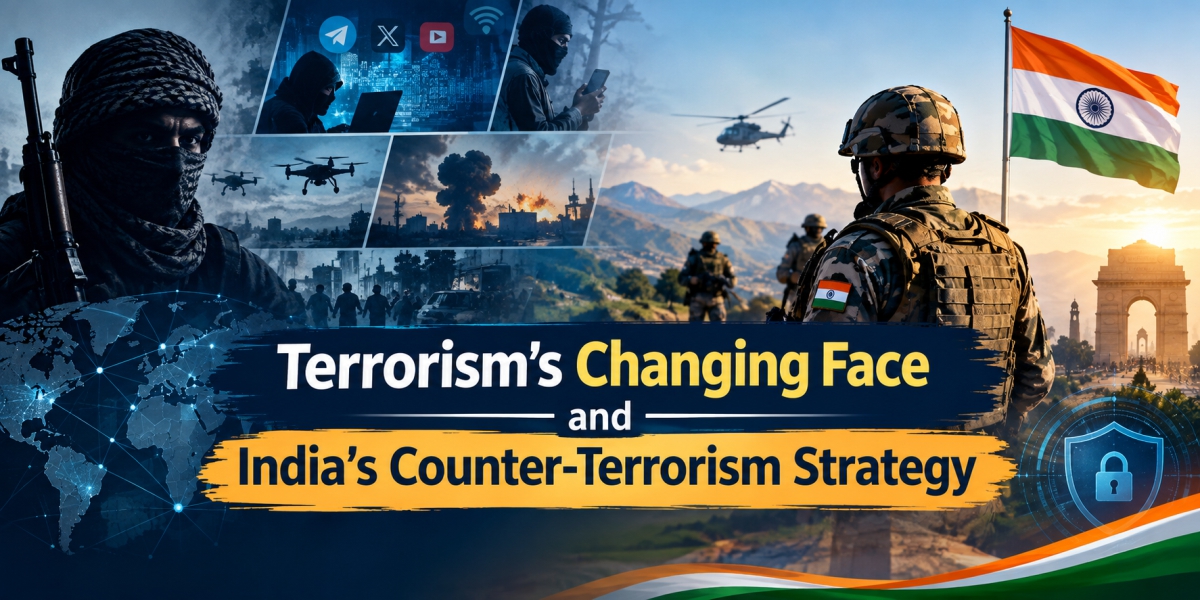
Terrorism has changed a lot after the 9/11 attacks. Earlier, terrorist groups were usually large organisations with a clear leadership structure. Today, many groups work through small, independent cells and lone attackers.
Why in the News?
- 25 years after 9/11, terrorism has evolved from large, centrally controlled organisations into smaller, decentralised networks and lone-wolf attacks.
- Terror groups increasingly exploit drones, cyber capabilities and Artificial Intelligence (AI).
- India’s counter-terrorism approach has also shifted from restraint and reactive responses to a more proactive strategy against cross-border terrorism.
- India unveiled PRAHAAR, its first comprehensive National Counter-Terrorism Policy and Strategy, on 23 February 2026.
Changing Nature of Terrorism
| Earlier Pattern | Emerging Pattern |
|---|
| Large, hierarchical organisations | Smaller, decentralised groups |
| Centralised leadership | Autonomous cells and lone actors |
| Conventional weapons | Drones, cyber tools and AI |
| Physical networks | Digitally enabled radicalisation and coordination |
| Large-scale coordinated attacks | Smaller, unpredictable attacks |
| Primarily physical battlefield | Physical + cyber + technological domains |
Post-9/11 Transformation
- The 9/11 attacks (2001) fundamentally altered global counter-terrorism strategies.
- Organisations such as al-Qaeda and Islamic State (ISIS) demonstrated the threat posed by highly organised transnational terrorism.
- Over time, counter-terrorism pressure weakened large hierarchical structures, encouraging terrorist networks to become more fragmented and autonomous.
- Technology has simultaneously created new avenues for recruitment, communication, surveillance evasion and attacks.
Evolution of Terrorism in India
1. Early Phase: Cross-Border Terrorism and Reactive Response
- India faced a growing terrorist threat, particularly in Kashmir, from the early 1990s.
Major attacks exposed weaknesses in India's internal security architecture:
- 1991: Assassination of former Prime Minister Rajiv Gandhi by LTTE at Sriperumbudur, Tamil Nadu.
- 1993: Mumbai serial blasts — over 250 deaths in 13 coordinated explosions.
- 1998: Coimbatore serial blasts.
- 1999: Hijacking of IC-814; India released terrorists including Masood Azhar and Ahmed Omar Sheikh in exchange for hostages.
- 2000: Red Fort attack by Lashkar-e-Taiba terrorists.
- 2001: Parliament attack by Jaish-e-Mohammed (JeM).
- 2002: Akshardham Temple attack.
- 2005: Delhi serial blasts.
- 2006: Varanasi serial blasts.
- 2008: Delhi blasts followed by the 26/11 Mumbai attacks.
- 2010: German Bakery blast, Pune.
- 2011: Delhi High Court blast.
2. Operation Parakram — 2001–02
- The Parliament attack triggered Operation Parakram, involving large-scale military mobilisation against Pakistan.
- However, India ultimately did not undertake direct military action against Pakistan.
- The presence of nuclear weapons on both sides raised concerns about escalation.
3. 26/11 Mumbai Attacks — A Turning Point
- The 2008 Mumbai attacks became a major turning point in international recognition of India's concerns regarding Pakistan-sponsored cross-border terrorism.
- Despite the severity of the attack, India did not undertake direct military action against Pakistan.
- This contributed to the perception of a largely restrained and reactive counter-terrorism policy.
Watch : Terrorism’s Changing Face and India’s Counter-Terrorism Strategy
Shift Towards Proactive Counter-Terrorism
- After 2014, India increasingly adopted a strategy aimed at imposing direct costs on terrorist networks operating across the border.
Uri Surgical Strikes — 2016
- 18 September 2016: JeM terrorists attacked an Army camp at Uri.
- 28–29 September 2016: Indian forces conducted cross-border surgical strikes against terrorist launch pads.
- Significance:
- Marked a major shift from strategic restraint.
- Demonstrated India's willingness to conduct pre-emptive cross-border operations.
Balakot Air Strike — 2019
- 14 February 2019: Pulwama attack targeted a CRPF convoy.
- The Indian Air Force subsequently conducted strikes against a JeM terror camp at Balakot, Pakistan.
- It marked the first instance cited in the source of the IAF crossing into Pakistani airspace to strike a terror target.
Operation Sindoor — 2025
- 22 April 2025: Terrorist attack in Pahalgam triggered a major Indian response.
- On 6–7 May 2025, Indian armed forces launched Operation Sindoor.
- The operation targeted the Pakistan-based terror infrastructure of LeT and JeM.
- It represented the strongest expression of India’s policy of imposing direct costs on cross-border terror networks.
India’s Present Counter-Terrorism Doctrine
Following Operation Sindoor, India articulated three broad positions:
- End of strategic restraint
- Terror attacks will no longer be met merely with warnings or diplomatic responses.
- Cross-border terrorism as an ‘act of war’
- Future attacks originating from Pakistan are to be treated with a much stronger security response.
- Nuclear deterrence will not prevent counter-action
- India has indicated that nuclear threats will not automatically restrain its response to terrorism.
PRAHAAR: National Counter-Terrorism Policy and Strategy, 2026
- Unveiled on 23 February 2026.
- Described as India’s first comprehensive National Counter-Terrorism Policy and Strategy.
- Focuses on:
- Prevention of terrorism.
- Effective response to terrorist threats.
- Countering radicalisation.
- Coordination among government agencies.
- Participation of wider society.
Core Approach
Whole-of-Government + Whole-of-Society
- Whole-of-Government: coordination among security, intelligence, law-enforcement and other governmental institutions.
- Whole-of-Society: involvement of communities and civil society in preventing radicalisation and strengthening resilience.
Four-Fold Strategy for India
1. Eliminate Remaining Terror Networks
- Continue intelligence-led operations against residual terrorist networks.
- Focus particularly on Jammu & Kashmir.
- Prevent surviving networks from rebuilding their operational capacity.
2. Pre-emptive Action
- Identify and neutralise threats developing across the Line of Control (LoC).
- Target potential terrorist launch infrastructure where necessary.
- Leverage India's established intelligence and security networks.
3. De-radicalisation
- Develop comprehensive programmes to:
- Prevent extremist recruitment.
- Bring vulnerable youth into the mainstream.
- Reduce social support for terrorist organisations.
- Make participation in terrorist activities increasingly unattractive and costly.
4. Counter Terror Financing
- Disrupt the financial ecosystem supporting terrorism.
- Strengthen cooperation with friendly and partner countries.
- Target the flow of funds that enables recruitment, logistics and operations.
Key Challenges
- Infiltration: Small groups of terrorists may still cross the LoC and evade security agencies.
- Lone-wolf terrorism: Decentralised actors are difficult to detect before an attack.
- Technology: Drones, cyber capabilities and AI provide new tools to terrorist organisations.
- Radicalisation: Online and social networks can facilitate extremist recruitment.
- Terror financing: Terror networks can use increasingly sophisticated financial channels.
- Nuclear backdrop: India-Pakistan tensions continue to carry escalation risks.
- International double standards: Countries may selectively respond to terrorism depending on geopolitical interests.
Global Dimension
At the Shanghai Cooperation Organisation Summit in Bishkek (1 September 2026), India stressed that countries supporting or sheltering terrorists should face a strong international message that terrorism cannot become a strategic instrument.
At the 18th BRICS Summit in New Delhi, the Delhi Declaration included a dedicated paragraph on the Pahalgam terror attack, reflecting broader international attention to terrorism.
India’s Counter-Terrorism Approach: Evolution
| Phase | Approach | Major Examples |
|---|
| 1990s–2001 | Reactive/internal security response | Mumbai blasts, Coimbatore blasts, Kashmir terrorism |
| 2001–2014 | Strategic restraint + diplomatic pressure | Parliament attack, Operation Parakram, 26/11 |
| 2016 onwards | Proactive cross-border response | Uri surgical strikes |
| 2019 | Air power against terror infrastructure | Balakot |
| 2025 onwards | Stronger deterrence + direct cost imposition | Operation Sindoor |
| 2026 | Institutionalised national strategy | PRAHAAR |
Key highlights
- Strengthen real-time intelligence sharing among central and State agencies.
- Improve counter-drone, cyber and AI-enabled threat detection.
- Expand community-based de-radicalisation and rehabilitation programmes.
- Strengthen international cooperation against terror financing and safe havens.
- Improve border surveillance and intelligence penetration along vulnerable infiltration routes.
- Maintain diplomatic efforts to build a stronger global consensus against terrorism and its sponsors.
- Ensure counter-terrorism operations remain consistent with rule of law and constitutional safeguards.
Conclusion
Terrorism has changed a lot after the 9/11 attacks. Earlier, terrorist groups were usually large organisations with a clear leadership structure. Today, many groups work through small, independent cells and lone attackers. Terrorists are also using drones, cyber tools, AI and social media for recruitment, communication and attacks. India has also changed its approach from mainly reacting after attacks to taking stronger preventive and cross-border action. The Uri surgical strikes (2016), Balakot air strike (2019) and Operation Sindoor (2025) show this change. In 2026, India introduced PRAHAAR, its first comprehensive National Counter-Terrorism Policy and Strategy. It focuses on preventing terrorism, stopping terror funding, countering radicalisation and improving coordination between security agencies. India still faces challenges such as infiltration, online radicalisation, lone-wolf attacks, terror financing and the misuse of new technology. Strong intelligence, border security and international cooperation remain important.
Test your understanding
Questions from this article
Prelims practiceQuestion: With reference to Terrorism’s Changing Face and India’s Counter-Terrorism Strategy, consider the following statements:
- Terrorism has changed a lot after the 9/11 attacks
- Earlier, terrorist groups were usually large organisations with a clear leadership structure
Which of the statements given above is/are correct?
- 1 only
- 2 only
- Both 1 and 2
- Neither 1 nor 2
View answer and explanation
Suggested answer: (c) Both 1 and 2
Explanation: Terrorism is evolving through lone-actor attacks, cyber threats, radicalisation, drones, terror financing, and transnational networks. Explore India’s counter-terrorism strategy, covering intelligence, legal frameworks, security agencies, technology, and international cooperation
Mains practiceQuestion: Discuss Terrorism’s Changing Face and India’s Counter-Terrorism Strategy with reference to Why in the News?, Changing Nature of Terrorism, Post-9/11 Transformation and Evolution of Terrorism in India. (150 words, 10 marks)
View answer-writing approach
Answer approach:
- Introduce the topic using its meaning and context.
- Explain Why in the News?, Changing Nature of Terrorism, Post-9/11 Transformation and Evolution of Terrorism in India.
- Use facts and examples given in the article.
- Conclude with a balanced way forward.
Frequently asked questionsFrequently asked questions
What is Terrorism’s Changing Face and India’s Counter-Terrorism Strategy?
Terrorism is evolving through lone-actor attacks, cyber threats, radicalisation, drones, terror financing, and transnational networks. Explore India’s counter-terrorism strategy, covering intelligence, legal frameworks, security agencies, technology, and international cooperation
Why is Terrorism’s Changing Face and India’s Counter-Terrorism Strategy relevant for UPSC preparation?
Earlier, terrorist groups were usually large organisations with a clear leadership structure
What key points should aspirants remember about Terrorism’s Changing Face and India’s Counter-Terrorism Strategy?
The article covers Why in the News?, Changing Nature of Terrorism, Post-9/11 Transformation and Evolution of Terrorism in India.