UPSC Current Affairs
Swell Waves
Indian National Centre for Ocean Information Services (INCOIS) on May 3 forecasted that high sea waves, also known as swell waves, might hit the coastal areas of Goa, Maharashtra, West Bengal, Odisha, Tamil Nadu, Kerala, Lakshadweep, Karnataka, Gujarat, and… To forecast swell waves, INCOIS launched the Swell Surge Forecast System in 2020 which can give forewarning seven days in advance. In March, swell waves led to flooding in several areas of Kerala — the worst affected were Alappuzha, Kollam, and Thiruvananthapuram districts.
VRAuthor Desk
2 min read
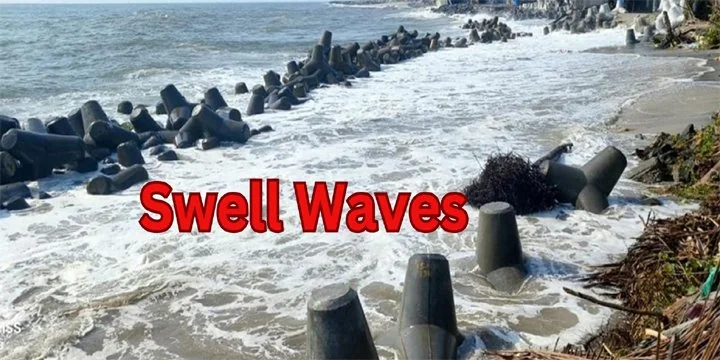
Indian National Centre for Ocean Information Services (INCOIS) on May 3 forecasted that high sea waves, also known as swell waves, might hit the coastal areas of Goa, Maharashtra, West Bengal, Odisha, Tamil Nadu, Kerala, Lakshadweep, Karnataka, Gujarat, and… To forecast swell waves, INCOIS launched the Swell Surge Forecast System in 2020 which can give forewarning seven days in advance. In March, swell waves led to flooding in several areas of Kerala — the worst affected were Alappuzha, Kollam, and Thiruvananthapuram districts.
Indian National Centre for Ocean Information Services (INCOIS) on May 3 forecasted that high sea waves, also known as swell waves, might hit the coastal areas of Goa, Maharashtra, West Bengal, Odisha, Tamil Nadu, Kerala, Lakshadweep, Karnataka, Gujarat, and Andaman & Nicobar Islands between May 4 and May 5.
To forecast swell waves, INCOIS launched the Swell Surge Forecast System in 2020 which can give forewarning seven days in advance.
In March, swell waves led to flooding in several areas of Kerala — the worst affected were Alappuzha, Kollam, and Thiruvananthapuram districts. Such flooding events are called Kallakkadal in Kerala.
WHAT ARE SWELL WAVES?
These waves are formed by an ocean swell, hence the name swell surge. Ocean swells occur not due to the local winds, but rather due to distant storms like hurricanes, or even long periods of fierce gale winds.
During such storms, huge energy transfer takes place from the air into the water, leading to the formation of very high waves.
Such waves can travel thousands of kilometres from the storm centre until they strike shore.
ARE SWELL WAVES FREQUENT?
Usually, states like Kerala witness swell waves as a result of strong winds in the southern part of the Indian Ocean, where an ocean swell is generated, and the waves then travel north to reach the coast in two or three days.
The March swell waves were generated after a low atmospheric pressure system moved over the region from the South Atlantic Ocean — 10,000 kilometres off the Indian coast.
The arrival of the pressure system resulted in strong winds, which led to the formation of swell waves of up to 11 metres in height. These waves hit the Kerala coast and Lakshadweep.
DIFFERENCE BETWEEN TSUNAMI & SWELL WAVES
Unlike swell waves, a tsunami is a series of enormous waves created by an underwater disturbance usually associated with earthquakes occurring below or near the ocean.
Tsunamis are around 10 times faster than swell waves.
Although both swell waves and tsunamis slow down near the coast, the latter hit land at 30–50 km/h.
- Prelims: Key facts, institutions, locations and terminology in the article.
- Mains: Connect the topic with Environment.
- Revision: Use the article headings to prepare concise notes and answer-writing points.
Test your understanding
Questions from this article
Prelims practiceWith reference to Swell Waves, consider the following statements:
- Indian National Centre for Ocean Information Services (INCOIS) on May 3 forecasted that high sea waves, also known as swell waves, might hit the coastal areas of Goa, Maharashtra, West Bengal, Odisha, Tamil Nadu, Kerala, Lakshadweep, Karnataka, Gujarat, and…
- To forecast swell waves, INCOIS launched the Swell Surge Forecast System in 2020 which can give forewarning seven days in advance.
- In March, swell waves led to flooding in several areas of Kerala — the worst affected were Alappuzha, Kollam, and Thiruvananthapuram districts.
Which of the statements given above are correct?
- 1 and 2 only
- 2 and 3 only
- 1 and 3 only
- 1, 2 and 3
View answer
Answer: (d) 1, 2 and 3. All three statements are drawn from the article.
Mains practiceDiscuss the background, key issues and significance of Swell Waves for India.
Answer in 250 words.
View answer approach
- Background and context
- Key facts and institutional framework
- Significance and way forward
Frequently asked questionsFrequently asked questions
Why is Swell Waves in the news?
Indian National Centre for Ocean Information Services (INCOIS) on May 3 forecasted that high sea waves, also known as swell waves, might hit the coastal areas of Goa, Maharashtra, West Bengal, Odisha, Tamil Nadu, Kerala, Lakshadweep, Karnataka, Gujarat, and… To forecast swell waves, INCOIS launched the Swell Surge Forecast System in 2020 which can give forewarning seven days in advance.
What are the key facts about Swell Waves?
In March, swell waves led to flooding in several areas of Kerala — the worst affected were Alappuzha, Kollam, and Thiruvananthapuram districts. Such flooding events are called Kallakkadal in Kerala. These waves are formed by an ocean swell, hence the name swell surge.
Why is Swell Waves important for UPSC preparation?
The topic connects current developments with Environment and is relevant for both objective revision and analytical answer writing.