UPSC Current Affairs
Super Blue Moon
second year in a row, Raksha Bandhan or Rakhi which is celebrated on the full moon day (that is on Purnima in the month of Shravan), is marked by the sighting of a ‘super blue moon’ on Monday (August 19). This is an unusual astronomical feat — the full moon being both a “blue moon” and a “super moon,” giving rise to the “Super Blue Moon,” a rare trifecta of astronomical events. A supermoon is a full moon that occurs when the Moon is closest to Earth in its orbit.
VRAuthor Desk
3 min read
second year in a row, Raksha Bandhan or Rakhi which is celebrated on the full moon day (that is on Purnima in the month of Shravan), is marked by the sighting of a ‘super blue moon’ on Monday (August 19). This is an unusual astronomical feat — the full moon being both a “blue moon” and a “super moon,” giving rise to the “Super Blue Moon,” a rare trifecta of astronomical events. A supermoon is a full moon that occurs when the Moon is closest to Earth in its orbit.
second year in a row, Raksha Bandhan or Rakhi which is celebrated on the full moon day (that is on Purnima in the month of Shravan), is marked by the sighting of a ‘super blue moon’ on Monday (August 19).
This is an unusual astronomical feat — the full moon being both a “blue moon” and a “super moon,” giving rise to the “Super Blue Moon,” a rare trifecta of astronomical events.
WHAT IS A SUPERMOON?
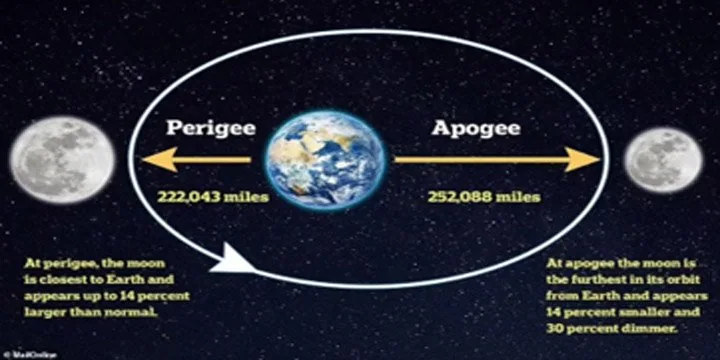
A supermoon is a full moon that occurs when the Moon is closest to Earth in its orbit.
This point in the Moon's orbit is called perigee. When a full moon coincides with perigee, it appears slightly larger and brighter than usual.
Why does it look bigger?
The Moon's orbit is not a perfect circle but an ellipse, meaning there are points where it's closer and farther from Earth.
When a full moon happens at the closest point (perigee), it appears larger in the sky.
WHAT IS A BLUE MOON?
Though the expression “once in a blue moon” implies a rare or unusual occurrence, a blue moon is not that rare an astronomical phenomenon. There are a couple of definitions of a blue moon.
(1) One that is most commonly understood — and is endorsed by NASA — describes the situation when a full moon is seen twice in a single month.
Because the new moon to new moon cycle lasts 29.5 days, a time comes when the full moon occurs at the beginning of a month, and there are days left still for another full cycle to be completed. Such a month, in which the full moon is seen on the 1st or 2nd, will have a second full moon on the 30th or 31st.
According to NASA, this happens every two or three years.
(2) Another widely accepted explanation relies on the astronomical season, defined as a period between a solstice and an equinox. The current astronomical summer began with the summer solstice on June 21, and will end with the autumn equinox on September 22.
The Maine Farmers’ Almanac in 1937 defined a blue Moon as the third full Moon in a quarterly season of four full Moons.
IS THE SUPER BLUE MOON ACTUALLY BLUE?
No. Sometimes, smoke or dust in the air can scatter red wavelengths of light, as a result of which the moon may, in certain places, appear more blue than usual. But this has nothing to do with the name “blue” moon.
IS THE SUPER BLUE MOON BIGGER IN SIZE?
According to NASA, a full moon at perigee (super moon) is about 14% bigger and 30% brighter than a full moon at apogee (called a “micro moon”).
Further, about 25 percent of all full moons are super moons, but only 3 percent of full moons are blue moons. The time between super blue moons is quite irregular ? it can be as much as 20 years ? but in general, 10 years is the average.
IS THE SIZE NOTICEABLE?
It is unlikely the difference in size will be noticeable to most people. The moon could appear somewhat brighter, though — but whether you are able to make out the difference will depend on factors such as the so-called ‘Moon illusion’, and how cloudy or polluted it is at your location.
- Prelims: Key facts, institutions, locations and terminology in the article.
- Mains: Connect the topic with Economy, Polity & Governance.
- Revision: Use the article headings to prepare concise notes and answer-writing points.
Test your understanding
Questions from this article
Prelims practiceWith reference to Super Blue Moon, consider the following statements:
- second year in a row, Raksha Bandhan or Rakhi which is celebrated on the full moon day (that is on Purnima in the month of Shravan), is marked by the sighting of a ‘super blue moon’ on Monday (August 19).
- This is an unusual astronomical feat — the full moon being both a “blue moon” and a “super moon,” giving rise to the “Super Blue Moon,” a rare trifecta of astronomical events.
- A supermoon is a full moon that occurs when the Moon is closest to Earth in its orbit.
Which of the statements given above are correct?
- 1 and 2 only
- 2 and 3 only
- 1 and 3 only
- 1, 2 and 3
View answer
Answer: (d) 1, 2 and 3. All three statements are drawn from the article.
Mains practiceDiscuss the background, key issues and significance of Super Blue Moon for India.
Answer in 250 words.
View answer approach
- IS THE SUPER BLUE MOON ACTUALLY BLUE?
- Background and context
- Key facts and institutional framework
- Significance and way forward
Frequently asked questionsFrequently asked questions
Why is Super Blue Moon in the news?
second year in a row, Raksha Bandhan or Rakhi which is celebrated on the full moon day (that is on Purnima in the month of Shravan), is marked by the sighting of a ‘super blue moon’ on Monday (August 19). This is an unusual astronomical feat — the full moon being both a “blue moon” and a “super moon,” giving rise to the “Super Blue Moon,” a rare trifecta of astronomical events.
What are the key facts about Super Blue Moon?
A supermoon is a full moon that occurs when the Moon is closest to Earth in its orbit. This point in the Moon's orbit is called perigee. When a full moon coincides with perigee, it appears slightly larger and brighter than usual.
Why is Super Blue Moon important for UPSC preparation?
The topic connects current developments with Economy, Polity & Governance and is relevant for both objective revision and analytical answer writing.