UPSC Current Affairs
Street Vendors Act
Street Vendors (Protection of Livelihood and Regulation of Street Vending) Act came into effect on May 1, 2014, marking a significant milestone after nearly four decades of legal jurisprudence and the tireless efforts of street vendor movements across India. Celebrated as a progressive legislation, the Act now faces numerous challenges in its implementation. SIGNIFICANCE Street vendors, estimated to constitute 2.5% of any city’s population, play multifaceted roles in city life.
VRAuthor Desk
3 min read
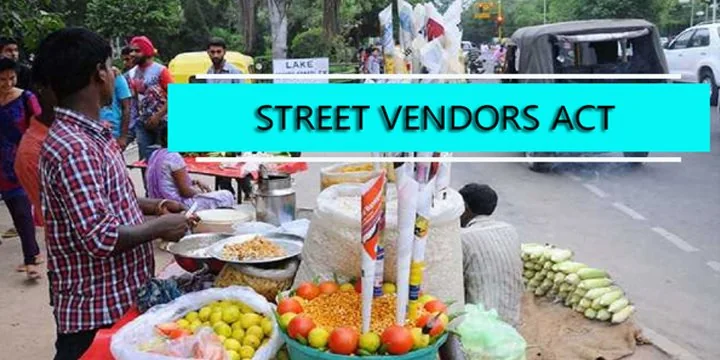
Street Vendors (Protection of Livelihood and Regulation of Street Vending) Act came into effect on May 1, 2014, marking a significant milestone after nearly four decades of legal jurisprudence and the tireless efforts of street vendor movements across India. Celebrated as a progressive legislation, the Act now faces numerous challenges in its implementation. SIGNIFICANCE Street vendors, estimated to constitute 2.5% of any city’s population, play multifaceted roles in city life.
Street Vendors (Protection of Livelihood and Regulation of Street Vending) Act came into effect on
May 1, 2014, marking a significant milestone after nearly four decades of legal jurisprudence and the tireless efforts of street vendor movements across India.
Celebrated as a
progressive legislation, the
Act now faces numerous challenges in its implementation.
SIGNIFICANCE
Street vendors, estimated to constitute
2.5% of any city’s population, play multifaceted roles in city life.
- Local vegetable sellers and food vendors are essential providers of daily services.
- Vending offers many migrants and the urban poor a source of modest yet consistent income.
- The vendors also make city life affordable for others by providing vital links in the food, nutrition, and goods distribution chain at reasonable prices.
- Street vendors are also integral to Indian culture.
PROVISIONS OF THE ACT
- It aimed to ‘protect’ and ‘regulate’ street vending in cities, with State-level rules and schemes, and execution by Urban Local Bodies (ULBs) through by-laws, planning, and regulation.
- The Act clearly delineates the roles and responsibilities of both vendors and various levels of government.
- It recognises the positive urban role of vendors and the need for livelihood protection.
- It commits to accommodating all ‘existing’ vendors in vending zones and issuing vending certificates.
- The Act establishes a participatory governance structure through Town Vending Committees (TVCs) and mandates that street vendor representatives must constitute 40% of TVC members, with a sub-representation of 33% of women street vendors.
- These committees are tasked with ensuring the inclusion of all existing vendors in vending zones.
- Additionally, the Act outlines mechanisms for addressing grievances and disputes, proposing the establishment of a Grievance Redressal Committee chaired by a civil judge or judicial magistrate.
CHALLENGES
- Challenges at the administrative level:
- There has been a noticeable increase in harassment and evictions of street vendors, despite the Act’s emphasis on their protection and regulation.
- This is often due to an outdated bureaucratic mindset that views vendors as illegal entities to be cleared.
- There is also a pervasive lack of awareness and sensitisation about the Act among state authorities, the wider public, and vendors themselves.
- TVCs often remain under the control of local city authorities, with limited influence from street vendor representatives.
- The representation of women vendors in TVCs is mostly tokenistic.
- Challenges at the Governance level:
- Existing urban governance mechanisms are often weak.
- The Act does not integrate well with the framework established by the 74th Constitutional Amendment Act for urban governance.
- ULBs lack sufficient powers and capacities.
- Schemes like the Smart Cities Mission, laden with resources and pushed through as policy priorities from the top-down, mostly focus on infrastructure development and ignore the provisions of the Act for the inclusion of street vendors in city planning.
- Challenges at the societal level:
- Prevailing image of the ‘world class city’ tends to be exclusionary.
- It marginalises and stigmatises street vendors as obstacles to urban development instead of acknowledging them as legitimate contributors to the urban economy.
- These challenges are reflected in city designs, urban policies, and public perceptions of neighbourhoods.
- Prelims: Key facts, institutions, locations and terminology in the article.
- Mains: Connect the topic with Economy, Polity & Governance.
- Revision: Use the article headings to prepare concise notes and answer-writing points.
Test your understanding
Questions from this article
Prelims practiceWith reference to Street Vendors Act, consider the following statements:
- Local vegetable sellers and food vendors are essential providers of daily services.
- Vending offers many migrants and the urban poor a source of modest yet consistent income.
- The vendors also make city life affordable for others by providing vital links in the food, nutrition, and goods distribution chain at reasonable prices.
Which of the statements given above are correct?
- 1 and 2 only
- 2 and 3 only
- 1 and 3 only
- 1, 2 and 3
View answer
Answer: (d) 1, 2 and 3. All three statements are drawn from the article.
Mains practiceDiscuss the background, key issues and significance of Street Vendors Act for India.
Answer in 250 words.
View answer approach
- PROVISIONS OF THE ACT
- CHALLENGES
- Background and context
- Key facts and institutional framework
- Significance and way forward
Frequently asked questionsFrequently asked questions
Why is Street Vendors Act in the news?
Street Vendors (Protection of Livelihood and Regulation of Street Vending) Act came into effect on May 1, 2014, marking a significant milestone after nearly four decades of legal jurisprudence and the tireless efforts of street vendor movements across India. Celebrated as a progressive legislation, the Act now faces numerous challenges in its implementation.
What are the key facts about Street Vendors Act?
SIGNIFICANCE Street vendors, estimated to constitute 2.5% of any city’s population, play multifaceted roles in city life. Local vegetable sellers and food vendors are essential providers of daily services. Vending offers many migrants and the urban poor a source of modest yet consistent income.
Why is Street Vendors Act important for UPSC preparation?
The topic connects current developments with Economy, Polity & Governance and is relevant for both objective revision and analytical answer writing.