UPSC Current Affairs
Special Category Status
Telugu Desam Party (TDP) president N Chandrababu Naidu emerged as a key player in national politics on Wednesday (June 4) after his party won 16 seats in the Lok Sabha election. TDP is in alliance with the Jana Sena Party and the BJP in Andhra Pradesh. Naidu is likely to extract several promises and assurances, the most important of which will be the status of a Special Category State for Andhra Pradesh.
VRAuthor Desk
3 min read
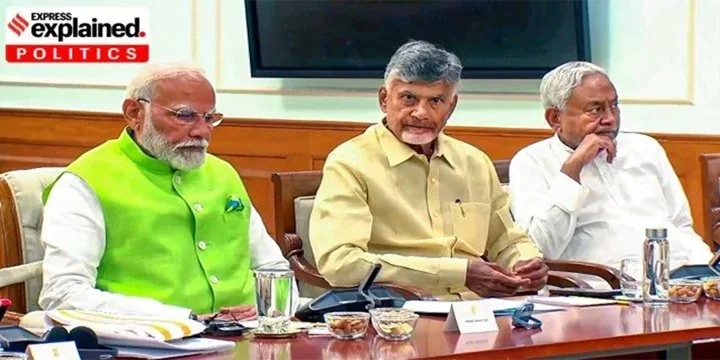
Telugu Desam Party (TDP) president N Chandrababu Naidu emerged as a key player in national politics on Wednesday (June 4) after his party won 16 seats in the Lok Sabha election. TDP is in alliance with the Jana Sena Party and the BJP in Andhra Pradesh. Naidu is likely to extract several promises and assurances, the most important of which will be the status of a Special Category State for Andhra Pradesh.
Telugu Desam Party (TDP) president N
Chandrababu Naidu emerged as a key player in national politics on Wednesday (June 4) after his party won 16 seats in the Lok Sabha election. TDP is in alliance with the Jana Sena Party and the BJP in Andhra Pradesh.
Naidu is likely to extract several promises and assurances, the most important of which will be the status of a
Special Category State for Andhra Pradesh.
WHAT IS SPECIAL CATEGORY STATUS?
In
1969, the
Fifth Finance Commission of India introduced the mechanism of SCS to
assist certain states in their
development and fast-tracking growth if they faced
historical, economic or geographical disadvantages.
FACTORS CONSIDERED:
- Difficult and hilly terrain,
- Low population density and/or a sizable tribal population,
- Strategic location along borders,
- Economic and infrastructural backwardness, and
- Non-viable nature of state finances.
TO WHICH STATES WAS SCS PROVIDED?
SCS was accorded to
11 states, including the
entire Northeast, and the border hill states of
Jammu and Kashmir, Himachal Pradesh, and Uttarakhand.
DID OTHER STATES DEMAND IT TOO?
Subsequently, other states too demanded SCS — including Naidu’s
AP; Bihar, whose Chief Minister Nitish Kumar is another key NDA ally; and
Odisha, where the BJP will now form the government.
THE CURRENT STATUS:
The system was
scrapped on the recommendation of the 14th Finance Commission, which suggested that the resource gap of the states should be filled by
increasing the devolution of tax to
42% from the existing 32%.
BENEFITS TO A SCS STATE
- SCS would mean higher grants-in-aid to the state government from the Centre. (grants to Special Category States is Rs. 5,573 crore per year, whereas AP (Non SCS) receives only Rs. 3,428 crore.)
- SCS states enjoy special industrial incentives such as:
- Income-tax exemptions,
- Custom duty waivers,
- Reduced excise duty,
- Corporate tax exemption for a certain period,
- Concessions and exemptions relating to GST, and
- Lower state and central taxes.
- In SCS states, the Centre funds Centrally Sponsored Schemes up to 90%, compared to 75% in non-SCS states.
WHY DOES AO WANT SPECIAL CATEGORY STATUS?
When
undivided AP was bifurcated to create
Telangana in 2014 through the AP Reorganisation Act, 2014,
the UPA government at the Centre had promised to grant SCS to AP
to compensate for the loss of revenue, and
of Hyderabad, where much of the development was concentrated.
- The 14th Finance Commission estimated that the post-devolution revenue deficit for AP for the five-year period 2015-20 would be 22,113 crore, but in reality, this figure stood at Rs. 66,362 crore.
- The debt of the residuary state, which was 97,000 crore at the time of bifurcation, reached Rs. 2,58,928 crore by 2018-19, and is more than Rs. 3.5 lakh crore now.
- AP argues that the undivided state was bifurcated in an unjust and inequitable manner — the successor state inherited nearly 59% of the population, debt, and liabilities of the original state, but only 47% of its revenues.
- For example, of the 57,000 crore of software exports from AP for the year 2013-14, Hyderabad city — with Telangana after the bifurcation — alone accounted for Rs. 56,500 crore.
- Today’s AP is essentially an agrarian state, with low economic buoyancy, leading to huge revenue disabilities. This is evident from the fact that the per capita revenue of Telangana for 2015-16 was Rs. 14,411, while it was only Rs. 8,397 for AP.
- Prelims: Key facts, institutions, locations and terminology in the article.
- Mains: Connect the topic with Economy, Polity & Governance.
- Revision: Use the article headings to prepare concise notes and answer-writing points.
Test your understanding
Questions from this article
Prelims practiceWith reference to Special Category Status, consider the following statements:
- Difficult and hilly terrain,
- Low population density and/or a sizable tribal population,
- Strategic location along borders,
Which of the statements given above are correct?
- 1 and 2 only
- 2 and 3 only
- 1 and 3 only
- 1, 2 and 3
View answer
Answer: (d) 1, 2 and 3. All three statements are drawn from the article.
Mains practiceDiscuss the background, key issues and significance of Special Category Status for India.
Answer in 250 words.
View answer approach
- FACTORS CONSIDERED:
- BENEFITS TO A SCS STATE
- Background and context
- Key facts and institutional framework
- Significance and way forward
Frequently asked questionsFrequently asked questions
Why is Special Category Status in the news?
Telugu Desam Party (TDP) president N Chandrababu Naidu emerged as a key player in national politics on Wednesday (June 4) after his party won 16 seats in the Lok Sabha election. TDP is in alliance with the Jana Sena Party and the BJP in Andhra Pradesh.
What are the key facts about Special Category Status?
Naidu is likely to extract several promises and assurances, the most important of which will be the status of a Special Category State for Andhra Pradesh. In 1969, the Fifth Finance Commission of India introduced the mechanism of SCS to assist certain states in their development and fast-tracking growth if they faced historical, economic or geographical disadvantages. FACTORS CONSIDERED: Difficult and hilly terrain, Low population density and/or a sizable tribal population, Strategic location along borders, Economic and infrastructural backwardness, and Non-viable nature of state finances.
Why is Special Category Status important for UPSC preparation?
The topic connects current developments with Economy, Polity & Governance and is relevant for both objective revision and analytical answer writing.