UPSC Current Affairs
SOLAR WASTE
100 kilo tonnes (kt) of solar waste in the financial year (FY) 2022-2023, according to a new study. The amount of solar waste produced by the country is expected to reach 600 kt by 2030, the study said. The current solar capacity of India stands at 66.7 GW as of March 2023 — it has increased by 23 times in the past 10 years — and is slated to jump to 292 GW of installed solar capacity by 2030.
VRAuthor Desk
3 min read

100 kilo tonnes (kt) of solar waste in the financial year (FY) 2022-2023, according to a new study. The amount of solar waste produced by the country is expected to reach 600 kt by 2030, the study said. The current solar capacity of India stands at 66.7 GW as of March 2023 — it has increased by 23 times in the past 10 years — and is slated to jump to 292 GW of installed solar capacity by 2030.
100 kilo tonnes (kt) of solar waste in the financial year
(FY) 2022-2023, according to a new study.
The amount of solar waste produced by the country is expected to reach
600 kt by 2030, the study said.
The
current solar capacity of India stands at
66.7 GW as of
March 2023 — it has
increased by 23 times in the past 10 years — and is slated to jump to
292 GW of installed solar capacity by 2030. Therefore, the management of solar waste is crucial for environmental, economic, and social reasons.
WHAT IS SOLAR WASTE?
Solar waste refers to the
waste generated during the manufacturing of solar modules and waste from the field (project lifetime), according to the study.
- Manufacturing involves two streams of waste,
- The scrap that’s produced and
- The waste generated from PV modules failing quality tests.
- Waste from the field involves three streams of waste.
- Waste generated during transporting and handling — the damaged modules are considered as waste.
- Waste produced due to the damage incurred by solar modules during their lifetime.
- When the modules reach their end-of-life and are not usable anymore.
THE FINDINGS
The study
only focused on waste from the field (project lifetime) category and excluded waste generated during manufacturing.
- By 2030, India’s current installed solar capacity will generate about 340 kt — three times more than the present. Around 67 per cent of this waste is expected to be produced by five states, including Rajasthan, Gujarat, Karnataka, Tamil Nadu, and Andhra Pradesh.
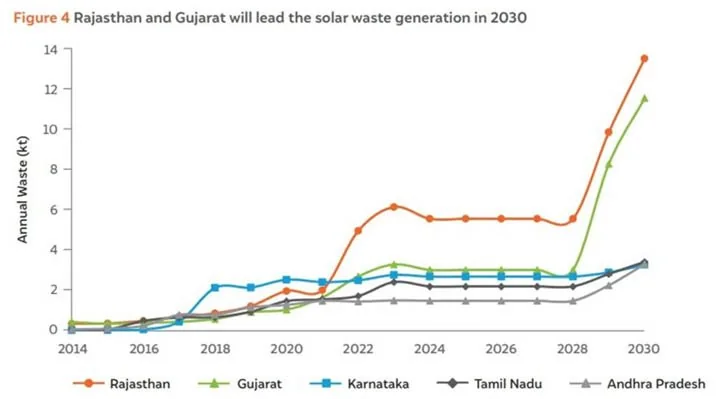
- The aforementioned states also plan to expand their solar capacity extensively in the following years.
- The cumulative waste from existing and new capacity (deployed between FY24 and FY30) will reach about 600 kt by 2030, according to the report.
- By 2050, it will increase to about 19,000 kt and 77% of which will be generated from new capacities.
- As the discarded modules contain minerals such as silicon, copper, tellurium, and cadmium — which have been classified as critical minerals for the country’s economic development and national security by the Indian government — the study
focused on them also. The 340 kt waste expected to be produced by 2030 would consist of 10kt of silicon, 12-18 tonnes of silver, and 16 tonnes of cadmium and tellurium.
HOW TO DEAL WITH SOLAR WASTE?
- Maintain a comprehensive database of the installed solar capacity, which would help in estimating solar waste in the following years.
- The policymakers should incentivise recyclers, and push stakeholders to effectively manage the growing solar waste.
- The report talked about two broad ways of recycling solar panels.
- First is conventional recycling or bulk material recycling, which involves mechanical processes like crushing, sieving, and shearing of the waste. While the majority of recycled materials consist of glass, aluminium, and copper, more valuable materials like silver and silicon cannot be recovered through this method.
- The other way of recycling is known as high-value recycling. It involves the use of a combination of mechanical, chemical, and thermal processes to recycle the modules. Unlike conventional recycling, this method can recover silver and silicon also with the help of chemical processes.
- Prelims: Key facts, institutions, locations and terminology in the article.
- Mains: Connect the topic with Economy, Polity & Governance.
- Revision: Use the article headings to prepare concise notes and answer-writing points.
Test your understanding
Questions from this article
Prelims practiceWith reference to SOLAR WASTE, consider the following statements:
- Manufacturing involves two streams of waste, The scrap that’s produced and The waste generated from PV modules failing quality tests.
- The scrap that’s produced and
- The waste generated from PV modules failing quality tests.
Which of the statements given above are correct?
- 1 and 2 only
- 2 and 3 only
- 1 and 3 only
- 1, 2 and 3
View answer
Answer: (d) 1, 2 and 3. All three statements are drawn from the article.
Mains practiceDiscuss the background, key issues and significance of SOLAR WASTE for India.
Answer in 250 words.
View answer approach
- HOW TO DEAL WITH SOLAR WASTE?
- Background and context
- Key facts and institutional framework
- Significance and way forward
Frequently asked questionsFrequently asked questions
Why is Solar Waste in the news?
100 kilo tonnes (kt) of solar waste in the financial year (FY) 2022-2023, according to a new study. The amount of solar waste produced by the country is expected to reach 600 kt by 2030, the study said.
What are the key facts about Solar Waste?
The current solar capacity of India stands at 66.7 GW as of March 2023 — it has increased by 23 times in the past 10 years — and is slated to jump to 292 GW of installed solar capacity by 2030. Therefore, the management of solar waste is crucial for environmental, economic, and social reasons. Solar waste refers to the waste generated during the manufacturing of solar modules and waste from the field (project lifetime), according to the study.
Why is Solar Waste important for UPSC preparation?
The topic connects current developments with Economy, Polity & Governance and is relevant for both objective revision and analytical answer writing.