UPSC Current Affairs
Roopkund Lake Impacted By Climate Change
located in Uttarakhand, is facing serious changes due to climate change. This glacial lake, known as the "lake of skeletons," sits at 16,500 feet above sea level at the base of Mt. It is famous for hiding hundreds of human skeletons, some with preserved flesh, which become visible when the snow melts.
VRAuthor Desk
3 min read
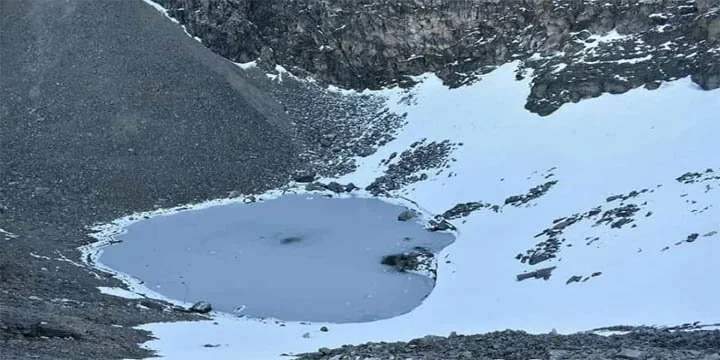
located in Uttarakhand, is facing serious changes due to climate change. This glacial lake, known as the "lake of skeletons," sits at 16,500 feet above sea level at the base of Mt. It is famous for hiding hundreds of human skeletons, some with preserved flesh, which become visible when the snow melts.
located in Uttarakhand, is facing serious changes due to climate change.
This glacial lake, known as the
"lake of skeletons," sits at 16,500 feet above sea level at the base of
Mt. Trishul in the Garhwal Himalayas.
It is famous for
hiding hundreds of human skeletons, some with preserved flesh, which
become visible when the snow melts.
The skeletal remains,
dating back to around the 9th century AD, have sparked various theories about their cause of death, with the 2019 study suggesting they
belonged to a mix of people rather than a single group.
DISCOVERY & THEORIES
- The lake gained attention when a forest official, HK Madhwal, discovered human bones in its frozen waters in 1942.
- Over the years, various theories have emerged about the origin of these skeletons.
- A 2019 study by scientists from India, the US, and Germany found that the skeletons were not from a single group that died at one time, but rather represented a mix of individuals who lived over a span of up to 1,000 years.
CURRENT CONCERNS
- Shrinking Lake:
- Forest officials have observed that Roopkund Lake, which covers around two acres and has a depth of about 9 feet, is shrinking.
- Sarvesh Dubey, Divisional Forest Officer (DFO) of Badrinath forest division, reported that the lake is 0.1 shrinking in both width and depth by about 1% to 0.5% annually.
- Changing Weather Patterns:
- Traditionally, the area experienced snow during rainfall, but now more rain is falling, causing loose soil and rocks to slide into the lake. This change is believed to be linked to climate change and global warming.
- Need for Expert Help:
- Due to recent heavy rainfall leading to increased silting, officials are reaching out to experts at the Forest Research Institute and the Wadia Institute of Himalayan Geology (WIHG) for solutions.
GLACIOLOGICAL INSIGHTS
- A senior glaciologist at WIHG, explained that there are about 1,200 lakes in the region, classified as either pro-glacial (near the front of a glacier) or peri-glacial (on the edges of a glacier).
- Roopkund is a peri-glacial lake.
- He said that climate variations are causing changes in snow and rainfall patterns, leading to the flow of loose material into the lake, which reduces its volume and area.
WIDER IMPACTS
- This phenomenon could lead to increased greenery in high-altitude areas and higher temperatures in the region. In 2022, it was reported that the Gangotri glacier's landscape was also changing due to climate variations.
- Officials in Chamoli district are noticing similar impacts on other high-altitude lakes.
Preserving Roopkund Lake
- A senior scientist from the Birbal Sahni Institute of Palaeosciences, emphasized the lake’s importance in studying past climate events. Analyzing the lake's sediments can provide valuable insights into historical weather patterns.
- He highlighted the need to preserve Roopkund, as it is a treasure trove of historical and climatic information.
- Prelims: Key facts, institutions, locations and terminology in the article.
- Mains: Connect the topic with Environment, Economy, International Relations.
- Revision: Use the article headings to prepare concise notes and answer-writing points.
Test your understanding
Questions from this article
Prelims practiceWith reference to Roopkund Lake Impacted By Climate Change, consider the following statements:
- The lake gained attention when a forest official, HK Madhwal, discovered human bones in its frozen waters in 1942.
- Over the years, various theories have emerged about the origin of these skeletons.
- A 2019 study by scientists from India, the US, and Germany found that the skeletons were not from a single group that died at one time, but rather represented a mix of individuals who lived over a span of up to 1,000…
Which of the statements given above are correct?
- 1 and 2 only
- 2 and 3 only
- 1 and 3 only
- 1, 2 and 3
View answer
Answer: (d) 1, 2 and 3. All three statements are drawn from the article.
Mains practiceDiscuss the background, key issues and significance of Roopkund Lake Impacted By Climate Change for India.
Answer in 250 words.
View answer approach
- DISCOVERY & THEORIES
- CURRENT CONCERNS
- GLACIOLOGICAL INSIGHTS
- WIDER IMPACTS
- Note:
Frequently asked questionsFrequently asked questions
Why is Roopkund Lake Impacted By Climate Change in the news?
located in Uttarakhand, is facing serious changes due to climate change. This glacial lake, known as the "lake of skeletons," sits at 16,500 feet above sea level at the base of Mt.
What are the key facts about Roopkund Lake Impacted By Climate Change?
It is famous for hiding hundreds of human skeletons, some with preserved flesh, which become visible when the snow melts. The skeletal remains, dating back to around the 9th century AD, have sparked various theories about their cause of death, with the 2019 study suggesting they belonged to a mix of people rather than a single group. DISCOVERY & THEORIES The lake gained attention when a forest official, HK Madhwal, discovered human bones in its frozen waters in 1942.
Why is Roopkund Lake Impacted By Climate Change important for UPSC preparation?
The topic connects current developments with Environment, Economy, International Relations and is relevant for both objective revision and analytical answer writing.