the consumer price index for cereals was 8.63% higher than that in April 2023.
But this
inflation in the price of roti may not have significantly hurt a majority of poor and lower middle class Indians, thanks to the government’s flagship food security scheme that provides
5 kg of rice or wheat, free of cost every month, to some
813.5 million persons.
The
same cannot be said about pulses, which posted an annual retail inflation of
16.84% in April 2024 — nearly twice that for cereals. This inflation would have hurt all the more, given that dal, unlike roti, is hardly sold through the public distribution system. Consumers, including low-income households, have to meet their requirement substantially, if not entirely, through open market purchases.
DAL PRICES (2023 V/S 2024)
| DAL |
PRICE IN 2023 (PER KG) |
PRICES NOW (PER KG) |
| CHANA |
70 |
85 |
| ARHAR/TUR |
120 |
160 |
| URAD |
110 |
120 |
| MOONG |
110 |
120 |
| MASOOR |
95 |
90 |
The main reason is the
El Niño-induced patchy monsoon and winter rain, causing a
decline in domestic pulses production.
- 27.30 million tonnes (mt) in 2021-22
- 26.06 mt in 2022-23 (as per the Agriculture Ministry’s estimates.)
- 23.44 mt in 2023-24
The
two pulses to register the highest inflation have both seen
sharp output falls:
- Chana (from 13.54 mt in 2021-22 to 12.27 mt in 2022-23 and 12.16 mt in 2023-34) and
- Arhar/Tur (from 4.22 mt to 3.31 mt and 3.34 mt).
Trade sources peg this year’s Chana production to be less than 10 mt and Arhar/Tur production to be below 3 mt.
THE RESULT: RISE IN IMPORTS
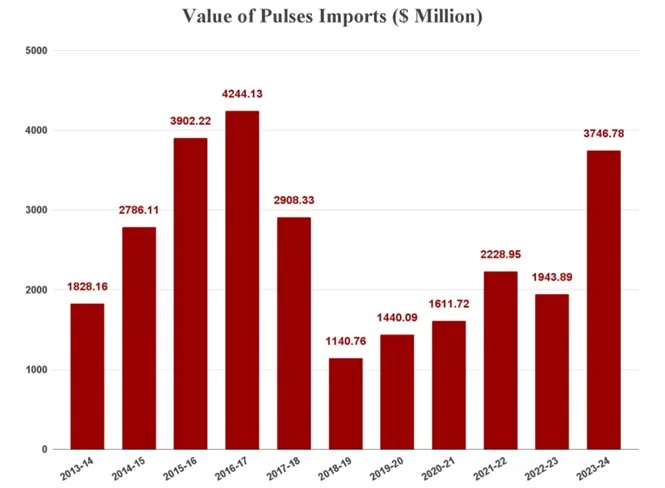
India’s pulses imports were valued at
$3.75 billion in 2023-24 (April-March), the highest since the record
$3.90 billion (2015-16) and
$4.24 billion (2016-17.)
In quantity terms, import of major pulses totaled
4.54 mt in 2023-24, up from 2.37 mt and 2.52 mt in the preceding two fiscals, although lower than the all-time-highs of 5.58 mt (2015-16) & 6.36 mt (2016-17).
 ARE WE TAKING ANY STEPS TO BE ATMA NIRBHAR?
The
resurgence in imports marks a
reversal of the relative self-sufficiency achieved by the country, with domestic
pulses production increasing from
16.32 mt to 27.30 mt between
2015-16 and 2021-22.
HOW WAS THAT ACHIEVED?
- Government policy measures incentivising farmers to grow pulses.
- These included MSP-based procurement and
- Levying of duties leading to a near stoppage of imports, particularly of yellow/white peas (matar) and chana, by 2022-23.
- Breeding of short-duration chana and moong varieties, making it possible to cultivate these with little or no irrigation, using the residual soil moisture left by the previous crops.
- The 50-75 day varieties of moong now allow planting of as many as four crops a year: kharif (post-monsoon), rabi (winter), spring and summer.
THE WAY AHEAD
Dal inflation in the coming months would
largely depend on the southwest monsoon. Global climate models are pointing to El Niño transitioning to a “neutral” phase next month and even to La Niña — associated with good rainfall activity in the subcontinent — by the second half of the four-month season (June-September).
But the
precarious domestic supply position (government agencies have procured barely any chana from this year’s crop, compared to 2.13 mt in 2023 and 2.11 mt in 2022) and
monsoon uncertainties make
higher imports inevitable.
The government has already permitted
duty-free imports of arhar/tur, urad, masoor and desi chana till March 31, 2025. It may have to extend the same for yellow/white peas imports too — beyond October 31, 2024 now.
?
Test your understanding
Questions from this article
Prelims practiceWith reference to Pulses Imports Rise, consider the following statements:
- 27.30 million tonnes (mt) in 2021-22
- 26.06 mt in 2022-23 (as per the Agriculture Ministry’s estimates.)
- Chana (from 13.54 mt in 2021-22 to 12.27 mt in 2022-23 and 12.16 mt in 2023-34) and
Which of the statements given above are correct?
- 1 and 2 only
- 2 and 3 only
- 1 and 3 only
- 1, 2 and 3
View answer
Answer: (d) 1, 2 and 3. All three statements are drawn from the article.
Mains practiceDiscuss the background, key issues and significance of Pulses Imports Rise for India.
Answer in 250 words.
View answer approach
- DAL PRICES (2023 V/S 2024)
- HOW WAS THAT ACHIEVED?
- Background and context
- Key facts and institutional framework
- Significance and way forward
Frequently asked questionsFrequently asked questions
Why is Pulses Imports Rise in the news?
the consumer price index for cereals was 8.63% higher than that in April 2023. But this inflation in the price of roti may not have significantly hurt a majority of poor and lower middle class Indians, thanks to the government’s flagship food security scheme that provides 5 kg of rice or wheat, free of cost every month, to some 813.5…
What are the key facts about Pulses Imports Rise?
The same cannot be said about pulses, which posted an annual retail inflation of 16.84% in April 2024 — nearly twice that for cereals. This inflation would have hurt all the more, given that dal, unlike roti, is hardly sold through the public distribution system. Consumers, including low-income households, have to meet their requirement substantially, if not entirely, through open market purchases.
Why is Pulses Imports Rise important for UPSC preparation?
The topic connects current developments with Environment, Economy, Polity & Governance and is relevant for both objective revision and analytical answer writing.