UPSC Current Affairs
Pradhan Mantri Suryodaya Yojana
Context: Recently Prime Minister Narendra Modi announced the ‘Pradhan Mantri Suryodaya Yojana’. It is a government scheme under which one crore households will get rooftop solar power systems. However it is important to note that this isn’t the first scheme for promoting the installation of rooftop solar power systems.
VRAuthor Desk
3 min read
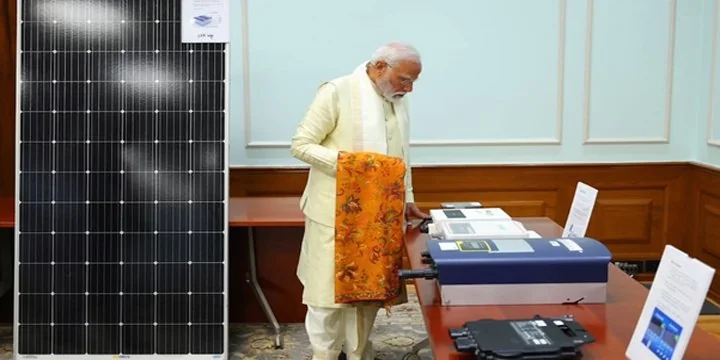
Context: Recently Prime Minister Narendra Modi announced the ‘Pradhan Mantri Suryodaya Yojana’. It is a government scheme under which one crore households will get rooftop solar power systems. However it is important to note that this isn’t the first scheme for promoting the installation of rooftop solar power systems.
Context:
- Recently Prime Minister Narendra Modi announced the ‘Pradhan Mantri Suryodaya Yojana’.
- It is a government scheme under which one crore households will get rooftop solar power systems.
- However it is important to note that this isn’t the first scheme for promoting the installation of rooftop solar power systems.
- The government launched the Rooftop Solar Programme in 2014.
- The scheme was aimed to achieve a cumulative installed capacity of 40,000 megawatts (MW) or 40 gigawatts (GW) by 2022.
- (Watt is a unit of power and is calculated as the amount of energy used over time, specifically one Joule per second).
- The newly launched Pradhan Mantri Suryodaya Yojana seems to be a new attempt to help reach the target of 40 GW rooftop solar capacity.
What is the Pradhan Mantri Suryodaya Yojana?
- It is actually a scheme that will involve installing solar power systems at rooftops for residential consumers.
- The scheme would help to not only reduce electricity bills of the “poor and middle class” but also try to push India’s goal of becoming self-reliant in the energy sector.
What is India’s current solar capacity?
- According to the Ministry of New and Renewable Energy’s website solar power installed capacity in India has reached around 73.31 GW (as of December 2023).
- At the same time, rooftop solar installed capacity is around 11.08 GW as of December 2023.
- In terms of total solar capacity it is state of Rajasthan which is at the top with 18.7 GW.
- The state of Gujarat is at the second position with 10.5 GW.
- But it comes to rooftop solar capacity, Gujarat tops the list with 2.8 GW and followed by Maharashtra by 1.7 GW.
- However it is important to note that the solar power has a major share in the country’s current renewable energy capacity, which stands at around 180 GW.
Why is an expansion of solar energy important for India?
- According to the latest World Energy Outlook by the International Energy Agency (IEA) India is going to witness the largest energy demand growth of any country or region in the world in the coming 30 years.
- In order to meet this demand the country would need a reliable source of energy.
- Although India has doubled down on its coal production in recent years India also aims to reach 500 GW of renewable energy capacity by 2030.
- Therefore, it is essential to expand solar power capacity and the country has increased it from less than 10 MW in 2010 to 70.10 GW in 2023, as mentioned before.
What is the Rooftop Solar Programme?
- The scheme is launched in 2014 and it aims to expand India’s rooftop solar installed capacity in the residential sector.
- It tries to do so by providing Central Financial Assistance — the financial assistance to the eligible projects as per MNRE Guidelines — and incentives to DISCOMs (distribution companies).
- The programme’s goal is to increase rooftop solar installed capacity to 40 GM by March 2026 and the scheme is currently in its second phase.
- Because of the scheme, the country’s rooftop solar has increased from 1.8 GW as of March 2019 to 10.4 GW as of November 2023.
- Prelims: Key facts, institutions, locations and terminology in the article.
- Mains: Connect the topic with Economy, Polity & Governance.
- Revision: Use the article headings to prepare concise notes and answer-writing points.
Test your understanding
Questions from this article
Prelims practiceWith reference to Pradhan Mantri Suryodaya Yojana, consider the following statements:
- Recently Prime Minister Narendra Modi announced the ‘Pradhan Mantri Suryodaya Yojana’.
- It is a government scheme under which one crore households will get rooftop solar power systems.
- However it is important to note that this isn’t the first scheme for promoting the installation of rooftop solar power systems.
Which of the statements given above are correct?
- 1 and 2 only
- 2 and 3 only
- 1 and 3 only
- 1, 2 and 3
View answer
Answer: (d) 1, 2 and 3. All three statements are drawn from the article.
Mains practiceDiscuss the background, key issues and significance of Pradhan Mantri Suryodaya Yojana for India.
Answer in 250 words.
View answer approach
- Context:
- What is the Pradhan Mantri Suryodaya Yojana?
- What is India’s current solar capacity?
- Why is an expansion of solar energy important for India?
- What is the Rooftop Solar Programme?
Frequently asked questionsFrequently asked questions
Why is Pradhan Mantri Suryodaya Yojana in the news?
Context: Recently Prime Minister Narendra Modi announced the ‘Pradhan Mantri Suryodaya Yojana’. It is a government scheme under which one crore households will get rooftop solar power systems.
What are the key facts about Pradhan Mantri Suryodaya Yojana?
However it is important to note that this isn’t the first scheme for promoting the installation of rooftop solar power systems. The government launched the Rooftop Solar Programme in 2014. The scheme was aimed to achieve a cumulative installed capacity of 40,000 megawatts (MW) or 40 gigawatts (GW) by 2022.
Why is Pradhan Mantri Suryodaya Yojana important for UPSC preparation?
The topic connects current developments with Economy, Polity & Governance and is relevant for both objective revision and analytical answer writing.